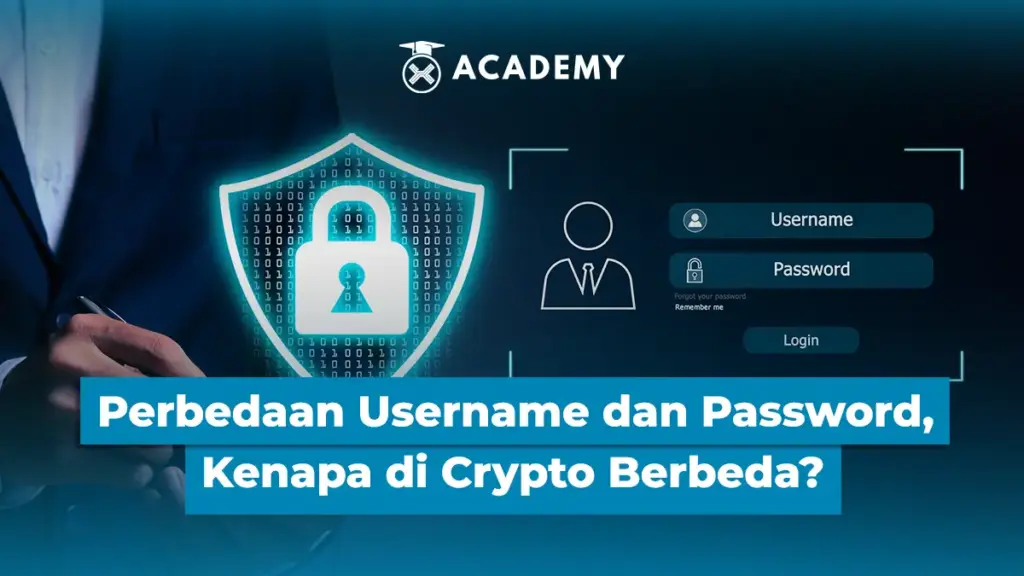
Many people are accustomed to logging in daily to various digital platforms. As a result, usernames and passwords are almost always requested together, often mistaken for one package with the same function.
However, their roles are distinct. A username serves as an identifier, while a password secures access. This distinction is often overlooked because, in everyday use, the login process seems simple.
This misunderstanding begins to emerge when entering the crypto ecosystem. This article will help clarify the roles of usernames and logins before delving into the broader context of blockchain.
Usernames and Passwords Are Often Misunderstood

Many internet users consider usernames and passwords to be a single entity, both serving the purpose of “logging in.” As long as they can log in, they are treated equally without truly understanding their roles.
This habit develops because the login process is repetitive and feels routine, so few people really think about its function.
In reality, a username is not a security feature. It simply serves as an identifier that tells the system who wants to log in.
Conversely, a password is not an identifier, but rather a key that proves that the person attempting to log in is indeed authorized to use that identity.
When these two roles are misinterpreted, the impact can be immediate on account security, especially when users underestimate the importance of maintaining passwords properly.
The Differences in the Roles of Usernames and Passwords
Before delving into more technical details, it’s important to understand that usernames and passwords are often used together, but they don’t fulfill the same role.
The following are the differences between the roles of usernames and passwords in everyday practice.
Usernames as Account Identifiers
Usernames serve as account identifiers within the system. When someone types a username, the system uses it to identify which account they are searching for or accessing.
Because their role is solely as identification, usernames are often publicly visible, for example on social media or forums. Usernames are not designed to protect access, are not confidential, and it’s okay for others to know them.
The most important thing is that usernames are unique so the system can’t confuse one account with another.
Passwords as Access Security
Unlike usernames, passwords serve as access security. They are used to prove that the person attempting to log in is truly the legitimate owner of the account.
Because they function as keys, passwords are confidential and should not be shared. The weakness of passwords, whether they are too simple or reused repeatedly, is that they immediately open up the risk of account hacking.
This is where the password’s role is crucial: not as an identity, but as a layer of protection for that identity.
Examples of Using Usernames and Passwords in Digital Systems
If you want to understand the role of usernames and passwords more clearly, the easiest way is through examples we encounter every day.
Almost all digital services use the same pattern, from email to social media. Below are examples of the use of usernames and passwords in digital systems.
1. Email and Social Media Logins
When logging in to email or social media, a username serves as the account name recognized by the system. It can be an email address, a username, or a combination of certain characters.
This username helps the system find the correct account and is often visible to others, for example as a profile name or account handle.
Furthermore, the password serves as the login key. It proves that the person entering the username is indeed the legitimate owner of the account.
That’s why passwords are kept secret, confidential, and should not be shared. If the password is weak or leaked, anyone can log in even if the username is not theirs.
2. Applications, Forums, and Online Services
The same pattern applies to applications, forums, and various other online services. Users are always asked to enter a username first so the system knows which account they are accessing. Once the account is found, the password is requested for verification.
This model is widely used because it is simple and effective. The username makes it easy for the system to identify the user, while the password prevents unauthorized access to that identity.
This combination is what makes the login process familiar and commonplace on almost all digital platforms.
Why Are Usernames and Passwords Always Paired?
Usernames and passwords are always paired because the system requires two different things. First, the system must know which account it wants to access. This is where the username serves as an identifier so the system can recognize the user.
Second, the system needs to ensure that the person attempting to log in is truly the account owner. This is why the password is used as proof of ownership. Without a password, anyone who knows the username can attempt to log in.
This combination makes the login process easier to understand. In this case, the username identifies the user, while the password proves their access rights.
Limitations of the Username and Password System
The username and password system has been around for a long time, but it’s not without its limitations. Because account data is stored in a centralized system, there’s always a risk of leaks if the system is hacked or misused.
Furthermore, passwords can be a weakness. If they’re too simple, they’re easy to guess. If they’re too complex, they’re often forgotten by the owner. As a result, account access can be compromised or even exploited by others.
Another limitation is the dependence on the system administrator. As long as accounts are centrally controlled, users must entrust their security and access entirely to the platform.
So, How Does This Concept Work in the Crypto World?
In the crypto ecosystem, the concept of account access operates differently. At the blockchain and non-custodial wallet level, there is no traditional login system like a username and password, commonly found in digital applications.
Blockchains also do not recognize username-based accounts. User identity is represented through a wallet address, a unique address recorded on the network. This address serves as a identifier, not a security measure.
Access to assets is determined entirely by ownership of the private key. As long as the private key is in the hands of the owner, the asset can be controlled. Conversely, if the private key is lost or leaked, there is no reset or recovery mechanism like in centralized systems.
Comparing Digital Login and Access on the Blockchain
Comparing account access methods in traditional digital systems and on the blockchain can help us understand the fundamental differences. While both systems manage accounts or assets, the mechanisms are very different.
Here is a comparison of digital login and access on the blockchain that you need to know.
1. Traditional Login System
In a traditional login system, users log in with a username and password, which serve as both identity and access key.
The account is controlled by the platform, so if a password is forgotten or there’s another issue, access can be restored by resetting it or seeking assistance from the service provider. This system is more practical, but it relies on the platform’s central security.
2. Blockchain Access System
On the other hand, in a blockchain access system, identity is identified through a wallet address, while access is completely secured by a private key. Control rests with the owner, so if the key is lost or forgotten, there’s no way to reset it.
This provides greater security, but also requires the owner to carefully guard the key.
Why Doesn’t Blockchain Use Usernames and Passwords?
On the blockchain, traditional account concepts like usernames and passwords no longer apply because the system is ownership-based. User identity is identified by the wallet address, and access is determined entirely by who holds the private key.
Every transaction and ownership is verified directly through cryptography, without relying on a central server or third party.
Because there is no account reset or recovery mechanism like in conventional systems, security and control rest entirely with the key holder.
This also makes each user directly responsible for their assets. If a key is lost or leaked, the consequences cannot be addressed through standard procedures like on traditional platforms.
Conclusion
So, that was an interesting discussion about the differences between usernames and passwords, including their functions, examples, and their relationship in crypto. You can read more about them in the INDODAX Academy Crypto Academy.
In conclusion, usernames and passwords are often used in pairs, but their roles are different. The username serves as an identity, while the password serves as an access key. Both remain important in traditional digital systems to maintain account security.
In crypto systems, this concept changes. Identity is replaced by the wallet address, and access is determined entirely by private key ownership.
Here, there are no account resets or recovery procedures like on traditional platforms, so control and responsibility rest with the asset owner.
By understanding this fundamental difference between identity and security, users will be better prepared when they start interacting with digital assets.
In addition to gaining in-depth insights through popular crypto education articles, you can also broaden your horizons through a collection of tutorials and choose from a variety of popular articles that align with your interests.
Besides updating your knowledge, you can also directly monitor digital asset prices on Indodax Market and stay up-to-date with the latest crypto news. For a more personalized trading experience, explore Indodax’s OTC trading service. Don’t forget to activate notifications so you don’t miss out on important information about blockchain, crypto assets, and other trading opportunities.
You can also follow our latest news via Google News for faster and more reliable access to information. For an easy and secure trading experience, download the best crypto app from INDODAX on the App Store or Google Play Store.
Maximize your crypto assets with the INDODAX Earn feature, a practical way to earn passive income from your stored assets. Register now with INDODAX and easily complete KYC to start trading crypto more safely, conveniently, and reliably!
Indodax Official Contact
Customer Service Number: (021) 5065 8888 | Support Email: [email protected]
Also follow us on social media here: Instagram, X, Youtube & Telegram
FAQ
- What is the main difference between a username and a password?
A username is an account identifier, while a password is the access key to prove ownership of that account. - Does Blockchain completely disregard usernames and passwords?
Blockchains don’t use them, but centralized platforms can still use login systems. - Why don’t crypto wallets have a forgot password feature?
Because access is determined by private keys, not centralized accounts. - Is a private key the same as a password?
Its function is similar to a key, but the private key also determines asset ownership. - Why is this understanding important for crypto beginners?
So that users understand the risks, responsibilities, and how digital asset ownership works.

Author: Boy
 Polkadot 2.25%
 BNB 0.52%
 Solana 4.62%
 Ethereum 2.32%
 Cardano 1.02%
 Polygon Ecosystem Token 1.87%
 Tron 2.75%
 Market