Most transactions on blockchains like Ethereum are transparent and visible to anyone, especially if you understand what Ethereum is and how it works.
While this makes the system more open and easily verifiable, it also raises privacy concerns because user activity can be tracked.
Therefore, many users and developers are looking for ways to maintain privacy without sacrificing security and decentralization.
One approach is privacy technology on blockchains, including zk-rollups, which allow transactions to be verified without disclosing all their data, especially if you understand what zk rollups are in blockchain systems.
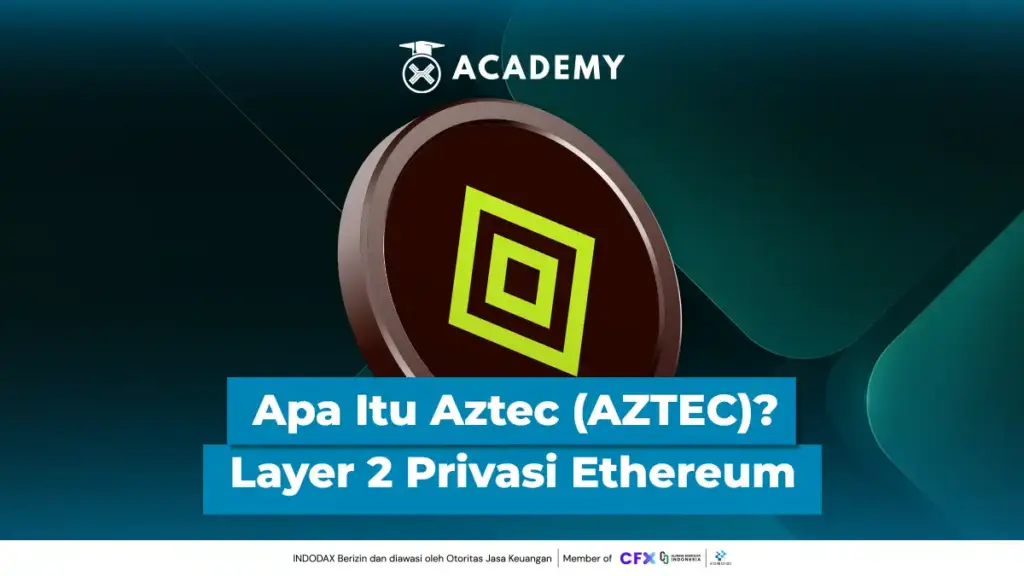
Among the projects embracing this concept, Aztec is a privacy solution on the Ethereum network.
This article will discuss what Aztec (AZTEC) is, how it works, and its role in the blockchain ecosystem.
What Is Aztec (AZTEC)?

Aztec is a Layer 2 solution on top of Ethereum that focuses on privacy. Aztec uses zk-rollup technology, a method that allows transactions to remain validated without exposing all data to the public.
Unlike other tokens, Aztec is a privacy-based network. Aztec has also introduced the AZTEC token into its ecosystem, although its use is still developing and not yet fully public.
Its primary function is to enable private transactions and private smart contracts. With this approach, users can transact without exposing sensitive data, while developers can still build secure applications on the Ethereum network.
How the Aztec Network Works
Simply put, Aztec works by separating private and public data, then efficiently processing it before sending it to Ethereum. Here’s an explanation of how it works.
1. Private Transaction Input
Users initiate transactions or execute smart contracts directly from their devices. Sensitive data remains locally stored, and then cryptographic proof (zero-knowledge) is generated without revealing the transaction content.
2. Layer 2 Processing
Transaction proofs are sent to the Aztec network and collected by the system (sequencer), then processed and combined in a rollup form without exposing the original data.
3. Validation to Ethereum
The final result, a proof of validity, is sent to the Ethereum mainnet for verification, allowing multiple private transactions to be confirmed simultaneously.
Token Status in the Aztec Ecosystem
Aztec has released a tokenomics document explaining the token’s role in its ecosystem, including supporting network security, staking mechanisms, and governance.
In this design, the token is intended to be used by network participants such as sequencers and validators as part of the incentive and validation system.
However, it’s important to understand that the AZTEC token has begun to be used in mechanisms such as staking, delegation, and certain governance mechanisms, but full public transfers still depend on the TGE process.
This implementation is not yet fully public, as it would be on a mature network.
Aztec’s Role in the Ethereum Ecosystem
Aztec is a Layer 2 platform on top of Ethereum that focuses on privacy through a client-side proving approach. Here are some of its roles in the Ethereum ecosystem.
1. Privacy Solutions
Aztec protects transaction data by processing it on the user’s device and only sending cryptographic proofs to the network, so transaction details remain encrypted and invisible to the public.
2. Private DeFi
Aztec is designed to enable DeFi activities with a higher level of privacy, preventing some transaction data from being exposed to the public. Conceptually, Aztec allows integration with various DeFi protocols through specific mechanisms, although its implementation is still evolving.
3. DApp Development
Aztec supports developers in building privacy-based dApps, where some execution processes are performed on the user’s side before the results are verified on the network, preventing sensitive data from being exposed to the public network.
Aztec’s Strengths (AZTEC)
Aztec offers key advantages in terms of privacy, where sensitive data such as balances and transaction values ??remain protected through a system that separates public and private information.
On the other hand, the use of zk-rollup technology makes transactions more efficient because they can be processed simultaneously and validated with a single proof.
As a Layer 2 on top of Ethereum, Aztec remains integrated with the main network, thus maintaining the security of the Ethereum network while offering additional data protection through a privacy approach.
Furthermore, the zero-knowledge innovations it employs, including user-side execution, allow transactions to be verified without revealing the original information. This makes it a novel approach to privacy-based blockchain development.
Aztec’s Challenges and Risks
Despite its potential, Aztec also faces challenges, particularly in terms of technological complexity. Its use of zero-knowledge and dual execution models makes the system more difficult to understand and develop than traditional Layer 2s.
Furthermore, its adoption is still in its infancy. Compared to other Layer 2s on Ethereum that focus on cost and speed, Aztec’s privacy approach will still take time to gain widespread acceptance among users and developers.
From the external perspective, regulation is also a significant factor. Technologies that emphasize privacy often fall into a policy gray area, particularly regarding transparency and transaction tracking.
On the user side, limited understanding can also be a barrier. Concepts like zk-proof and private transactions are still relatively new, requiring further education to fully utilize them.
How Aztec Differs from Other Layer 2 Projects

Aztec has a different approach than other Layer 2s on Ethereum, such as Arbitrum and Optimism, including the following:
1. Technology Focus
Aztec focuses on privacy, while Arbitrum and Optimism emphasize scaling, such as increasing transaction speed and cost efficiency.
2. Use Case
Aztec is designed for private transactions and smart contracts that maintain data confidentiality, while other Layer 2s are generally used for public transactions, similar to those on most blockchains.
3. Technology Used
Aztec uses zk-rollups, which enable verification without data disclosure, while Arbitrum and Optimism use optimistic rollups, which rely on the assumption that transactions are valid until proven otherwise.
In addition to gaining in-depth insights through various popular crypto education articles, you can also broaden your knowledge through a collection of tutorials and choose from a variety of popular articles that suit your interests.
In addition to updating your knowledge, you can also directly monitor digital asset prices on Indodax Market, such as Bitcoin (BTC to IDR) or other assets, and stay up-to-date with the latest developments through the latest crypto news. For a more personalized trading experience, explore Indodax’s OTC trading service. Don’t forget to activate notifications so you don’t miss out on important information about blockchain, crypto assets, and other trading opportunities.
You can also follow our latest news via Google News for faster and more reliable access to information. For an easy and secure trading experience, download the best crypto app from INDODAX on the App Store or Google Play Store.
Maximize your crypto assets with the INDODAX crypto staking feature, a practical way to earn passive income from your stored assets. Register now with INDODAX and easily complete KYC to start trading crypto more safely, conveniently, and reliably!
In practice, asset transparency is now adopted by a number of crypto platforms, one of which is through the publication of Proof of Reserves (PoR) data from third parties like CoinMarketCap. In Indonesia, Indodax is one of the platforms that regularly updates this information for public access.
Indodax Official Contact
Customer Service Number: (021) 5065 8888 | Support Email: [email protected]
Also follow our social media here: Instagram, X, YouTube & Telegram
Conclusion
So, that was an interesting discussion about Aztec as a privacy solution on the Ethereum blockchain. You can read more about it in the INDODAX Academy’s Crypto Academy.
In conclusion, Aztec demonstrates how a zk-rollup-based Layer 2 can bring a different approach to Ethereum, by making privacy a core feature, not just an add-on.
In an ecosystem that has historically been synonymous with full transparency, Aztec’s presence opens up a new space: transactions can still be verified, but not all details need to be exposed.
This direction reflects a shift in perspective in blockchain development. It’s no longer about choosing between transparency and secrecy, but rather about finding a more flexible solution that meets the needs of users and applications.
In this regard, Aztec serves as an example of how technology is evolving to address more complex needs, from individual use to potential business adoption.
Going forward, solutions like Aztec will not stand alone but will be part of the evolving blockchain ecosystem, which continues to seek a balance between openness, security, and privacy.
FAQ
- What is Aztec (AZTEC)?
Aztec is a privacy-focused Layer 2 on Ethereum using zk-rollups. - What is the function of the AZTEC token?
The AZTEC token is used within the ecosystem for mechanisms such as staking, delegation, and specific governance, with full public distribution following the TGE process. - What is a zk-rollup?
A technology that aggregates multiple transactions and verifies them on the main blockchain. - Is Aztec the same as Ethereum?
No. Aztec is a Layer 2 that runs on top of Ethereum. - What are Aztec’s advantages over other Layer 2s?
Aztec adds privacy features that most other Layer 2s lack.

Author: Boy
 Polkadot 2.25%
 BNB 0.52%
 Solana 4.62%
 Ethereum 2.32%
 Cardano 1.02%
 Polygon Ecosystem Token 1.87%
 Tron 2.75%
 Market