
Many novice investors view MATIC (now transitioned to POL) and ETH as two competing assets. However, the relationship between Polygon and Ethereum is more complex because they each have different roles.
Ethereum is the largest Layer 1 blockchain for smart contracts. If you don’t yet understand how this network works in depth, you can read about Ethereum first. Meanwhile, Polygon exists to help address Ethereum’s limitations, particularly transaction fees and scalability.
In this article, we will discuss the differences between Polygon and Ethereum, their relationship, and when each network is more suitable for use.
Why is Polygon Built on Ethereum?

Ethereum has faced issues such as high gas fees, a congested network, and limited transactions per second (TPS). This makes transactions slower and more expensive as usage increases.
Here, Polygon exists as an ecosystem designed to help increase Ethereum’s capacity and efficiency through a Layer 2 blockchain solution designed to improve the scalability of the main network.
Polygon remains connected to Ethereum, supporting scalability without replacing the main network. In short, Polygon was created to complement Ethereum, not replace it.
MATIC vs. ETH: A Complete Comparison
Ethereum and Polygon have different functions in the blockchain ecosystem, with a complete comparison below.
1. Function in the Blockchain Ecosystem
Ethereum acts as the main blockchain (Layer 1) that handles network security and transaction settlement. Meanwhile, Polygon serves as a scalability solution that helps Ethereum process transactions faster and more cheaply.
2. Transaction Speed
Ethereum has a more limited transaction capacity because all activity runs on the main network. Polygon is able to offer higher processing speeds because it uses a companion network that reduces the load on Ethereum.
3. Transaction Fees
Ethereum transaction fees can increase when the network is busy due to high demand for block space. Polygon offers lower fees, making it more efficient for activities such as asset transfers, token swaps, NFTs, and other blockchain applications.
4. Security and Decentralization
Ethereum excels in security and decentralization because it is supported by a large validator network. Polygon still leverages the Ethereum ecosystem but focuses on faster and more cost-effective transactions.
5. Scalability
Scalability is a key focus for Polygon to help Ethereum handle more users and transactions. By processing certain activities on a companion network, the load on Ethereum can be reduced.
6. Ecosystem and Use Cases
Ethereum is widely used for Decentralized Finance (DeFi), institutions, and key smart contracts that require high security. Polygon is better suited for use cases such as gaming, NFTs, micropayments, and applications that require low transaction fees.
Ethereum and Polygon: Competitors or Partners?
Polygon and Ethereum are often considered rivals, but they actually serve distinct roles.
Ethereum serves as the primary foundation for smart contracts, dApps, and network security, while Polygon serves as a supporting layer that helps increase transaction speeds and reduce costs.
Many Web3 projects use both platforms simultaneously, with Ethereum for core transactions and Polygon for applications like NFTs, gaming, and high-traffic applications.
Therefore, Polygon is intended to complement Ethereum, not replace it.
When Should You Use Ethereum?
Ethereum is suitable for applications that prioritize network security and stability.
This network is often chosen for high-value transactions, use of key DeFi protocols, and activities that require high asset protection.
As a leading blockchain with a broad ecosystem, Ethereum is also often used for long-term asset storage and applications that require a high level of trust.
When Should You Use Polygon?
Polygon (POL to IDR) is suitable for activities that require fast transactions and low fees, such as daily transactions, NFTs, blockchain gaming, and asset transfers.
With lower fees than the Ethereum main network, Polygon is more practical for applications that require high transaction volumes without increasing user costs.
What Does the Future Hold for Ethereum and Polygon?
Ethereum continues to evolve through Proof of Stake (PoS), Layer 2, and the Dencun Upgrade to improve scalability, efficiency, and transaction costs.
Polygon is also strengthening its ecosystem through Polygon 2.0, the POL token, zkEVM, and AggLayer to support fast transactions and inter-blockchain connectivity.
Going forward, Ethereum and Polygon have the potential to complement each other. Ethereum serves as the main foundation, while Polygon helps expand blockchain usage with faster and more cost-effective solutions.
Risks Investors Need to Understand
Ethereum and Polygon still face risks despite being important parts of the blockchain ecosystem. Some of the challenges are as follows:
1. Ethereum Risks
Ethereum faces the risk of increased gas fees when the network is busy. Furthermore, competition from other Layer 1 blockchains and the challenge of increasing transaction capacity remain concerns.
2. Polygon Risks
Polygon faces competition from various other Layer 2 solutions that offer low fees and fast transactions.
The transition from MATIC to POL and the ever-evolving nature of blockchain technology are also factors to consider.
MATIC vs. ETH: Which is Better Suited to Your Needs?
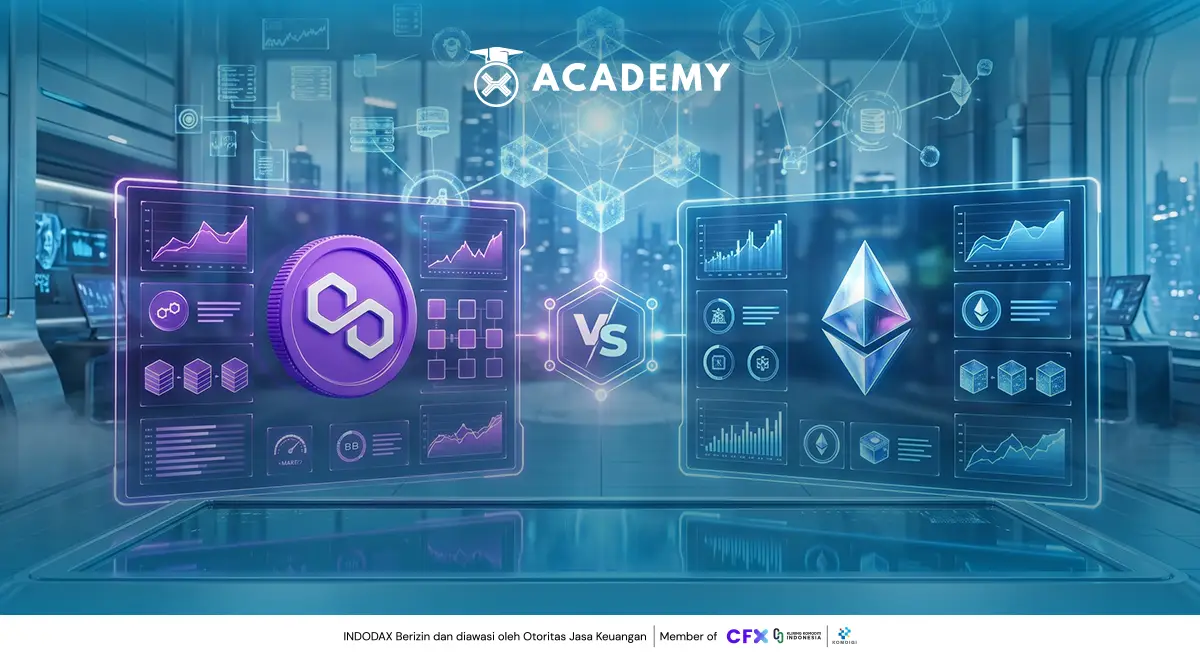
Ethereum and Polygon each have their own advantages. Ethereum is better suited for security-focused needs, large ecosystems, and mainstream blockchain use cases like DeFi or critical smart contracts.
Meanwhile, Polygon is better suited for activities that require low fees, fast transactions, and daily use cases like NFTs, gaming, or applications with high transaction volumes.
Therefore, there’s no absolute superiority. The choice between MATIC (now transitioning to POL) and ETH depends on your needs, intended use, and the priority between security and efficiency.
Conclusion
So, that was an interesting discussion about MATIC vs. ETH, specifically the differences between Polygon and Ethereum. You can read more about it in the INDODAX Academy Crypto Academy.
In conclusion, Ethereum and Polygon aren’t two networks that can be singled out as winners or main competitors. Both were built with different goals in the blockchain ecosystem.
Ethereum remains the main foundation, offering security, decentralization, and a vast smart contract ecosystem.
Meanwhile, Polygon exists to help address Ethereum’s limitations, particularly in terms of transaction speed and usage fees.
The relationship between Ethereum and Polygon is more accurately viewed as a collaboration. Ethereum provides robust infrastructure.
On the other hand, Polygon helps expand blockchain usage to make it more efficient for various needs, such as NFTs, gaming, DeFi, and high-transaction applications.
Understanding the differences between MATIC (now transitioning to POL) and ETH isn’t just about determining which asset is superior, but also about understanding their respective roles in the development of blockchain technology.
Besides broadening your investment horizons, you can also stay updated with the latest crypto news and monitor digital asset price movements directly on the INDODAX Market.
For a more personalized trading experience, explore our OTC trading service on INDODAX. Don’t forget to activate notifications to stay up-to-date with the latest information about digital assets, blockchain technology, and various other trading opportunities, only on INDODAX Academy.
You can also follow our latest news via Google News for faster and more reliable access to information. For an easy and secure trading experience, download INDODAX’s best crypto app on the App Store or Google Play Store.
Maximize your crypto assets with the INDODAX Staking/Earn feature, a practical way to earn passive income from your savings. Register now with INDODAX and easily complete KYC to start trading crypto more safely, conveniently, and reliably!
In practice, asset transparency is now being adopted by a number of crypto platforms, one of which is through the publication of Proof of Reserves (PoR) data from third parties like CoinMarketCap. In Indonesia, Indodax is one of the platforms that regularly updates this information for public access.
Official Indodax CS Contact
Official Customer Support Number: (021) 5065 8888
Help email: [email protected]
Follow INDODAX on social media here: Instagram, X, Youtube & Telegram

FAQ
- What are the main differences between MATIC and ETH?
ETH is the native asset of the Ethereum network, used to pay transaction fees, staking, and support network security.Meanwhile, MATIC (now transitioned to POL) is a utility token within the Polygon ecosystem, used to pay transaction fees, staking, and support various services on the Polygon network.The two serve different functions, although they both exist within an interconnected ecosystem.
- Is Polygon part of Ethereum?
No. Polygon is a standalone blockchain network, but it is designed to be compatible with Ethereum.Its primary goal is to help improve Ethereum’s scalability by providing faster transactions and lower fees. - Why are Polygon transaction fees cheaper than Ethereum?
Polygon can process a large number of transactions at a much lower cost than Ethereum Layer 1.Because transaction overhead isn’t directly processed on the Ethereum mainnet, users typically pay only a fraction of the fees they would on Ethereum. - What are the differences between MATIC and POL?
MATIC is Polygon’s native token, used since the project was still called Matic Network.In the Polygon 2.0 roadmap, this token is gradually being replaced by POL, which is designed to support a broader and more integrated Polygon ecosystem. - Will Polygon replace Ethereum?
No. Polygon was not created to replace Ethereum. Instead, Polygon exists to help Ethereum handle more transactions more cost-efficiently. The two are designed to complement each other. - Which is better suited for NFTs, Ethereum or Polygon?
Both support NFTs, but they have different advantages. Ethereum is often used for high-value NFT collections and large-scale projects, while Polygon is more popular for NFTs that require low minting and transaction fees. - Can assets on Polygon be transferred to Ethereum?
Yes. Users can move assets from Polygon to Ethereum or vice versa using a blockchain bridge that supports both networks. However, this process usually takes time and requires additional fees depending on network conditions. - Is Polygon a Layer 2 Ethereum?Polygon is often referred to as Ethereum’s scalability solution, but the Polygon ecosystem today extends beyond just Layer 2.
Polygon has a variety of technologies, including Polygon PoS, zkEVM, and other infrastructure designed to help expand Ethereum’s capabilities.
Author: Boy
DISCLAIMER: All forms of crypto asset transactions carry risks and the potential for loss. Always invest based on your own research to minimize the risk of loss of your crypto assets (Do Your Own Research/ DYOR). The information contained in this publication is provided on a general basis without obligation and is for informational purposes only. This publication is not intended to be, and should not be construed as, an offer, recommendation, solicitation, or advice to buy or sell any investment product and should not be transmitted, disclosed, copied, or relied upon by anyone for any purpose.✕
 Polkadot 2.25%
 BNB 0.52%
 Solana 4.62%
 Ethereum 2.32%
 Cardano 1.02%
 Polygon Ecosystem Token 1.87%
 Tron 2.75%
 Market