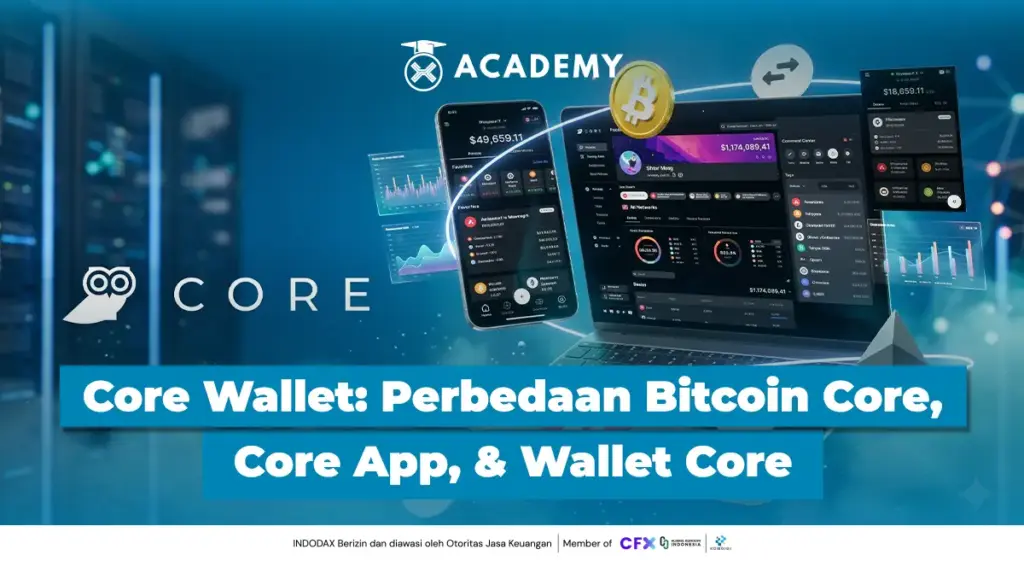
When searching for information about Core Wallet, the results often vary. Some point to Bitcoin Core, the Core App developed by Ava Labs for the Avalanche ecosystem, and the Core Wallet developed by Trust Wallet.
Although they all use the term “Core,” each has its own distinct function, purpose, and usage.
In this article, we will discuss the differences between the three to avoid misunderstanding the terms or choosing a wallet in the crypto world.
What is a Core Wallet?

Core Wallet is not a specific product, but rather a term that can refer to several pieces of software or crypto technology.
This term is often confusing because some projects use the name “Core” together, even though their functions and purposes are different.
Therefore, understanding the context in which Core Wallet is used is important to avoid choosing the wrong wallet or misunderstanding the technology in question.
A discussion of each type of Core Wallet can be found in the next section of this article.
Why Does the Term Core Wallet Have Multiple Meanings?
The term Core Wallet has multiple meanings because the word “Core” is commonly used in the software world to refer to a main component or application. Various blockchain projects then use the name for different products.
Although the names are similar, Bitcoin Core, Core App, and Wallet Core are developed by different organizations and have different functions and purposes. Therefore, similar names do not always refer to the same product.
Differences Between Bitcoin Core, Core App, and Wallet Core
Although they all use the name “Core,” they have different functions and purposes, as can be seen in the following table.
| Aspect | Bitcoin Core | Core App | Wallet Core |
| Developer | Bitcoin developer community (initially released by Satoshi Nakamoto) | Ava Labs | Trust Wallet |
| Main Function | Running a full node and managing Bitcoin transactions | Web3 wallet for managing assets and accessing dApps | Open-source library for building wallet applications |
| Target Users | Advanced users and node operators | General Web3 ecosystem users | Blockchain application developers |
| Blockchain | Bitcoin | Multi-chain (focused on Avalanche and other supported networks) | Supports multiple blockchains through integration |
| Full Node | Yes | No | No |
| Web3 | Not focused on Web3 | Yes | Supports Web3 feature development |
| Staking | No | Yes, on supported assets | Depends on the application using it |
| Open Source | Yes | Some components are open source | Yes |
| Direct Usage | Yes, as a software wallet and full node | Yes, as a wallet app | No, used as a development library |
| Difficulty Level | High | Low–medium | High (for developers) |
The most fundamental difference lies in their intended use. Bitcoin Core is used to run the Bitcoin network as a full node, allowing users to verify transactions and help maintain the security of the Bitcoin network.
Meanwhile, Core App is a non-custodial Web3 wallet that provides access to staking, bridges, and dApps. Wallet Core is a library that developers use to build wallet applications.
Which One is Right for You?
The choice of Core Wallet should be tailored to your needs, as each has different functions, as explained below.
1. If You Want to Run a Bitcoin Node
Bitcoin Core is suitable for those who want to run a full node and verify transactions on the Bitcoin network. This wallet is more intended for users who understand the technical aspects of Bitcoin.
2. If You Want to Use Web3 and DeFi
Core App is more suitable for managing crypto assets, staking, and accessing various Web3 and DeFi applications from a single wallet.
3. If You’re a Developer
Wallet Core is intended for developers who want to build crypto wallet applications. Unlike the other two options, Wallet Core is a library integrated into the application.
Essentially, each option has a different purpose. Therefore, the most suitable wallet depends on your needs and usage style.
Are All Three Equally Secure?
The security of Bitcoin Core, Core App, and Wallet Core depends on how they are used, not just the type of wallet.
Seed phrases and private keys must be stored securely, software should always be kept up to date, and applications should only be downloaded from official sources.
Each wallet takes a different security approach according to its function. Therefore, proper wallet management is the primary factor in keeping crypto assets secure.
Pros and Cons of Each
Below is a brief comparison table showing the pros and cons of Bitcoin Core, Core App, and Wallet Core:
| Aspect | Bitcoin Core | Core App | Wallet Core |
| Ease of Use | More complex | Easy to use | Intended for developers |
| Features | Focuses on the Bitcoin network and full node | Supports Web3, staking, and dApps | Provides libraries for building wallets |
| Security | Supports direct verification via full node | Depends on wallet management | Depends on application implementation |
| Flexibility | Limited to Bitcoin | Supports various Web3 activities | Flexible for various blockchain applications |
| Storage Requirements | High (must download the blockchain) | Low | Depends on the developed application |
| Target Users | Advanced users and node operators | General users | Developers |
In general, Bitcoin Core is better suited for supporting the Bitcoin network, Core App is designed for daily Web3 activities, while Wallet Core serves as a foundation for developers to build wallet applications.
Common Mistakes Beginners Make When Searching for a “Core Wallet”
The term Core Wallet has several meanings, which often confuses beginners. Here are a few common mistakes:
1. Assuming All “Core Wallets” Are the Same Product
Bitcoin Core, Core App, and Wallet Core are completely different products. To avoid confusion, check their features and developers first.
2. Downloading the Wrong Application
Similar names can lead to selecting the wrong app. Always download exclusively from official sources.
3. Misunderstanding the Role of a Full Node
Bitcoin Core is not just a wallet; it is also a full node that requires a large amount of storage space. Make sure you understand your hardware requirements before using it.
4. Assuming All Wallets Support the Same Blockchains
Every wallet supports a different set of blockchains. Ensure the wallet you choose supports the network you plan to use.
Tips for Choosing a Wallet Suited to Your Needs
Before choosing a wallet, consider the supported blockchains, your intended purpose, and feature needs like staking or DeFi. Your experience level should also be taken into account so the selected wallet matches your technical ability.
Additionally:
-
Use applications only from official sources.
-
Regularly update your software.
-
Securely store your seed phrase and private keys offline.
Understanding that the term Core Wallet refers to several distinct products will help you find the solution best suited to your needs.
The Evolution of Core Wallets and the Blockchain Ecosystem
The development of increasingly modern crypto wallets has started to introduce multi-chain support, interoperability, continuously improved security, easier user experiences, and broader Web3 adoption.
Each product is evolving according to the needs of its ecosystem. Bitcoin Core focuses on the Bitcoin network, Core App on Web3 activities, while Wallet Core supports the development of wallet applications for various blockchains.
Conclusion
In conclusion, the term “Core Wallet” often causes confusion because it is used by several different products.
Bitcoin Core, Core App, and Wallet Core all use the word “Core”, but they are developed by different organizations for different purposes. Therefore, having a similar name does not mean they share the same function or way of use.
Understanding these differences helps in determining the most suitable solution for your needs, whether it is for running a Bitcoin node, accessing Web3 services, or developing a blockchain application.
By understanding the context behind the term “Core Wallet,” the process of choosing a wallet becomes more accurate, while also reducing the risk of misusing the intended application or technology.
That concludes the interesting information about Core Wallets and the differences between Bitcoin Core, Core App, and Wallet Core, which you can explore further in the collection of crypto articles from Indodax Academy.
Besides gaining deep insights through various popular crypto educational articles, you can also broaden your knowledge through a collection of tutorials and choose from a variety of trending articles that match your interests.
In addition to updating your knowledge, you can also directly monitor digital asset prices on the Indodax Market, such as the price of Bitcoin (BTC to IDR) or other assets, and follow the latest developments through the newest crypto news.
For a more personalized trading experience, you can also explore the OTC trading services from Indodax. Don’t forget to turn on notifications so you won’t miss important information regarding blockchain, crypto assets, and other trading opportunities.
You can also follow our latest news via Google News for faster and more reliable access to information. For an easy and secure trading experience, download the best crypto app from INDODAX on the App Store or Google Play Store.
Maximize your crypto assets with the INDODAX crypto staking feature, a practical way to earn passive income from your stored assets.
Register immediately on INDODAX and easily complete your KYC to start trading crypto safely, comfortably, and reliably!
Official Indodax Customer Support (CS) Contacts
-
Official Customer Support Number: (021) 5065 8888
-
Official Priority CS Number: (021) 5036 8888
-
Support Email: [email protected]
Also, follow INDODAX’s social media here: Instagram, X (Twitter), YouTube & Telegram.

FAQ
-
What is a Core Wallet?
Core Wallet is a term that can refer to several different products or technologies in the crypto world, such as Bitcoin Core, Core App, and Wallet Core. -
What is the difference between Bitcoin Core and Core App?
Bitcoin Core is full node software for the Bitcoin network, while Core App is a Web3 wallet developed by Ava Labs to access the Avalanche ecosystem and other blockchains. -
Is Wallet Core the same as Trust Wallet?
Wallet Core is not the Trust Wallet application; rather, it is an open-source software library (SDK) used to support various blockchain functions within Trust Wallet and other applications. -
Which one is suitable for beginners?
For most beginners looking to use Web3 services, wallets with simple interfaces are generally easier to use compared to full node software. However, the choice ultimately depends on your needs and the blockchain you wish to use. -
Does Bitcoin Core have to download the entire blockchain?
Yes. Bitcoin Core operates as a full node, so it needs to download and verify the Bitcoin blockchain data locally. -
Does Core App support staking?
Core App provides various features that can be used to interact with the blockchain ecosystem, including staking on supported networks. -
Can Wallet Core be used directly as a crypto wallet?
No. Wallet Core is an SDK for developers, so it is not used directly by users like standard wallet applications. -
Why is it important to understand the difference between these three terms?
Because each has a different function, technology, and target user base. Understanding the differences helps you choose the wallet or technology that best suits your needs without misinterpreting the term “Core Wallet.”That concludes the interesting information about xxx, which you can explore further in the collection of crypto articles from Indodax Academy. Besides gaining deep insights through various popular crypto educational articles, you can also broaden your knowledge through a collection of tutorials and choose from a variety of trending articles that match your interests.
In addition to updating your knowledge, you can also directly monitor digital asset prices on the Indodax Market, such as the price of Bitcoin (BTC to IDR) or other assets, and follow the latest developments through the newest crypto news. For a more personalized trading experience, you can also explore the OTC trading services from Indodax. Don’t forget to turn on notifications so you won’t miss important information regarding blockchain, crypto assets, and other trading opportunities.
You can also follow our latest news via Google News for faster and more reliable access to information. For an easy and secure trading experience, download the best crypto app from INDODAX on the App Store or Google Play Store.
Maximize your crypto assets with the INDODAX crypto staking feature, a practical way to earn passive income from your stored assets. Register immediately on INDODAX and easily complete your KYC to start trading crypto safely, comfortably, and reliably!
Official Indodax Customer Support (CS) Contacts
-
Official Customer Support Number: (021) 5065 8888
-
Official Priority CS Number: (021) 5036 8888
-
Support Email: [email protected]
Also, follow INDODAX’s social media here: Instagram, X, YouTube & Telegram.
-
Author: Boy
 Polkadot 2.25%
 BNB 0.30%
 Solana 4.19%
 Ethereum 2.32%
 Cardano 1.02%
 Polygon Ecosystem Token 1.87%
 Tron 2.75%
 Market