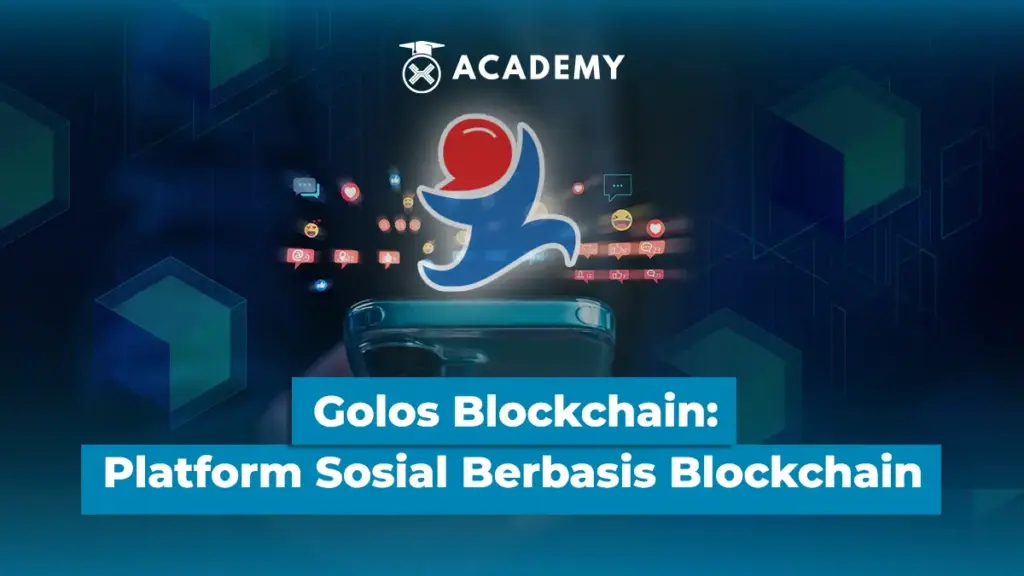
Since 2016, decentralized social platforms have emerged that utilize blockchain to create censorship-free communication spaces while rewarding content creators.
At that time, Golos was one of the early experiments combining the blogosphere with blockchain and a token incentive system.
Through this approach, Golos aimed to demonstrate that writing and sharing ideas could be rewarded openly without relying on a central platform.
By understanding projects like Golos, you can see how the concept of social blockchain has evolved, from a simple experiment to becoming the foundation for the various blockchain-based social platforms that have emerged since.
What is Golos Blockchain?
Golos is a social blockchain launched on October 18, 2016, as a fork of Steem.
The project was designed to be an independent blogging space that emphasizes freedom of speech, user data ownership, and a fairer distribution of incentives.
Through a decentralized approach, Golos aims to provide a platform where users can write and share content without fear of pressure from a central authority.
Vision and Purpose of Creation
Golos’ primary goal is to provide an alternative to mass media that is not easily censored. The platform was originally intended for the Slavic/Russian community, who needed an open discussion space without the interference of a centralized institution.
By utilizing a blockchain structure, Golos aims to reduce the dominance of traditional social platforms that typically control algorithms, content distribution, and data ownership.
Through this model, Golos demonstrates that social media can be more transparent, with users controlling their data, content not being able to be unilaterally removed, and appreciation being shared openly through tokens.
Golos’ Technical Framework and How It Works
Golos is built on a similar technical foundation to Steem, but is geared towards meeting the need for a fast, censorship-free, and easy-to-use social network. The following is a description of the technical framework and how it works.
Delegated Proof-of-Stake (DPoS)
Golos uses the DPoS mechanism, where users influence the direction of the network by electing witnesses, the parties responsible for producing blocks.
The more votes a person has, the greater their influence in the election process.
This system is designed to maintain network efficiency and scalability. Blocks are created regularly, energy consumption is low, and governance decisions can be made more quickly than traditional blockchain models.
Through DPoS, every user plays a role, not just as a spectator, but as part of the decision-making process.
Steem-style Proof-of-Brain
For its reward system, Golos implements the proof-of-brain concept, a model that rewards based on community assessment.
Content deemed highly valuable, whether written or curated, will be rewarded with tokens through a voting mechanism. This scheme seeks to create an ecosystem that emphasizes quality and participation, rather than spamming.
3-Second Block Speed
The block creation process, which takes only about three seconds, makes Golos responsive for daily activities.
This speed benefits social apps, dApps, and features that require real-time interaction. Users can post, comment, or make transactions without waiting long.
Free Transactions
One of Golos’ distinctive features is its zero-fee transactions. This approach significantly streamlines the user experience, especially for creators and active readers.
For dApp developers, this zero-fee model helps reduce barriers to adoption and enables more user-friendly applications.
(Role-Based Permissions) System
Golos adopts a layered permissions system similar to Steem, based on four types of keys:
- Owner: the most important key for account recovery
- Active: the key for transactions and asset changes
- Post: the key specifically for social activities such as posts and comments
- Memo: the key for message encryption
This structure gives users complete control over their account security. Even if one key is compromised, access to the others remains secure.
For developers, this system also opens up greater flexibility to create dApps with more granular access controls.
Key Features of the Golos Blockchain
As a social blockchain launched on October 18, 2016, Golos was built to be a censorship-free, fast, and open digital public space for the creator community. Here are four of its key features.
Uncensored Social Platform
From the beginning, Golos was designed as a place where users could express themselves without fear of their content being unilaterally removed.
Every post, comment, or interaction made by users is recorded on the blockchain, making it unmodified by any central authority.
This principle provides a safer space for creators and readers: control of the content remains in the hands of users, not corporations.
Decentralized Blogosphere
Golos combines blogging features with a blockchain structure. The platform allows communities to write, discuss, and manage their own spaces openly.
Content is stored directly on the blockchain or via IPFS, making it accessible without relying on a central server. This approach makes the blogging ecosystem more self-sufficient, censorship-resistant, and truly community-owned.
dApp Support
While its ecosystem is small, Golos provides the technical foundation for decentralized applications.
With free transactions, DPoS consensus, and a flexible key-based permission system, developers can build dApps that leverage the network’s censorship resistance and speed.
This model opens up opportunities for applications such as digital publishing, donations, MSME asset tokenization, and other services that want to leverage blockchain transparency.
High Responsiveness
Network speed is one of Golos’ strengths. With a block time of around three seconds, every interaction, from posting and voting to running dApps, feels fast and smooth.
This responsiveness makes Golos well-suited for social activities that require instant updates while providing a more convenient user experience.
The Golos Ecosystem and Built Applications
The Golos ecosystem was created to support blockchain-based social activities, from blogging and curation to application development.
While not as large-scale as Steem, Golos has successfully created a comprehensive foundation for a community of writers, curators, and developers. Below is a look at the Golos ecosystem and the applications it has built.
golos.io as the Core Application
golos.io serves as the hub of ecosystem activity, serving as a decentralized blogging platform with posting, commenting, upvoting, and curation features.
All interactions are recorded on the blockchain, preventing content from being deleted unilaterally, while the upvote system distributes token rewards openly among writers and curators.
With free transactions and fast block times, the social experience is lightweight and responsive.
Developer Tools
The Golos ecosystem provides GitHub repositories and libraries that enable developers to build or integrate dApps into the network.
DPoS support, key-based permissions, and fast and free transactions provide a stable technical foundation for the development of additional social applications and community services that leverage Golos’ censorship-resistant properties.
Golos’ Journey from 2016 to 2025
As one of the early experiments in building blockchain-based social media, Golos has had a long and interesting journey to follow.
From its early days of enthusiasm to its stagnation, here’s a brief overview of Golos’ journey from 2016 to 2025.
Early Growth Phase
Golos launched on October 18, 2016, as a fork of Steem with a clear mission: to build a decentralized, censorship-free blogosphere, especially for the Russian-speaking community.
Thanks to its fast DPoS design and free transactions, the platform experienced rapid growth. The community actively produced content, curated content, and utilized the on-chain reward system.
Developers also began experimenting with creating Golos-based dApps due to its solid technical foundation, including 3-second block times, key-based permissions, and responsive social media systems.
Emerging Challenges
In the following years, Golos’ growth began to slow. Competition from Steem and Hive made Golos’ position increasingly difficult, especially given its limited number of active developers.
Community fragmentation is beginning to emerge, while new adoption is not growing as rapidly as other ecosystems.
Although Golos has attempted to expand its features, from dApps to new revenue models, its momentum has waned. Activity has declined, and fewer projects are being built on it.
Status in 2025
As we enter 2025, Golos is technically still a viable blockchain, complete with its DPoS mechanism, hierarchical permissions, free transactions, and a functioning infrastructure.
However, in practice, network activity is minimal, volume is low, and development is barely moving. Many have placed Golos in the category of a “stagnant project” or “barely active.”
The ecosystem isn’t completely gone, but more like a network surviving without the community dynamics that once made it vibrant.
Key Lessons from the Golos Blockchain
The Golos experience provides a clear picture of what is needed and what is often missing from a social blockchain. Here are some key lessons from the Golos Blockchain.
The Role of Community in Social Blockchain
Golos was built as a censorship-free space for writers and content creators, complete with token incentives and full control over accounts through a key-based permission system.
However, without an active community, such ecosystems struggle to survive. Reward models that rely on organic participation eventually weaken as the number of creators and curators declines, shrinking the distribution of value within the network.
DPoS Governance Challenges
With Delegated Proof-of-Stake (DPoS), Golos offers a fast, efficient system that allows users to participate in choosing the direction of the network.
However, this mechanism still requires precise coordination, engaged voters, and ongoing maintenance from delegates. Without this, ideal governance on paper isn’t always reflected in practice.
Why Some Projects Don’t Survive
Golos boasts many features, from free transactions and dApps to an independent blogosphere approach, but it still faces significant obstacles.
A small ecosystem, competition from global open-source projects, stagnant value-added, and governance challenges make it difficult to maintain momentum.
This demonstrates that solid technology isn’t necessarily enough without community support, continuous innovation, and a truly relevant usage model.
Is Golos Still Relevant?
Although the Golos ecosystem is no longer as active as it once was, the project remains relevant as a study. Golos was one of the early social blockchain models, attempting to combine social networking, token incentives, and user data ownership.
This concept has since evolved into various other forms, such as Web3 social, decentralized identity, and even a blockchain-based creator economy.
Golos also provides a concrete example of how a decentralized reward system is implemented: users create content, the community evaluates it, and rewards are distributed on-chain without intermediaries.
This mechanism has become the foundation for many modern social blockchain projects seeking to create a fairer participation model.
Furthermore, Golos’s journey also serves as an important reference for how a project can stagnate.
From community challenges and the dynamics of DPoS governance to the lack of continuous innovation, these factors help us understand what to avoid in developing crypto projects today.
Fundamentally, Golos remains interesting to study not because of its investment value, but because it holds lessons about the early evolution of blockchain-based social media.
Conclusion
So, that was an interesting discussion about Golos Blockchain as a blockchain-based social platform that you should know about. You can read more about it in the INDODAX Academy’s Crypto Academy.
In conclusion, Golos’s journey demonstrates the difference between big ideas and reality on the ground.
This project carries a strong vision of freedom of speech, data ownership, and advanced technology like DPoS, free transactions, and fast block times.
However, without an active community and growing adoption, Golos eventually lost momentum and stalled. Nevertheless, Golos remains an important learning resource.
For Indodax Academy readers, this project helps you understand how the social blockchain concept is built, its advantages, and the challenges that can prevent a platform from surviving.
That’s interesting information about Blockchain that you can explore further in Indodax Academy’s collection of crypto articles. In addition to gaining in-depth insights through various popular crypto education articles, you can also broaden your horizons through a collection of tutorials and choose from a variety of popular articles that suit your interests.
Besides updating your knowledge, you can also directly monitor digital asset prices on Indodax Market and stay up-to-date with the latest crypto news. For a more personalized trading experience, explore Indodax’s OTC trading service. Don’t forget to activate notifications so you don’t miss out on important information about blockchain, crypto assets, and other trading opportunities.
You can also follow our latest news via Google News for faster and more reliable access to information. For an easy and secure trading experience, download the best crypto app from INDODAX on the App Store or Google Play Store.
Maximize your crypto assets with the INDODAX Earn feature, a practical way to earn passive income from your stored assets. Register now with INDODAX and easily complete KYC to start trading crypto more safely, conveniently, and reliably!
Indodax Official Contact
Customer Service Number: (021) 5065 8888 | Support Email: [email protected]
Also follow us on social media here: Instagram, X, Youtube & Telegram
FAQ
1.Is the Golos Blockchain still active?
The network is technically still running, but user activity is very low and the ecosystem is no longer growing.
2.How is Golos different from Steem and Hive?
All three share similar technical foundations, being based on the same code, but Steem and Hive have much larger and more active communities.
Golos focuses on the Russian-speaking community, while the other two are expanding more globally.
3.What is the GLS token used for?
The GLS token is used to reward content creators, increase voting power, and stake in the DepoS system.
4.What are the technical advantages of the Golos Blockchain?
Golos offers a DPoS mechanism, fast block confirmation times, free transactions, and a role-based permission system for account security.
5.Why is Golos important as an example of a decentralized social project?
Because Golos demonstrates how the social blockchain concept is built, while also exemplifying the real-world challenges of maintaining a community, ecosystem, and long-term value.

Author: Boy
 Polkadot 2.25%
 BNB 0.52%
 Solana 4.62%
 Ethereum 2.32%
 Cardano 1.02%
 Polygon Ecosystem Token 1.87%
 Tron 2.75%
 Market