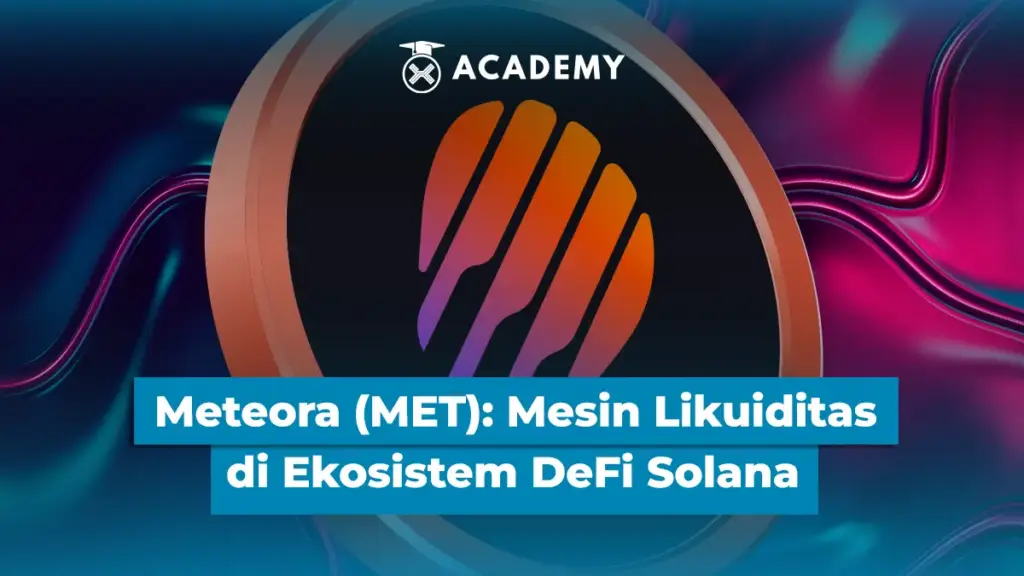
Liquidity is a fundamental component that determines whether Decentralized Finance (DeFi) can run smoothly or stall.
With sufficient liquidity, asset exchanges are smoother, price differences are more stable, and yield opportunities are more easily achieved. When liquidity is minimal, issues like slippage and pricing inefficiencies immediately arise.
In the Solana ecosystem, the need for flexible liquidity management is increasingly apparent due to the rapid pace of transaction activity.
Meteora exists as an infrastructure focused on dynamic liquidity management, so that liquidity doesn’t remain stagnant but can adapt to market conditions and the needs of other protocols on the Solana network.
What is the Meteora (MET) Token?
Meteora is a decentralized liquidity protocol on the Solana network. Its role is simple: to manage and provide liquidity to ensure the smooth operation of various DeFi applications.
Meteora is not used for swaps or direct transactions by users, as its functions are behind the scenes.
In the Solana DeFi ecosystem, Meteora serves as the liquidity foundation that supports the efficiency of other applications. This token also helps maintain stable price movements during times of increased activity.
Meteora’s role also differs from DeFi applications at the user level. DeFi applications focus on the interface and features directly used by users, while Meteora focuses on the supporting system.
Therefore, MET is better understood as part of the protocol’s working mechanism, rather than as a standalone underlying asset.
Why Is Liquidity an Important Issue in DeFi?
Liquidity indicates how easily assets can be exchanged without drastic price fluctuations. When liquidity is high, transactions are smooth and prices remain close to market value. Users can swap with expected returns.
When liquidity is low, problems immediately arise. Even a small swap can cause prices to spike or plummet significantly, causing users to experience slippage and less profitable transactions. Transactions can feel expensive and inefficient.
On a fast network like Solana, this is even more apparent. Transactions can be processed very quickly, but without sufficient liquidity, that speed is of little help.
High activity can actually cause price fluctuations, making liquidity a key factor for DeFi to truly function effectively.
How the Liquidity Engine Works in Meteora
Meteora manages liquidity so that it remains in areas where transactions are actually taking place. Liquidity is not allowed to accumulate in one place or spread to rarely touched prices, but is instead directed to the currently active price range.
This approach is known as a Dynamic Liquidity Market Maker. Simply put, this system allows liquidity to adapt to market conditions.
When prices move or activity increases, liquidity follows suit, ensuring smooth asset exchange processes and price gaps do not widen.
This differs from the traditional model, which allocated liquidity evenly without regard to market activity. As a result, much of the liquidity went unused.
Meteora itself chooses a more adaptive approach so that liquidity actually works when needed, rather than simply waiting.
Dynamic Liquidity Market Maker (DLMM) Simply Put
DLMM is Meteora’s way of placing liquidity at prices that are frequently used for transactions. This way, funds aren’t spread everywhere, but are focused on active areas.
Liquidity needs to be managed adaptively because asset prices are constantly fluctuating. If liquidity is left stagnant or evenly distributed, much of it will go unused. By following price movements, liquidity is always ready to be used when a transaction occurs.
As a result, capital is used more efficiently. Liquidity providers have better income opportunities because their funds are actively traded. Users also benefit because swaps feel smoother and price differences are better maintained.
Meteora as Infrastructure in the Solana DeFi Ecosystem
Meteora serves as a liquidity provider used by various DeFi applications on Solana. It is not used directly by users, but ensures liquidity is always available so that transactions in other applications can run smoothly.
Other DeFi applications use Meteora’s liquidity to power their services. This eliminates the need to manage liquidity themselves and can focus on the features they offer to users.
This working model reflects how interconnected DeFi is. Each protocol plays a distinct role and supports each other.
Meteora provides liquidity, while other applications leverage it to build simpler and more efficient services.
The Role of the MET Token in the Meteora Protocol
The MET token is used as the primary tool for the smooth and orderly operation of the Meteora Protocol. This token connects users to the system, allowing activities within the protocol to proceed without the need for a centralized management body.
MET has two primary functions. First, for governance. MET holders can vote on important decisions related to the rules and direction of the protocol’s development.
Second, it serves as an incentive. MET is used to reward users for contributions, such as providing liquidity or actively using the protocol.
Tokens like MET are widely used in DeFi because they facilitate automated system management.
Through tokens and smart contracts, voting rights, reward distribution, and protocol rules can be executed transparently without intermediaries. This way, DeFi can remain open and accessible to anyone.
Transparency and On-Chain Data in Liquidity Protocols
DeFi protocols utilize on-chain data because all activity occurs directly on the blockchain.
Every transaction and fund movement is automatically recorded on the public network. Therefore, no data is stored privately or accessible only to administrators.
From on-chain data, anyone can check important information, such as the amount of available liquidity, incoming and outgoing funds, fees generated, and how smart contracts operate.
All these records are directly visible and immutable, ensuring data consistency.
This transparency is crucial in liquidity management because users can see where their funds are being used.
With open data, protocol management can be collectively monitored, reducing the risk of misuse. Trust is built on data that anyone can verify directly, not on one-sided claims.
What Can Users Learn from Meteora?

From Meteora, users can learn the importance of understanding how DeFi works as a whole, not just how to use the application.
Liquidity is a crucial part of keeping the blockchain ecosystem running smoothly and transactions running smoothly.
Understanding the protocol also helps users become more aware of potential risks, allowing them to make safer decisions when using DeFi platforms.
With this knowledge, users don’t just follow the crowd and use the application, but truly understand how the system works.
In addition to gaining in-depth insights through various popular crypto education articles, you can also broaden your horizons through a collection of tutorials and choose from a variety of popular articles that suit your interests.
Besides updating your knowledge, you can also directly monitor digital asset prices on Indodax Market and stay up-to-date with the latest crypto news. For a more personalized trading experience, explore Indodax’s OTC trading service. Don’t forget to activate notifications so you don’t miss out on important information about blockchain, crypto assets, and other trading opportunities.
You can also follow our latest news via Google News for faster and more reliable access to information. For an easy and secure trading experience, download the best crypto app from INDODAX on the App Store or Google Play Store.
Maximize your crypto assets with the INDODAX Earn feature, a practical way to earn passive income from your stored assets. Register now with INDODAX and easily complete KYC to start trading crypto more safely, conveniently, and reliably!
Indodax Official Contact
Customer Service Number: (021) 5065 8888 | Support Email: [email protected]
Also follow us on social media here: Instagram, X, Youtube & Telegram
Conclusion
So, that was an interesting discussion about Meteora (MET), the liquidity engine driving Solana DeFi. You can read more about it in the INDODAX Academy crypto academy.
In conclusion, Meteora demonstrates that in DeFi, liquidity isn’t just a number stored in a pool, but a mechanism that determines whether the ecosystem can operate efficiently. On a fast network like Solana, transaction speed means little without adaptive and targeted liquidity management.
Meteora’s approach through DLMM highlights one crucial point: liquidity needs to follow market activity, not remain static. By placing capital in price areas where it’s actually used, the protocol seeks to reduce liquidity waste and maintain a stable swap experience, even as volume increases.
For users, understanding Meteora’s role helps them view DeFi from a more holistic perspective. It’s not just about the applications used on the surface, but also the infrastructure behind them.
With this perspective, users can better understand that efficiency, risk, and returns in DeFi depend heavily on how liquidity is managed, not just on the application’s visible features.
FAQ
- Is Meteora directly aimed at retail users?
Not directly. Meteora serves as the liquidity infrastructure used by other DeFi protocols, not the application users use for everyday swaps. - Why is it necessary to make liquidity management dynamic, as it is in Meteora?
Because prices and market activity are constantly changing. Static liquidity often isn’t used in the right areas, leading to decreased capital efficiency and increased slippage. - Does DLMM eliminate DeFi risks?
No. DLMM helps improve efficiency, but market risks, volatility, and smart contract risks remain and need to be understood by users. - What are the main benefits of the MET token to the Meteora ecosystem?
MET serves as a governance and incentive tool, allowing protocol decisions and reward distribution to be executed in a decentralized and transparent manner. - What is the most important lesson from Meteora for DeFi users?
That liquidity is the foundation of the ecosystem. Understanding how liquidity works helps users view DeFi opportunities and risks more rationally, rather than simply following trends or the lure of returns.

Author: Boy
 Polkadot 2.25%
 BNB 0.52%
 Solana 4.62%
 Ethereum 2.32%
 Cardano 1.02%
 Polygon Ecosystem Token 1.87%
 Tron 2.75%
 Market