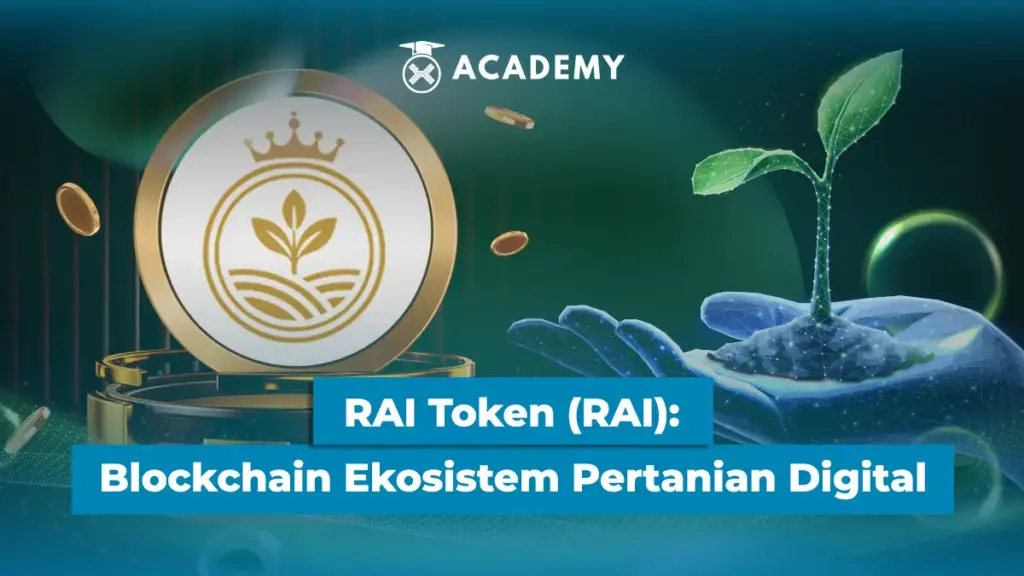
Challenges in the agricultural sector extend beyond harvests. Some frequently complained-about challenges include unclear production data, prices set without transparent information, and profits largely lost in the distribution channel.
Furthermore, smallholder farmers still struggle to access technology that could help them.
To address this, blockchain is beginning to be used as the foundation for digital agriculture. The goal is to make data more transparent and the value distribution process clearer.
RAI Token (RAI) is also part of this system, helping connect farmers, data, and the distribution process for a more streamlined and equitable process.
What is RAI Token (RAI)?
RAI Token (RAI) is a blockchain-based token used as a tool within a system. This token was created to support the system’s operation, not simply for trading. Therefore, its function is more about usage than speculation.
In the digital agricultural ecosystem, RAI serves as a connector. This token unites data, processes, and actors within a single system, allowing agricultural activities to be managed more efficiently and easily understood.
Furthermore, it’s important to distinguish between tokens as system tools and tokens as trading assets. RAI is used as part of the system to support its activities.
Meanwhile, tokens as trading assets are typically used for buying and selling. In the case of RAI, the primary focus is on its function and utility within the digital agricultural ecosystem, not its trading activities.
Challenges in the Digital Agricultural Ecosystem
In the digital agricultural ecosystem, many problems remain directly experienced by actors in the field. The flow of harvested produce to buyers is often unclear.
Furthermore, farmers find it difficult to understand where their products are going and how prices are determined.
The relationship between farmers and the market is also not well-connected. Price and market demand information rarely reaches producers directly. As a result, farmers simply follow established channels without much choice.
Furthermore, agricultural data remains scattered across various disconnected systems, complicating management.
Another problem is the contribution of farmers and small-scale actors, which is often not rewarded appropriately.
There is no clear system for recording their roles and providing incentives. This results in multiple stakeholders being involved, but the benefits received are unequal.
How Is Blockchain Used in the Agricultural Sector?
Blockchain in the agricultural sector is used as a place to record data openly. Information such as harvest yields, shipments, and transactions are recorded in a single, publicly accessible system.
Because the data is stored securely, it is not easily tampered with and easier to track. It includes smart contracts, which are digital rules that can be run automatically.
If certain conditions are met, processes, such as recording transactions or sharing profits, are executed immediately without the need for intermediaries. This speeds up the process and reduces errors.
Blockchain is also not controlled by a single party. Farmers, cooperatives, distributors, and other parties can be connected within the same system. All work on the same data, making collaboration clearer.
Because data is recorded directly on the blockchain, the history of agricultural activities is securely stored and can be checked at any time. This helps build trust and facilitates agricultural business management.
The Role of the RAI Token in the AgroFi Ecosystem
Before discussing further, it’s important to understand that the RAI token is a utility token used within the digital agricultural ecosystem called AgroFi. This token is used to support activities, not as a means of buying and selling or speculating.
RAI helps encourage user participation. When users engage in various activities in the ecosystem, such as recording data or following certain processes, their role can be recognized through mechanisms that use RAI.
The relationship between user activity and RAI is functional. This token helps the system record participation and ensure that rules are followed, allowing the AgroFi ecosystem to operate in a more organized and understandable manner.
ERC-20 Standard and Why It’s Used
ERC-20 is the standard used to create tokens on the Ethereum network.
This standard defines how tokens are created, sent, received, and their balances checked. Because its rules are standardized, all ERC-20 tokens operate in more or less the same way.
The ERC-20 standard is used for tokens like RAI because it is widely used and has proven to be stable.
Using this standard allows tokens to run directly on the Ethereum network without having to build a new system from scratch. This simplifies development and reduces the risk of technical issues.
Another advantage of ERC-20 is its compatibility. Tokens that use this standard can be directly used in various wallets and blockchain applications that already support Ethereum.
Users don’t need special tools or additional systems, as tokens can be stored, sent, and used in familiar ways.
Transparency and On-Chain Data in the Agricultural Ecosystem
In the agricultural ecosystem, blockchain is used to digitally record data. This recorded data can include harvest yields, delivery times, distribution channels, and transaction records. All of this information is neatly stored and can be reviewed when needed.
Data transparency is crucial in agribusiness because many parties are involved. With clear records, every actor can see the process and know the origin of the product.
This will help reduce confusion and build trust between parties.
Blockchain is also not a substitute for fieldwork. The processes of planting, harvesting, and shipping goods continue as usual. Blockchain simply serves as a tool to ensure that data from these processes is clearly recorded and verifiable.
What Can Be Learned from the RAI Token Model

The RAI Token model demonstrates that blockchain isn’t always used for speculative purposes.
This technology can also serve as a supporting tool for real sectors, such as agriculture, by facilitating data recording, system connectivity, and collaboration between actors.
This model also demonstrates the importance of understanding a token’s function or use case. Tokens aren’t always created for trading, but can serve as part of a system’s working mechanism.
By understanding its context and use, the token’s role becomes clearer and more relevant to the needs of the sector in which it operates.
Conclusion
So, that was an interesting discussion about RAI Token (RAI) and its role as an example of blockchain in the digital agriculture ecosystem. You can read more about it in the INDODAX Academy’s Crypto Academy.
In conclusion, RAI Token demonstrates how blockchain can be used in real life in the agricultural sector.
This technology isn’t positioned as a grand concept far removed from the field, but rather as a tool to streamline data, clarify distribution flows, and record the roles of each involved party.
The main strength of the RAI approach lies not in the token’s name, but in how it is positioned within the system.
RAI works as a bridge between data, processes, and participation, enabling the digital agricultural ecosystem to operate in a more structured and traceable manner.
This approach illustrates that blockchain’s value in the real sector emerges when technology is used to support daily work, not simply as a symbol of innovation.
Ultimately, understanding the function of tokens and their role within the system is crucial so that technology doesn’t remain a concept but truly provides benefits.
In addition to gaining in-depth insights through popular crypto education articles, you can also broaden your horizons through a collection of tutorials and choose from a variety of popular articles that suit your interests.
Besides updating your knowledge, you can also directly monitor digital asset prices on Indodax Market and stay up-to-date with the latest crypto news. For a more personalized trading experience, explore Indodax’s OTC trading service. Don’t forget to activate notifications so you don’t miss out on important information about blockchain, crypto assets, and other trading opportunities.
You can also follow our latest news via Google News for faster and more reliable access to information. For an easy and secure trading experience, download the best crypto app from INDODAX on the App Store or Google Play Store.
Maximize your crypto assets with the INDODAX Earn feature, a practical way to earn passive income from your stored assets. Register now with INDODAX and easily complete KYC to start trading crypto more safely, conveniently, and reliably!
Indodax Official Contact
Customer Service Number: (021) 5065 8888 | Support Email: [email protected]
Also follow us on social media here: Instagram, X, Youtube & Telegram
FAQ
- Is the RAI Token only accessible to those familiar with crypto?
No. RAI is designed to work within a digital farming system. Users in the field can still participate without needing a deep understanding of blockchain technicalities. - How is the RAI Token different from other commonly traded crypto tokens?
RAI is used as a system support tool. Its purpose is to run processes and record participation, not for trading. - Why is data transparency important in digital farming?
This is because multiple parties are involved in a single workflow. Clear data helps reduce misunderstandings and facilitates collaboration between actors. - Does blockchain replace agricultural processes in the field?
No. All physical activities continue as usual. Blockchain simply records and ensures that data from these processes can be verified. - What lessons can be learned from the RAI Token model?
That tokens are more meaningful when used as part of a clear system. Without a concrete function, tokens easily lose their role in the ecosystem.

Author: Boy
 Polkadot 2.25%
 BNB 0.52%
 Solana 4.62%
 Ethereum 2.32%
 Cardano 1.02%
 Polygon Ecosystem Token 1.87%
 Tron 2.75%
 Market