Artificial Intelligence (AI) and Web 3 often converge in the same direction. Both often use blockchain as an open system to store data and transmit value without intermediaries.
Meanwhile, AI is increasingly being used to help automate tasks and make decisions faster. This intersection of the two is beginning to be seen in Base, a layer-2 Ethereum network widely used to experiment with new ideas.
There, the concept of AI agents is being introduced in practice, not just in theory. Nexa (NXA) is one example of how AI agents are linked to on-chain mechanisms.
What is Nexa (NXA) on the Base Network?
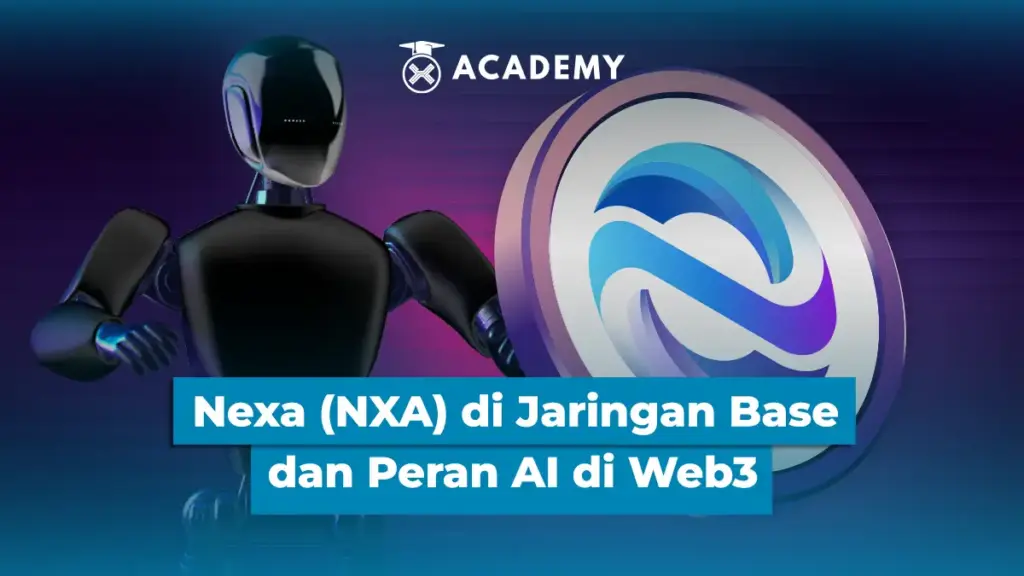
Nexa (NXA) on the Base network is a crypto token that runs on top of Base, Ethereum’s layer-2 network.
So, NXA is not a new blockchain, but rather a digital asset that leverages the Base infrastructure for use in applications and smart contracts.
This is important because the name “Nexa” is also used by other stand-alone blockchains with different technical designs, even using different tickers. The Nexa blockchain is a layer-1 network with its own purpose and function.
Meanwhile, Nexa (NXA) on Base is a separate entity, although the name is similar, so the two cannot be confused. In the context of Base, NXA is better understood as part of the AI ??experimentation in the Web3 ecosystem.
The NXA token is used in on-chain mechanisms that support the interaction and recording of AI agent activity.
In this regard, AI is no longer just a tool, but is beginning to be positioned as part of a decentralized system.
Understanding the Base Network as a Web3 Ecosystem
Base is a layer-2 network that runs on Ethereum. Its role is to help process transactions outside the Ethereum main network, while still connecting them to the same system.
This way, users still use Ethereum, but through a more streamlined platform. Base’s goal is simple: to make transactions cheaper and more efficient.
Fees, which are typically high on Ethereum, can be reduced. This makes blockchain activities more feasible for everyday use and applications that require high interaction.
This makes Base attractive to new Web3 projects. Developers can experiment without the burden of high fees, while still connecting to the already large Ethereum ecosystem.
For this reason, Base is often chosen as the birthplace of new projects, including those exploring AI concepts in Web3.
Why Is AI Starting to Be Connected to Web3?
Web3 does provide an open and transparent system. However, without intelligent automation, many processes still have to be done manually by users.
As a result, usage becomes less practical, especially when responding to data and rapid changes.
AI is then seen as a complementary solution because it can analyze big data and help make decisions more efficiently.
Their role isn’t to replace humans, but rather to simplify complex processes within Web3 applications.
This is where the idea of ??AI agents emerged, automated systems that can operate based on rules within decentralized networks.
While not yet definitive and still in the experimental phase, this trend demonstrates why AI is increasingly associated with Web3.
The Concept of AI Agents in the Blockchain Ecosystem
Simply put, an AI agent can be understood as an AI system designed to automatically execute tasks based on specific data and rules. This system not only follows fixed commands but can also adjust its actions according to conditions.
In blockchain, AI agents differ from ordinary smart contracts. Smart contracts operate with fixed patterns, where each action is only executed when predetermined conditions are met.
Conceptually, AI agents have additional analytical capabilities that allow them to select actions rather than simply execute fixed rules.
Therefore, AI agents are considered to have the potential to fill certain roles in Web3, such as assisting with more flexible automated processes in decentralized systems. However, their role is still conceptual and experimental, not guaranteed to be effective.
The Role of Nexa (NXA) in the AI ??and Web3 Approach
Regarding Nexa, NXA is positioned as a token used within the system, rather than a standalone asset. Its role is more like an operational component that supports various activities in the ecosystem.
The relationship between tokens and activities is usually seen in how NXA is used to access features, perform certain functions, or become part of the interaction flow within the application being developed.
In other words, tokens serve as a link between users, systems, and the processes occurring within the network.
Therefore, NXA is more accurately understood as part of the system mechanism in AI and Web3 experiments. Its existence supports the functioning of the ecosystem, without carrying any guarantees of value, returns, or specific financial claims.
Challenges of AI Integration in the Web3 Environment
Combining AI with Web3 is not without challenges. One issue that frequently arises is the risk of centralization.
Many AI systems still rely on infrastructure, data, or models controlled by a specific party, which can conflict with the decentralization principles of Web3.
Another challenge lies in data and transparency. AI models often operate as “black boxes,” whose decision-making processes are difficult to understand.
On the other hand, Web3 emphasizes openness and verifiability, creating a gap between how AI works and the fundamental values ??of blockchain.
Security and trust are also concerns. The integration of AI into on-chain systems opens up new risks, ranging from model errors to potential manipulation.
Therefore, AI approaches in Web3 still need to be carefully tested and reviewed to avoid compromising the fundamental principles of a decentralized ecosystem.
Transparency and On-Chain Data in Web3 AI Projects
In Web3-based AI projects, not all data is suitable for recording on the blockchain. Data that is concise, such as decision outcomes, specific parameters, or evidence of activity, makes more sense to store on-chain.
Conversely, large, raw, or sensitive data typically remains off-chain due to cost and privacy constraints.
Here, the role of blockchain is better understood as a verification tool. Blockchain helps ensure that certain processes or outcomes are properly recorded and cannot be easily tampered with, not as a replacement for AI itself.
AI still operates on a separate layer, while the blockchain provides a source of trust for what is happening.
Therefore, transparency is key in Web3 AI systems. With on-chain recordkeeping, users can see the trail of important decisions or activities, so the system is not completely closed.
This approach essentially helps maintain trust even though the AI ??used still has limitations.
What Can Be Learned from Nexa (NXA)

Nexa (NXA) can be used as an example of how Web3 projects are beginning to incorporate AI into decentralized systems. What matters is not the final result, but the process of experimentation.
From this, we need to understand the function of tokens within the context of the system. Tokens like NXA are used as part of the working mechanism, not as a direct measure of the technology’s quality or the project’s value.
Because many AI blockchain projects are still in their early stages, a critical attitude remains important. Not all claims are immediately reflected in their implementation, so it’s more appropriate to view them as technological experiments, not as firm promises.
In addition to gaining in-depth insights through various popular crypto education articles, you can also broaden your horizons through a collection of tutorials and choose from a variety of popular articles that suit your interests.
Besides updating your knowledge, you can also directly monitor digital asset prices on Indodax Market and stay up-to-date with the latest developments through the latest crypto news. For a more personalized trading experience, explore Indodax’s OTC trading service. Don’t forget to activate notifications so you don’t miss important information about blockchain, crypto assets, and other trading opportunities.
You can also follow our latest news via Google News for faster and more reliable access to information. For an easy and secure trading experience, download the best crypto app from INDODAX on the App Store or Google Play Store.
Maximize your crypto assets with the INDODAX crypto staking feature, a practical way to earn passive income from your stored assets. Register now with INDODAX and easily complete KYC to start trading crypto more safely, conveniently, and reliably!
Indodax Official Contact
Customer Service Number: (021) 5065 8888 | Support Email: [email protected]
Also follow us on social media here: Instagram, X, YouTube & Telegram
Conclusion
So, that was an interesting discussion about Nexa (NXA) on the Base network as an AI that is starting to enter the Web3 ecosystem. You can read more about it in the INDODAX Academy crypto academy.
In conclusion, Nexa (NXA) on the Base network provides a clear picture of the new direction being explored in the Web3 ecosystem: efforts to combine AI-based automation with decentralized infrastructure.
What’s important to note is that this isn’t about mature technology, but rather an experimental process still seeking its most relevant form.
Base serves as a reasonable testbed due to its low cost and connection to Ethereum, while NXA exists as part of the system’s mechanisms supporting the AI ??agent idea within it.
In this regard, tokens aren’t symbols of value or promises of the future, but rather tools for testing concepts in real-world environments.
Because AI and Web3 are both still developing, understanding context is key. Projects like Nexa are best read as signals of industry direction and learning materials, rather than as final benchmarks.
This approach helps us remain rational and critical, and avoid getting caught up in technological narratives that are too far removed from actual applications.
FAQ
- Is Nexa (NXA) actually an AI project or a blockchain project?
Nexa (NXA) is more accurately viewed as a blockchain project exploring the use of AI. AI exists as a concept being tested, not as a fully established, mainstream technology. - Why does Nexa (NXA) use the Base network, rather than Ethereum directly?
Base offers lower transaction fees and a more flexible environment for experimentation. This makes testing new concepts, including AI agents, more realistic. - Are AI agents in Nexa truly autonomous?
Not necessarily. AI agents in this context are still in the early concept and implementation stages, so their independence depends heavily on the system design and technical expertise. - Does the NXA token reflect the sophistication of the AI ??being used?
Not directly. The NXA token serves as part of the system’s mechanisms, not an indicator of the AI’s sophistication or the project’s success. - How should we approach Web3 AI projects like Nexa?
View them as technology experiments. Focus on understanding the concept, the role of the system, and its limitations, without immediately considering it as a final solution or a proven breakthrough.

 Polkadot 2.25%
 BNB 0.30%
 Solana 4.19%
 Ethereum 2.32%
 Cardano 1.02%
 Polygon Ecosystem Token 1.87%
 Tron 2.75%
 Market