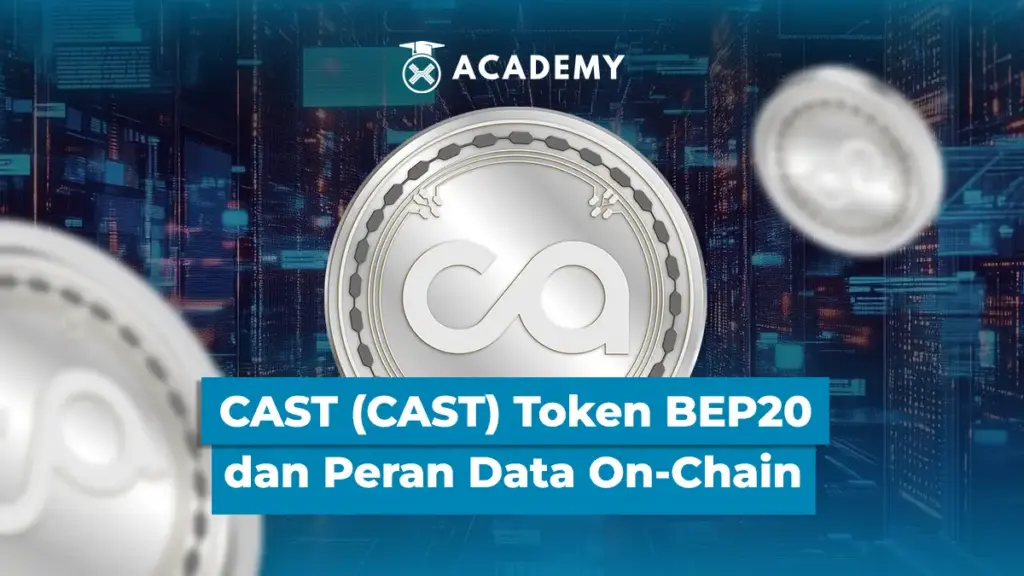
Crypto tokens with limited supply and minimal information often leave people guessing about their value based on circulating speculation.
If you find yourself in this situation, on-chain data can be a more credible answer because all transactions and token movements are clearly recorded on the blockchain.
In this article, the main focus will be on discussing CAST (CAST), a BEP20 token whose information is easier to understand through on-chain data.
Why is this? Because the data can be clearly seen through actual activity, not through claims or promotional stories.
Through blockchain transparency, anyone can see who holds the token, how it moves, and what patterns are actually occurring.
What is CAST (CAST) a BEP20 Token?

CAST (CAST) is a crypto token built on the BEP20 standard. As a BEP20 token, CAST is recorded and managed through a smart contract on the blockchain, can be stored in crypto wallets, sent between wallets, and its transaction history can be tracked openly.
BEP20 tokens run on a blockchain network designed to process transactions quickly and with relatively low fees. As a result, transferring CAST from one wallet to another takes little time and is not expensive.
CAST itself is a purely on-chain token. It is not a stock, not a financial product, and does not represent ownership or claims to a specific company or business.
Characteristics of BEP20 Tokens in the Blockchain Ecosystem
The BEP20 standard is a token standard on the BNB Chain network. This standard governs fundamentals, such as how tokens enter wallets, are sent to others, and how their amounts are recorded.
Because the rules are the same, BEP20 tokens are usually readily usable across multiple wallets and applications without any hassle. When compared to other token standards, the differences lie more in the location and system used, rather than in their basic functionality.
All token standards are created with a similar goal: to ensure tokens are usable and recognizable, but they adapt to the characteristics of each blockchain network.
A token standard is crucial for interconnectedness and easy verification. Users can send tokens, view transaction history, and inspect token data openly.
Without standards like BEP20, token usage would be confusing and transparency on the blockchain would be difficult.
Why On-Chain Data Is Important in Understanding Crypto Tokens
On-chain data is important because the blockchain functions like an open ledger that can be viewed and monitored by anyone. Every transaction and token movement is recorded directly within the system, so the information cannot be altered or hidden.
On-chain information comes from real data on the blockchain, such as transactions and token ownership. This differs from off-chain information, which typically consists of claims, announcements, or narratives outside the blockchain that cannot necessarily be verified.
By viewing on-chain data, users can understand the status of the token more honestly and objectively. This transparency ensures that every activity can be accounted for without relying on stories or promises from specific parties.
Types of On-Chain Data That Can Be Analyzed on the CAST Token
For the CAST Token, basic on-chain data can be viewed directly on the blockchain and is open and can be used to understand the token’s current status.
The first is smart contract information and the token’s official address. This serves as the CAST identity on the blockchain and serves as a reference to ensure the token is valid and accurate.
Next, there is total supply and circulating supply data. This allows us to determine how many tokens have been created and how many are currently circulating on the network.
There is also token distribution data based on the number of holders. This information shows how many wallets hold CAST and how those tokens are distributed.
Finally, there is transaction history and on-chain activity, a record of all CAST transfers between wallets that is permanently recorded and can be traced at any time.
What Can Be Read from On-Chain Distribution and Activity
Token distribution helps us see how CAST is distributed among its holders. This data provides an open picture of ownership. This allows us to understand the token’s structure more transparently without making assumptions.
Transaction activity shows how frequently tokens move from one wallet to another. From here, users can see patterns of token movement based on real-world records on the blockchain.
However, on-chain data has limitations. The blockchain only records what happens, not the reasons behind it. Meanwhile, the purpose of transactions, relationships between holders, and contexts outside the blockchain cannot be explained by this data.
On-Chain Data Is Not a Guarantee, But a Literacy Tool

On-chain data should be viewed as a tool for understanding token conditions, not as a definitive decision-making tool. This data shows what is recorded on the blockchain, but it does not automatically provide complete answers.
Numbers on the blockchain need to be understood in context. A single piece of data or transaction activity does not necessarily reflect the true situation.
Therefore, on-chain data is more appropriate for enhancing understanding, rather than drawing quick conclusions from a single indicator.
What Can Be Learned from CAST as a Case Study?
CAST can serve as an example of how BEP20 tokens can be objectively read through on-chain data without relying on stories or claims outside the blockchain.
By looking at data such as supply, distribution, and transaction activity, the token’s condition can be understood as it is.
This approach demonstrates the importance of getting into the habit of reading data before forming opinions.
Furthermore, on-chain literacy is relevant for all crypto users. With this skill, digital assets can be better understood and data-driven, regardless of the token being studied.
That’s some interesting information about Blockchain that you can explore further in Indodax Academy’s collection of crypto articles. Besides gaining in-depth insights through popular crypto education articles, you can also broaden your horizons through a collection of tutorials and choose from a variety of popular articles that suit your interests.
Besides updating your knowledge, you can also directly monitor digital asset prices on Indodax Market and stay up-to-date with the latest crypto news. For a more personalized trading experience, explore Indodax’s OTC trading service. Don’t forget to activate notifications so you don’t miss out on important information about blockchain, crypto assets, and other trading opportunities.
You can also follow our latest news via Google News for faster and more reliable access to information. For an easy and secure trading experience, download the best crypto app from INDODAX on the App Store or Google Play Store.
Maximize your crypto assets with the INDODAX Earn feature, a practical way to earn passive income from your stored assets. Register now with INDODAX and easily complete KYC to start trading crypto more safely, conveniently, and reliably!
Indodax Official Contact
Customer Service Number: (021) 5065 8888 | Support Email: [email protected]
Also follow us on social media here: Instagram, X, Youtube & Telegram

Conclusion
So, that was an interesting discussion about the CAST (CAST) Token BEP20 and why understanding on-chain data is important. You can read more about it in the Crypto Academy at INDODAX Academy.
In conclusion, the CAST Token BEP20 demonstrates that a crypto token can be understood without having to believe stories or claims circulating.
While official information is limited, the blockchain provides data that can be viewed and verified directly by anyone.
Through on-chain data, CAST demonstrates that understanding crypto tokens makes more sense if we start by looking at their structure.
The number of tokens, their distribution, and transaction activity provide a clear picture of what is truly happening within the system.
This approach reminds us that healthy crypto literacy begins with the habit of reading data. While on-chain data doesn’t provide certainty, it helps us understand digital assets more clearly and doesn’t rely solely on narratives.
Author: AL
FAQ
- What is CAST? CAST Token BEP20?
CAST is a crypto token based on the BEP20 standard, whose entire activity is recorded directly on the blockchain and can be understood through public on-chain data. - Can CAST be understood without looking at the market price?
Yes. CAST can be read from a technical perspective, such as supply, token distribution, and transaction activity, without needing to discuss price or market performance. - Does on-chain data guarantee full transparency?
On-chain data is open and verifiable, but transparency also depends on users’ ability to read and understand the data accurately. - Does token distribution directly indicate asset quality?
No. Distribution only reflects ownership patterns, not the quality, purpose, or future value of a token. - Is on-chain data sufficient to understand a crypto token?
On-chain data is a crucial foundation for understanding a token’s technical condition, but it must also be understood alongside its context and limitations.
 Polkadot 2.25%
 BNB 0.52%
 Solana 4.62%
 Ethereum 2.32%
 Cardano 1.02%
 Polygon Ecosystem Token 1.87%
 Tron 2.75%
 Market