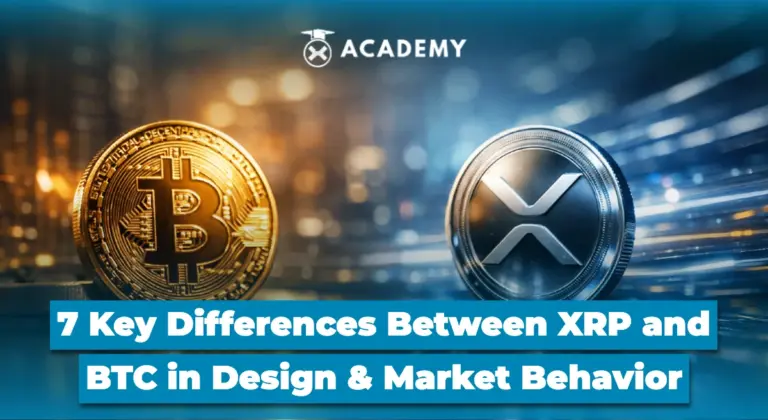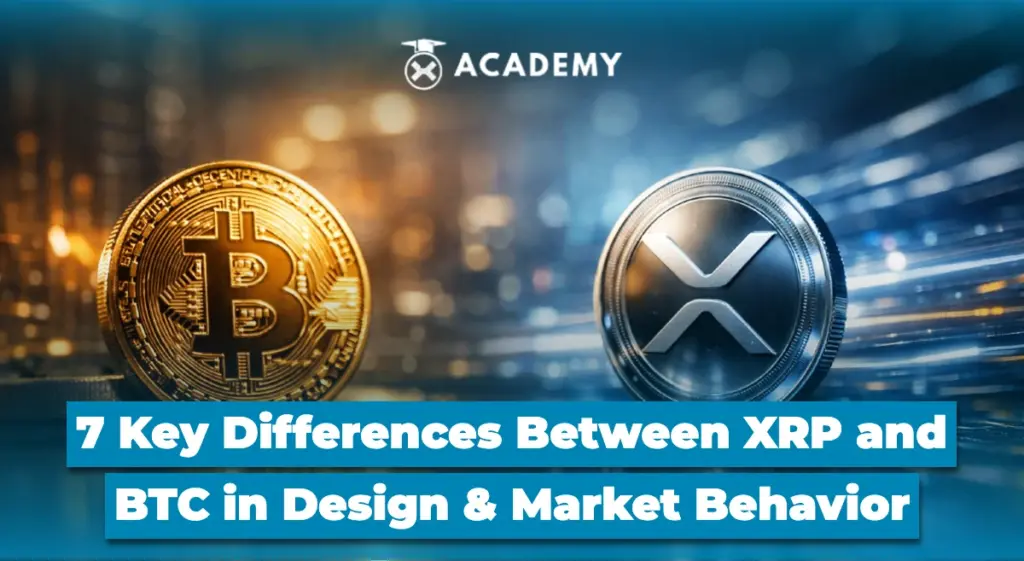
XRP and Bitcoin are often mentioned in the same breath simply because they both exist within the crypto ecosystem. At a glance, that comparison feels natural.
But once you look beneath the surface, treating XRP and Bitcoin as comparable assets can quickly lead to misunderstanding. They were built for different purposes, shaped by different design choices, and behave differently in the market as a result.
7 Differences Xrp Vs BTC
Understanding those differences is not about deciding which one is better. It is about recognizing why they cannot be evaluated using the same framework in the first place, Based on website sources investopedia.com
1. Original Purpose: Preserving Value vs Moving Value
Bitcoin was created as a response to centralized monetary systems. Its core idea was to enable value storage and transfer without relying on intermediaries or centralized authority. Over time, this design naturally positioned Bitcoin less as a day-to-day payment tool and more as a long-term store of value.
XRP followed a very different path. From the beginning, it was designed to improve how value moves across systems, particularly where speed and cost efficiency matter. Rather than replacing existing financial infrastructure, XRP aims to make parts of it work more efficiently.
This divergence in purpose sets the tone for every technical and economic difference that follows.
2. Network Design: Maximum Security vs Operational Efficiency
Bitcoin prioritizes security and decentralization above all else. Its Proof-of-Work mechanism requires significant computational effort, making the network extremely resistant to manipulation. The trade-off is slower transaction times and higher costs during periods of congestion.
XRP Ledger takes an efficiency-first approach. It relies on a consensus mechanism that does not require mining, allowing transactions to settle quickly with minimal energy use. This design dramatically improves speed and cost efficiency, but it also results in a governance structure that differs from Bitcoin’s.
These contrasting design choices reflect different definitions of what “robust” means within a blockchain network.
3. Practical Impact: When Speed and Cost Actually Matter
In real-world use, Bitcoin’s slower settlement times are rarely seen as a flaw by long-term holders. Security, predictability, and resistance to change are often viewed as acceptable trade-offs for a network designed to preserve value.
XRP, on the other hand, is optimized for situations where delays and high fees are unacceptable. Transactions settle in seconds at very low cost, making XRP more suitable for scenarios where speed and efficiency are critical.
Rather than competing directly, Bitcoin and XRP serve different functional roles within the broader crypto landscape.
4. Supply Mechanics: Programmed Scarcity vs Managed Distribution
Bitcoin’s supply is capped, and new coins enter circulation through a predictable halving cycle. Each halving reduces issuance, reinforcing Bitcoin’s scarcity narrative and shaping long-term market expectations.
XRP operates under a different model. The total supply was created at inception, with tokens released into circulation gradually through an escrow mechanism. This creates a controlled and transparent supply flow rather than a deflationary issuance curve.
These differing supply dynamics influence how each asset is perceived, valued, and traded over time.
5. Decentralization and Governance Structure
Bitcoin is widely regarded as one of the most decentralized blockchain networks in existence. No single entity controls its development, and meaningful changes require broad community consensus. This process is slow, but it reinforces trust in the network’s independence.
XRP Ledger follows a more coordinated governance model. While the network is open-source, development and ecosystem direction are more structured. This has led to frequent confusion between XRP as a digital asset, the XRP Ledger as a network, and Ripple as a company.
These governance differences affect how risk, control, and long-term stability are perceived by market participants.
6. Market Behavior: Macro-Driven Asset vs Event-Driven Asset
Bitcoin often reacts to macroeconomic forces such as monetary policy shifts, institutional adoption, and global liquidity conditions. It is increasingly treated as a proxy for the broader crypto market.
XRP tends to move differently. Its price behavior is more sensitive to discrete events, including regulatory developments, legal outcomes, and network-specific news. This can result in sharper short-term movements that do not always align with Bitcoin’s trajectory.
Understanding these behavioral patterns helps explain why the two assets frequently diverge on price charts.
7. How Each Asset Is Commonly Used
Bitcoin is widely held as a long-term asset, with many users prioritizing security and scarcity over transactional efficiency. Its role aligns closely with its original design philosophy.
XRP is often used with a more functional or tactical mindset. Some use it for efficient value transfer, while others engage with it around specific market events tied to network or regulatory developments.
Neither approach is inherently superior. Each reflects the underlying characteristics of the asset itself.
Conclusion
Comparing XRP and Bitcoin purely on price or market capitalization misses the deeper story. These assets were built to solve different problems, and their technical foundations continue to shape how they function and how markets respond to them.
Bitcoin emphasizes durability, independence, and long-term value preservation. XRP prioritizes speed, efficiency, and transactional utility. Recognizing these distinctions allows for clearer analysis and more informed interpretation of market behavior, without forcing two fundamentally different systems into the same mold.
Here’s an overview of interesting insights about Comparing XRP and Bitcoin that you can explore further through Indodax Academy’s collection of crypto articles. Beyond gaining in-depth insights from popular educational crypto content, you can also expand your knowledge through practical tutorials and a wide range of trending articles tailored to your interests.
In addition to staying informed, you can monitor digital asset prices directly on Indodax Market and keep up with the latest developments through up-to-date crypto news. For a more personalized trading experience, you can also explore Indodax’s OTC trading services. Make sure to enable notifications so you don’t miss important updates on blockchain, crypto assets, and other trading opportunities.
You can also follow our latest updates via Google News for faster and more reliable access to information. For a smooth and secure trading experience, download the INDODAX app on the App Store or Google Play Store.
Optimize your crypto assets with INDODAX’s staking feature, a practical way to earn passive income from assets you hold. Register on INDODAX and complete your KYC easily to start trading crypto in a safer, more convenient, and trusted environment.
In practice, asset transparency has been adopted by many crypto platforms, including through the publication of Proof of Reserves (PoR) data by third-party providers such as CoinMarketCap. In Indonesia, Indodax is among the platforms that regularly update this information to ensure it remains publicly accessible.
Official Indodax Contact
Customer Service Number: (021) 5065 8888
Support Email: [email protected]

Follow us on social media: Instagram, X, Youtube & Telegram
FAQ
1. Why does XRP often appear more reactive than Bitcoin?
Because its price is more influenced by specific developments such as regulatory decisions or network-related events, while Bitcoin tends to respond to broader macroeconomic forces.
2. Is it fair to directly compare XRP and Bitcoin?
It can be useful, but only when the comparison focuses on purpose and function rather than price alone.
3. Why do many people hold Bitcoin long term but use XRP operationally?
Bitcoin’s design favors long-term value storage, while XRP’s efficiency makes it better suited for rapid value movement.
4. Do supply mechanics really affect price behavior?
Yes. Bitcoin’s halving-driven scarcity and XRP’s managed distribution create different market expectations and trading dynamics.
5. What is the most common mistake when comparing XRP and BTC?
Assuming they are designed to serve the same role. Without understanding their original objectives, comparisons often lead to misleading conclusions.
Author: AL
 Polkadot 2.25%
 BNB 0.52%
 Solana 4.62%
 Ethereum 2.32%
 Cardano 1.02%
 Polygon Ecosystem Token 1.87%
 Tron 2.75%
 Market