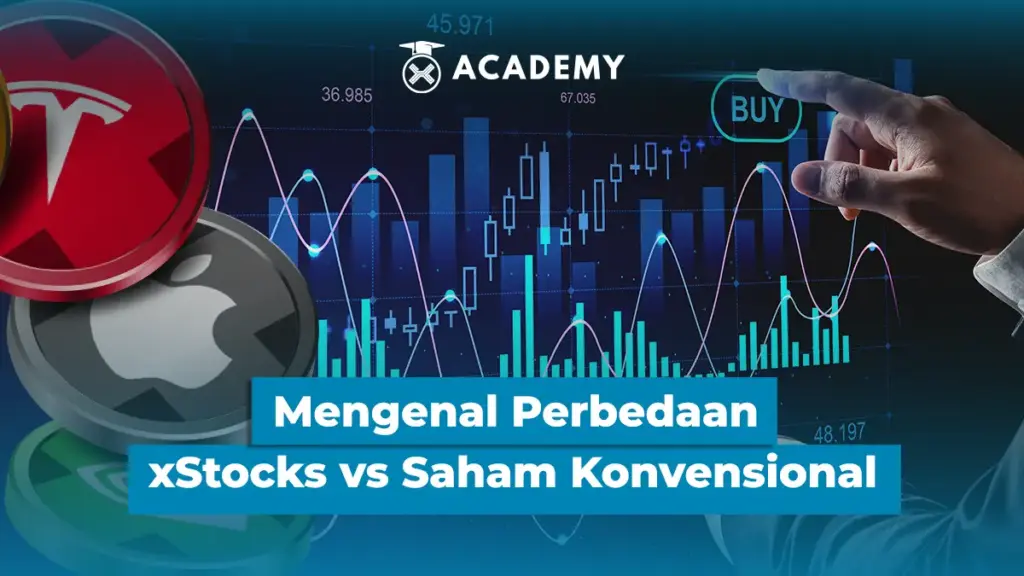
The financial market is changing. While stocks used to be bought and sold only during stock exchange hours, now there are digital versions on the blockchain. These are called xStocks, or tokenized stocks.
Some say this allows broader access to global markets. However, others consider them simply old stocks repackaged in digital form.
So, what exactly is the difference between them and regular stocks, and is this really a major change?
The Difference Between xStocks and Conventional Stocks

Although both offer the opportunity to profit from stock price movements, the way xStocks and conventional stocks operate is not entirely the same. Here are some important differences between xStocks and conventional stocks that are important to understand.
1. Ownership Structure
With conventional stocks, investor ownership is officially recorded through a broker and custodian system recognized by capital market authorities such as the Financial Services Authority. Investors’ names are recorded in a securities sub-account connected to the securities deposit and settlement system in the Indonesian capital market.
Meanwhile, xStocks are tokens representing the value of shares held by a specific issuer or custodian.
Investors hold their tokens in a crypto wallet but are not always directly registered as official shareholders on the stock exchange. Rights such as voting at the AGM or dividends may vary depending on the service provider.
2. Trading Hours
Conventional stocks can only be bought and sold during active stock exchange hours. For example, the IDX or the Indonesia Stock Exchange operates during specific business hours.
In contrast, xStocks run on a blockchain network, allowing them to be traded 24 hours a day, without being tied to stock exchange hours. This provides greater flexibility, especially for investors who want to transact outside of business hours or follow global market movements.
3. Settlement Process
In traditional stocks, transaction settlement follows a T+2 system, meaning it takes two business days for the transaction to be fully administratively completed.
At xStocks, settlement is fast because it is recorded directly on the blockchain when the transaction is confirmed. The process is faster because it doesn’t go through a long administrative chain.
4. Intermediary Infrastructure
Conventional stocks involve several parties such as brokers, clearing houses, and centralized custodians. This system is well-established and supervised by regulators.
xStocks utilizes smart contracts to partially eliminate the role of intermediaries. However, a custodian still holds the actual shares as the underlying asset. So, while more streamlined, it isn’t completely intermediary-free.
5. Access and Purchase Amount
Conventional stocks are generally purchased in lots, with a minimum of 100 shares per transaction. The value can be quite large depending on the price per share.
xStocks typically allow fractional purchases. Investors can purchase a small portion of a single share for a lower nominal amount.
Access is also through a crypto platform that supports tokenization, eliminating the need to open a traditional securities account.
6. Additional Risks
Conventional stocks carry market and company performance risks, such as price fluctuations or the issuer’s business conditions.
xStocks have broader risks. In addition to stock market risks, there are also crypto platform risks, potential vulnerabilities in smart contracts, and dependence on the token issuer’s custodian.
Will xStocks Change the Way You Access Stocks in the Future?
xStocks offers the potential for change in terms of access and efficiency. Trading becomes more flexible and allows for fractional purchases.
Blockchain-based distribution also opens up broader participation opportunities compared to traditional exchange mechanisms.
However, regulatory challenges remain a determining factor. Conventional stock markets operate within a clear legal framework and are subject to strict oversight.
Meanwhile, stock tokenization in many jurisdictions is still developing and lacks fully uniform standards. Without regulatory certainty, adoption is likely to be gradual.
Going forward, the most realistic scenario is the integration of traditional finance (TradFi) and the Web3 ecosystem. Tokenization doesn’t have to replace legacy systems, but can be an additional layer that increases distribution efficiency and access.
In this regard, xStocks has the potential to be a strategic complement rather than a complete alternative to conventional stocks.
Conclusion
So, that was an interesting discussion about the differences between xStocks and conventional stocks, as a revolution or simply a new packaging. You can read more about them in the INDODAX Academy’s Crypto Academy.
In conclusion, the differences between xStocks and conventional stocks essentially reflect two ways of viewing access to the same asset.
One relies on a time-tested exchange system and regulations, while the other leverages blockchain technology to make distribution and transactions faster and more flexible.
For investors, this isn’t just a technical choice; it’s also about structure and consequences.
How ownership is recorded, how rights are assigned, how clear legal protections are, and who controls the underlying assets all create different risk profiles.
In practice, stock tokenization hasn’t replaced the foundations of traditional capital markets. However, it expands options and challenges old boundaries regarding trading hours, minimum denominations, and the role of intermediaries.
Ultimately, it could evolve into a new standard or remain a niche alternative. The direction of regulation and the level of market confidence in the next few years will be crucial in determining its position.
In addition to gaining in-depth insights through various popular crypto education articles, you can also broaden your horizons through a collection of tutorials and choose from a variety of popular articles that suit your interests.
Besides updating your knowledge, you can also directly monitor digital asset prices on Indodax Market and stay up-to-date with the latest crypto news. For a more personalized trading experience, explore Indodax’s OTC trading service. Don’t forget to activate notifications so you don’t miss out on important information about blockchain, crypto assets, and other trading opportunities.
You can also follow our latest news via Google News for faster and more reliable access to information. For an easy and secure trading experience, download the best crypto app from INDODAX on the App Store or Google Play Store.
Maximize your crypto assets with the INDODAX Earn feature, a practical way to earn passive income from your stored assets. Register now with INDODAX and easily complete KYC to start trading crypto more safely, conveniently, and reliably!
Indodax Official Contact
Customer Service Number: (021) 5065 8888 | Support Email: [email protected]
Also follow us on social media here: Instagram, X, Youtube & Telegram
FAQ
- Is xStocks the same as buying shares directly on the stock exchange?
Not entirely. When buying shares directly on the stock exchange, the investor’s name is officially registered in the capital market custodian system through a broker.With xStocks, what you own are tokens that represent claims on shares held by a specific custodian or issuer. This means that ownership is representative, not a direct registration in the investor’s name on the stock exchange. - Do xStocks have underlying assets?
Generally, yes. Many xStocks are designed with a 1:1 scheme, depending on the model, meaning each token is backed by a single share actually held by the issuer or custodian.However, it’s important to understand the custodian’s mechanism and transparency, as this structure relies on trust in the parties holding the underlying shares. - Are xStocks riskier than regular stocks?
In addition to market risks such as price fluctuations and company performance, xStocks carry additional layers of risk. These risks include the security of the crypto platform, potential smart contract vulnerabilities, and operational or compliance risks of the token issuer. Therefore, the risk spectrum is broader than that of conventional stocks. - Can xStocks be traded at any time?
Technically, yes. Because they run on a blockchain network, xStocks are not tied to the operating hours of traditional exchanges and can be traded almost 24 hours a dayHowever, liquidity and transaction volume still depend on market activity on the platform where the token is traded. - Are xStocks regulated like conventional stocks?
Not always. Conventional stocks fall under a clear capital market regulatory framework and are supervised by official authorities. Meanwhile, xStocks’ regulation depends on the jurisdiction where the issuer and platform operate.In some countries, regulations are still developing and not yet fully standardized like traditional exchange systems.

Author: Boy
 Polkadot 2.25%
 BNB 0.52%
 Solana 4.62%
 Ethereum 2.32%
 Cardano 1.02%
 Polygon Ecosystem Token 1.87%
 Tron 2.75%
 Market