
Many novice traders use Fibonacci to identify support and resistance levels, as well as entry and exit opportunities. However, the biggest problem is usually not the Fibonacci tool, but rather how to draw the lines.
It’s important to understand that incorrectly determining the start and end points can result in a significantly different analysis of market conditions.
In this article, we’ll discuss how to draw Fibonacci lines correctly, how to read important levels, and the most common mistakes made by crypto traders.
Why is Fibonacci Popular Among Crypto Traders?
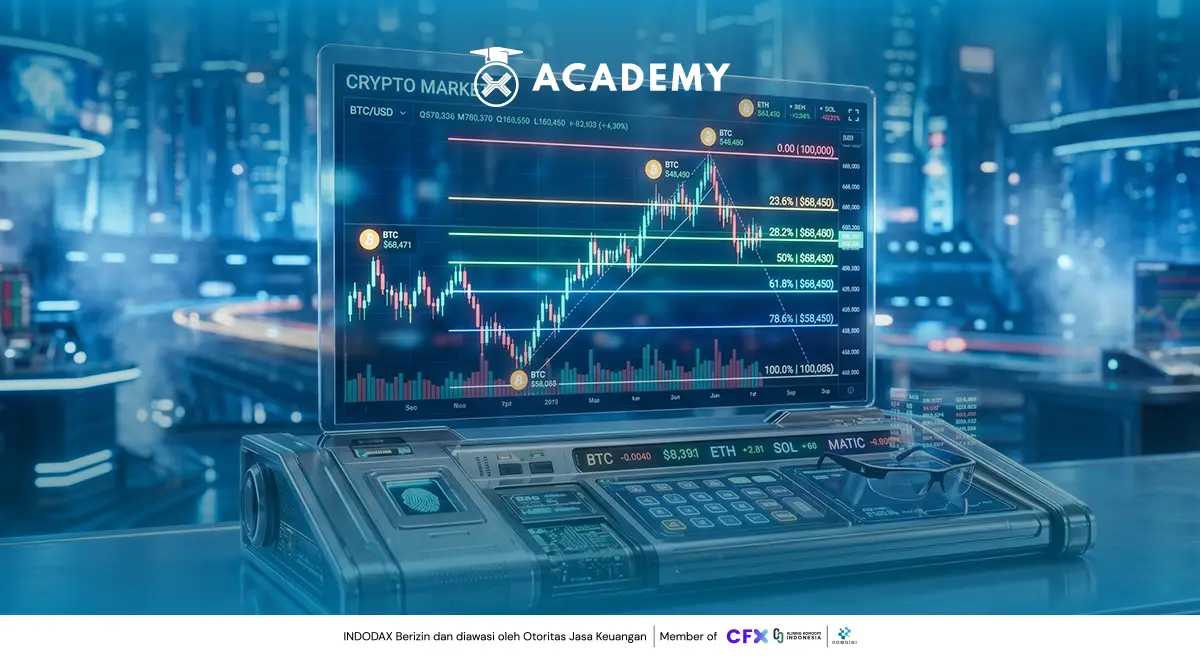
Fibonacci is widely used in crypto trading because it helps identify potential key areas after a strong price movement. Here are some reasons why Fibonacci is popular among crypto traders.
Helps Find Support and Resistance Areas
Fibonacci is often used to identify potential support and resistance areas, namely price levels that could potentially become points of price rebound or rejection.
These areas are often of interest to traders when looking for market entry and exit opportunities.
Helps Determine Entry and Exit Points
Many traders use Fibonacci levels to identify potential entry points when prices correct and to determine exit points when the target price movement begins to be reached.
Suitable for Use in Trending Markets
Fibonacci tends to be more effective when the market is in a clear trend, either up or down, because it can help gauge correction areas before the trend continues.
Understanding the Most Commonly Used Fibonacci Levels
In Fibonacci Retracement, there are several levels that traders most often use to gauge potential price corrections and identify support and resistance areas, as follows.
23.6% Level
The 23.6% level usually indicates a shallow correction. If the price only falls or rises to this area before resuming the trend, this is often considered a sign that the trend is still quite strong.
38.2% Level
The 38.2% level often represents a mild pullback area that occurs within a healthy trend. Many traders watch this level to see if the price is able to resume its previous trend direction.
50% Level
Although not a pure Fibonacci ratio, the 50% level is very popular in technical analysis. This level is considered the midpoint of a correction and is often used by traders to gauge the balance between buying and selling pressure.
61.8% Level
The 61.8% level is known as the Golden Ratio. This area is one of the most closely watched levels because it is often considered an important correction zone before the price returns to follow the main trend.
78.6% Level
The 78.6% level indicates a deeper correction. If the price reaches this area, traders will usually observe whether the trend still has the potential to continue or is starting to lose strength.
How to Draw Fibonacci Lines Correctly
The correct way to draw Fibonacci lines starts with identifying the trend direction and important price movement points. Here are the steps.
Step 1: Identify the Trend Direction First
Illustration of identifying trend direction. [Image source: astronacci.com]
Before drawing Fibonacci lines, determine whether the market is in an uptrend or a downtrend. The trend direction will determine the starting and ending points of the Fibonacci lines.
Step 2: Determine the Swing High and Swing Low
A swing high is the highest point the price reaches before it falls, while a swing low is the lowest point before it rises again.
For example, if the price rises from Rp100,000,000 to Rp120,000,000, then Rp100,000,000 is the swing low and Rp120 million is the swing high.
Step 3: Drawing Fibonacci during an Uptrend
In an uptrend, Fibonacci lines are drawn from the swing low to the swing high. The goal is to identify correction areas where the price could potentially continue rising.
Step 4: Drawing Fibonacci during a Downtrend
In a downtrend, Fibonacci is drawn from the swing high to the swing low. This method helps identify rebound areas before the price resumes its decline.
Step 5: Observe Price Reactions at Fibonacci Levels
Illustration of price reactions at Fibonacci levels. [Image source: astronacci.com]
After drawing Fibonacci, traders typically observe price reactions at key levels such as 38.2%, 50%, or 61.8% before making entry or exit decisions.
Example of Using Fibonacci in Crypto Trading
For example, if Bitcoin rises from US$90,000 to US$100,000, then Fibonacci is drawn from the lowest point to the highest. The 38.2%, 50%, and 61.8% levels can then be used to identify potential correction areas.
Another example is Ethereum, which rose from US$2,000 to US$2,500. Traders can also use Fibonacci levels to identify potential price rebound areas before the trend continues.
The same principle applies to altcoins. After a strong price movement, Fibonacci helps identify correction areas that could potentially become entry opportunities.
How to Read Fibonacci Levels after Lines Are Drawn
After Fibonacci levels are drawn, the main focus is to observe the price reaction at the levels that appear. Here’s a guide on how to read Fibonacci levels after lines are drawn.
Potential Price Rebound Areas
In an uptrend, Fibonacci levels can serve as potential support areas, zones that could trigger a price rebound after a correction.
Potential Price Rejection Areas
In a downtrend, Fibonacci levels often serve as potential resistance areas, zones that could halt price increases and trigger further declines.
Confirmation Before Entry
Before entering, it’s best to wait for additional confirmation from price movements or candlestick patterns so that trading decisions don’t rely solely on Fibonacci levels.
Common Mistakes Made When Drawing Fibonacci
Misuse of Fibonacci can make analysis results less accurate, even if the tools are used correctly. Here are some common mistakes made when drawing Fibonacci.
Drawing Fibonacci in a Sideways Market
Fibonacci tends to be less effective when the market is moving sideways because there is no clear trend to measure.
Incorrectly Determining Swing Highs and Swing Lows
The most common mistake of beginner traders is choosing swing highs and swing lows incorrectly, which makes Fibonacci levels irrelevant.
Using Too Many Fibonacci Levels
Too many levels can make the chart appear cluttered and confusing, making it more difficult to find truly important areas.
Assuming Fibonacci is Always Accurate
Fibonacci is only an analytical tool for finding potential support and resistance areas, not a price prediction tool that is always accurate.
Indicators That Are Suitable to Combine with Fibonacci
Professional traders generally do not use Fibonacci as the sole basis for analysis. To increase accuracy, Fibonacci is often combined with other indicators or analysis tools, including the following.
Support and Resistance
The most common combination is matching Fibonacci levels with support and resistance areas. If both are in the same zone, that area is usually considered stronger.
RSI
The RSI (Relative Strength Index) is often used to confirm momentum. When this indicator indicates overbought or oversold conditions at important Fibonacci areas, traders usually get additional confirmation before making a decision.
For example, when the price is at an important Fibonacci level and the RSI indicates overbought or oversold conditions, the resulting signal can be more convincing.
1. Volume
Volume helps validate the price reaction at Fibonacci levels. A bounce accompanied by increased volume is usually considered stronger than a bounce with low volume.
2. Trendline
Trendlines can strengthen Fibonacci signals when they meet in the same area. This combination is often used to increase confidence in the support or resistance area being observed.
Traders often pay attention to this condition because it indicates the presence of several technical factors supporting that level.
When Shouldn’t Fibonacci Be Used?
Fibonacci is less effective when market conditions lack a clear direction or are overly influenced by external factors.
In extreme sideways markets, prices move flat without a clear trend, so Fibonacci levels often don’t provide consistent signals.
When volatility is high due to news, price movements can become erratic and easily break through Fibonacci levels without a clear reaction.
If the market structure is unclear, such as when there are no valid swing highs and swing lows, Fibonacci is difficult to use because reference points are not well-formed.
Why Do Crypto Traders Need to Understand Fibonacci?
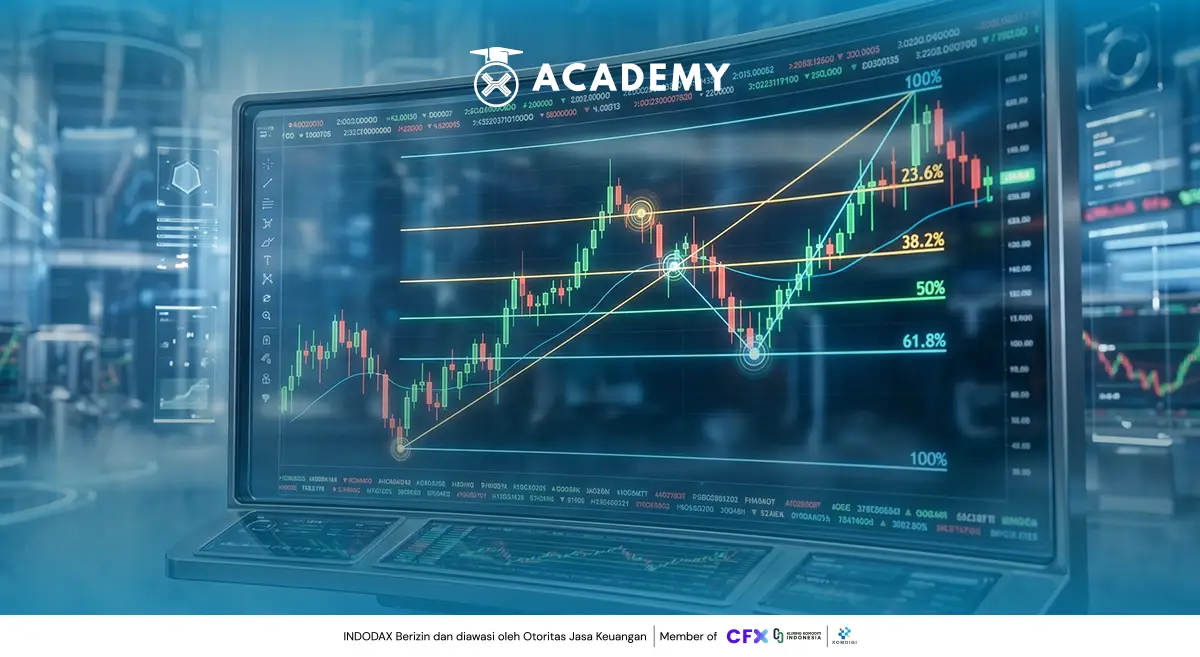
Fibonacci helps traders read market structure, not just look for buy or sell signals, because its levels indicate areas of correction and potential trend continuation.
Essentially, the ability to understand corrections and the direction of continued trends is a crucial skill in technical analysis so that price movements are not read in isolation.
Fibonacci is also related to risk management, so trading decisions still require additional confirmation before entry to avoid relying solely on a single tool.
Conclusion
So, that was an interesting discussion on how to draw Fibonacci lines correctly for crypto trading, which you can read more about in the Crypto Academy at INDODAX Academy.
In conclusion, Fibonacci Retracements essentially work as a tool to help read the structure of price movements, especially in identifying correction areas that have the potential to become support or resistance.
In practice, this tool functions more as an “area map” than as a definitive indicator of price direction.
Differences in analysis results often arise not from the Fibonacci itself, but from inconsistent drawing methods, especially when determining swing highs and swing lows.
Furthermore, its use becomes much more relevant when combined with other confirmations such as momentum, volume, or the current trend structure.
Amidst the rapidly changing dynamics of the crypto market, Fibonacci is more appropriately positioned as a decision-making tool, not the sole basis for entry or exit.
This approach helps traders view the market from a more measured perspective before making decisions.
That’s interesting information about xxxx that you can explore in more depth in the popular article on the INDODAX Crypto Academy. In addition to broadening your investment horizons, you can also stay updated with the latest crypto news and monitor digital asset price movements directly on the INDODAX Market.
For a more personalized trading experience, explore our OTC trading service on INDODAX. Don’t forget to activate notifications to stay up-to-date with the latest information about digital assets, blockchain technology, and various other trading opportunities only on INDODAX Academy.
For an easy and secure trading experience, download INDODAX’s best crypto app on the App Store or Google Play Store.
Maximize your crypto assets with the INDODAX Staking/Earn feature, a practical way to earn passive income from your savings. Register now with INDODAX and easily complete KYC to start trading crypto more safely, conveniently, and reliably!
In practice, asset transparency is now being adopted by a number of crypto platforms, one of which is through the publication of Proof of Reserves (PoR) data from third parties like CoinMarketCap. In Indonesia, Indodax is one of the platforms that regularly updates this information for public access.
Official Indodax CS Contact
Official Customer Support Number: (021) 5065 8888
Help email: [email protected]
Also follow INDODAX on social media here: Instagram, X, YouTube & Telegram

FAQ
- How do you draw Fibonacci lines during an uptrend?
During an uptrend, Fibonacci lines are drawn from swing lows to swing highs. The goal is to gauge potential correction areas before the uptrend resumes. - How do you draw Fibonacci lines during a downtrend?
During a downtrend, Fibonacci lines are drawn from swing highs to swing lows to identify resistance areas and potential continuation of the downtrend. - Which Fibonacci levels do traders use most often?
The most commonly watched levels are 38.2%, 50%, and 61.8% because they often serve as price reaction areas within a trend. - Is Fibonacci suitable for crypto trading?
Yes. Fibonacci is widely used in crypto trading because it can help identify support, resistance, and potential pullback areas in trending assets. - Can Fibonacci be used on all timeframes?
Yes. However, many traders consider Fibonacci levels on higher timeframes to be more visible because they are formed from larger price movements.
Author: Boy
 Polkadot 2.25%
 BNB 0.52%
 Solana 4.62%
 Ethereum 2.32%
 Cardano 1.02%
 Polygon Ecosystem Token 1.87%
 Tron 2.75%
 Market