Early Blockchain often faced dissatisfaction when used for real-time needs because their capabilities often felt limited.
For example, online games, virtual worlds, and digital entertainment require rapid response and synchronous data movement. This is where legacy blockchains began to feel unsatisfactory.
This need led to the birth of the Somnia Network. This network is designed to be faster, more synchronous, and ready for large-scale use.
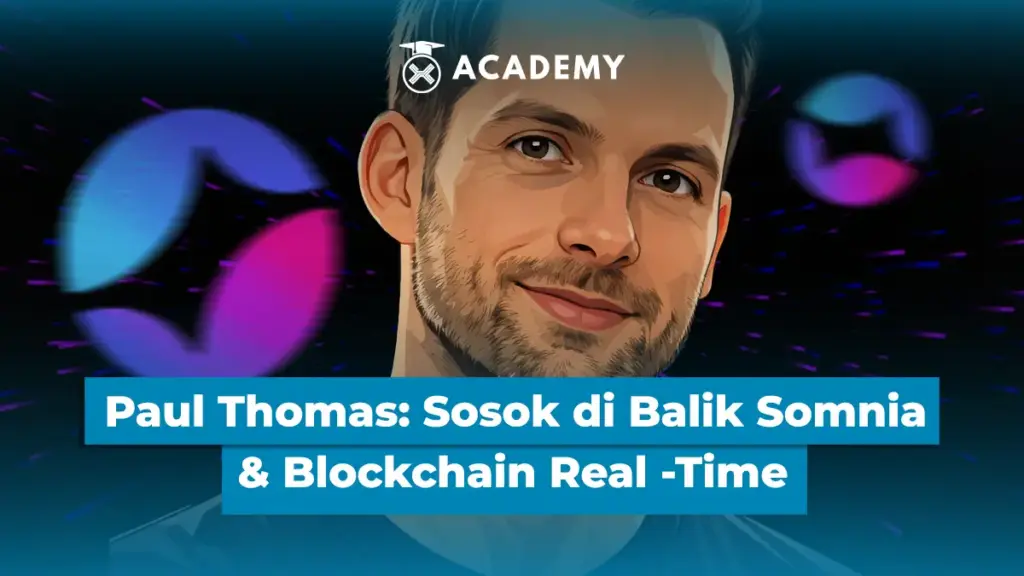
Behind its development is Paul Thomas, a technologist who wants blockchain to be more than just a behind-the-scenes system. His goal is simple: blockchain can be directly used by millions of people simultaneously.
Who is Paul Thomas?
Paul Thomas is a technologist and software engineer. He has experience building complex and stable digital systems.
Before founding Somnia Network, Paul spent over ten years working at Improbable and Goldman Sachs.
There, he was involved in the development of distributed systems and gaming technology. These systems must run in real time and serve many users simultaneously.
Paul’s focus is on developing large-scale systems. He emphasizes speed, synchronization, and readiness for real-world use.
As Founder and CEO of Somnia Network, Paul brings this approach to blockchain. He is pushing Somnia to become a fast and synchronous network. The goal is to enable the blockchain to be used by millions of users simultaneously.
Blockchain Challenges for Real-Time Applications
Conventional blockchains have a limit on the number of transactions that can be processed. Each activity must wait for its turn and confirmation. As a result, response times are slow, and latency is difficult to reduce.
As the number of users increases, another problem arises. Data must remain consistent across the network. This synchronization process takes time, especially when many activities occur simultaneously.
This situation makes it difficult for games, digital entertainment, and virtual worlds to run smoothly. Real-time applications themselves require rapid and continuous updates. Legacy blockchains are not designed for this type of usage.
In contrast, financial applications have different needs. Transaction security and certainty are more important than speed. Therefore, a slight delay is acceptable. This is why legacy blockchains are better suited for finance than real-time applications.
What is the Somnia Network?
The Somnia Network is a blockchain built for real-time applications. This network is designed to remain fast when many users are active simultaneously. Responses are kept short and data movement remains synchronous.
Somnia is not focused on DeFi. Its focus is more on online games, digital entertainment, and virtual worlds. Applications like these require continuous updates and cannot wait long.
Therefore, Somnia seeks to address these needs. This blockchain is prepared to handle real-time interactions on a large scale.
For more technical details and a discussion of its ecosystem, you can read the article “Somnia (SOMI): Layer-1 Gaming Token Arrives on Indodax.”
Somnia’s Real-Time Blockchain Concept
A real-time blockchain is a network capable of responding to activity very quickly. Every action is processed in a shorter time, and the results are immediately visible to users.
In Somnia, data remains constant across users. When one user interacts, the changes are immediately visible to other users. This synchronization is crucial to keeping everyone in sync.
Somnia also processes multiple events or actions occurring in the application simultaneously, processing them in parallel through specific mechanisms. This keeps the network running smoothly even when used by many people.
A real-time approach is crucial for mass adoption of Web3. This is because general users are accustomed to responsive applications. If the blockchain feels slow, the experience suffers and widespread adoption becomes difficult.
Paul Thomas’ Role in Somnia’s Vision
Paul Thomas views blockchain as a technological foundation, not simply a token issuance tool. Therefore, Somnia’s design (SOMI to IDR) is geared toward real-world use. The focus is on speed, stability, and scale.
For Paul, tokens are simply part of the system. What’s more important is a well-functioning infrastructure. Blockchains should feel useful, not complicated, for users.
He also focuses on the user and developer experience. Users need fast and convenient applications. Developers, on the other hand, need a simple environment to build without too many obstacles.
Going forward, Paul is promoting Somnia as a Web3 foundation for real-time applications. The goal is to enable blockchain to be widely used, not just for experiments, but for everyday needs.
Somnia’s Position in the Web3 Ecosystem
In the Web3 ecosystem, Somnia is a Layer-1 blockchain with a specific focus. This network is designed for real-time applications, not for all blockchain needs. It is positioned more as a network with a clear purpose.
Somnia has close relationships with game and interactive application developers. Its architecture is prepared to handle fast and synchronous interactions, making it well-suited for active digital experiences.
Somnia’s approach differs from DeFi-centric or DeFi-focused blockchains. DeFi blockchains prioritize financial transactions and asset security. Somnia, on the other hand, prioritizes speed, responsiveness, and user experience.
Although synonymous with digital entertainment, Somnia’s potential extends beyond that. Its real-time technology is also relevant for social applications, simulations, and digital collaboration. This opens up opportunities for applications beyond the entertainment sector.
What Can Be Learned from Paul Thomas’ Approach
Paul Thomas’s approach demonstrates that blockchain can’t be used for everything in the same way. This is because each use case has different needs.
Regarding this, games and interactive applications require speed, not just transaction security.
He also emphasized the importance of robust infrastructure. Without a ready-to-use foundation, Web3 will struggle to achieve widespread adoption. Complicated technology will only limit users.
Speed ??and real-time capabilities are key to Web3’s widespread adoption. General users are accustomed to fast and responsive applications. If blockchain feels slow, they won’t stick around.
Ultimately, blockchain is just a tool. The goal isn’t the technology, but the user experience. That approach is at the heart of Paul Thomas’s vision.
Conclusion
So, that was an interesting discussion about Paul Thomas, the man behind Somnia and real-time blockchain, which you can read more about in the INDODAX Academy’s Crypto Academy.
In conclusion, Paul Thomas’s journey demonstrates that blockchain development isn’t always about adding features, but about adapting technology to how people actually use it.
Through Somnia, he doesn’t try to improve legacy blockchains piecemeal, but instead starts with a more fundamental question: whether blockchain can keep up with the fast-paced pace of digital interaction.
Somnia serves as an example of Web3 beginning to move beyond purely financial boundaries. The focus is no longer simply on transactions and asset security, but rather on responsive, synchronous, and natural-feeling user experiences.
This approach marks a significant shift, positioning blockchain not only as financial infrastructure but also as the foundation for everyday digital interactions.
From this, an important lesson emerges: understanding a blockchain network isn’t simply about its tokens or technological claims. What’s more relevant is understanding the problems it aims to solve and the context in which it’s actually used.
In this regard, Paul Thomas and Somnia demonstrate that the future of Web3 is largely determined by its ability to adapt to real-time needs, not just by its cryptographic strength.
In addition to gaining in-depth insights through popular crypto education articles, you can also broaden your horizons through a collection of tutorials and choose from a variety of popular articles that align with your interests.
Besides updating your knowledge, you can also directly monitor digital asset prices on Indodax Market and stay up-to-date with the latest crypto news. For a more personalized trading experience, explore Indodax’s OTC trading service. Don’t forget to activate notifications so you don’t miss out on important information about blockchain, crypto assets, and other trading opportunities.
You can also follow our latest news via Google News for faster and more reliable access to information. For an easy and secure trading experience, download the best crypto app from INDODAX on the App Store or Google Play Store.
Maximize your crypto assets with the INDODAX Earn feature, a practical way to earn passive income from your stored assets. Register now with INDODAX and easily complete KYC to start trading crypto more safely, conveniently, and reliably!
Indodax Official Contact
Customer Service Number: (021) 5065 8888 | Support Email: [email protected]
Also follow us on social media here: Instagram, X, Youtube & Telegram
FAQ
- Who is Paul Thomas and what is his role at Somnia?
Paul Thomas isn’t just a figure emerging from the crypto world. His background in distributed systems and gaming technology shaped his view that blockchains should be able to perform under the pressure of high usage and simultaneous interactions, not just on paper. - What sets Somnia apart from other blockchains?
Somnia isn’t trying to be a do-it-all network. Its focus is clearly on real-time applications that require fast responses and constant data synchronization, something that is often a weakness of conventional blockchains. - Why is a real-time approach important for Web3?
Most internet users are already accustomed to applications that react instantly. If Web3 is to be widely adopted, its infrastructure must meet these expectations, rather than forcing users to adapt to technical limitations. - Is Somnia only relevant for gaming?
While strong in the gaming and digital entertainment sectors, Somnia’s real-time approach is also relevant for social applications, collaboration, and digital simulations that require fast synchronization between users. - What is the key lesson from Paul Thomas’ vision?
Technology should follow the needs of users, not the other way around. Blockchain will be more easily adopted when it works seamlessly behind the scenes and provides a straightforward experience that feels simple to users.

Author: Boy
 Polkadot 2.25%
 BNB 0.52%
 Solana 4.62%
 Ethereum 2.32%
 Cardano 1.02%
 Polygon Ecosystem Token 1.87%
 Tron 2.75%
 Market