The development of Artificial Intelligence (AI) is no longer limited to systems that wait for human commands. Now, AI agents are emerging that can act autonomously, communicate with each other, conduct transactions, and collaborate without direct intervention.
This change has given rise to a new need for payment and coordination systems that don’t rely on a single central entity. Therefore, blockchain is seen as the right foundation, and Kite exists to fill this need.
What is Kite (KITE)?

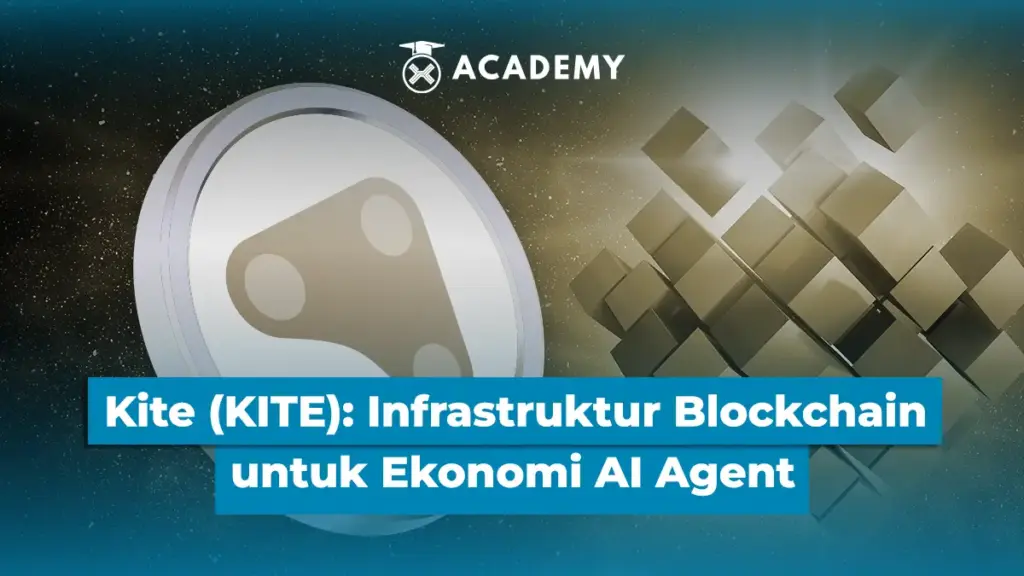
Kite is a blockchain project created to support the AI ??agent economy. This system is designed to allow AI to interact, collaborate, and conduct transactions autonomously without relying on a centralized entity.
Its primary goal is to provide a technical foundation for activities between AI agents to proceed according to clear and automated rules.
Within this ecosystem, KITE serves as a utility token used for transactions and incentives. This token serves as a means of connecting value when AI agents exchange services, data, or resources within the Kite network.
Kite itself focuses on providing transaction mechanisms, coordination, and incentive systems between AI agents.
It’s important to distinguish that Kite is the infrastructure, while KITE is simply a token that is part of the system, driving its economic activity.
What is an AI Agent Economy?
An AI agent economy is a concept in which AI acts as a digital actor capable of working independently. Autonomous AI agents are capable of making decisions and carrying out tasks based on predetermined goals and rules.
In this system, AI agents can execute tasks, exchange data with each other, and even provide digital services automatically.
For all these activities to run smoothly, a native payment system is needed that allows AI agents to give and receive value directly without manual processes or intermediaries.
Payment Challenges and AI Agent Coordination
One of the main challenges in AI agent coordination lies in the centralized payment system. AI must rely on a single service provider, making transaction flows less independent and easily disrupted if the central system fails.
Another problem arises when AI needs to perform microtransactions across systems. Frequent, small transactions become inefficient due to the complex process and disproportionate costs.
Furthermore, there is no clear standard for AI agent identity and transactions. Each system uses a different approach, making coordination between AI agents more difficult and often hindering integration.
Traditional payment systems also have limitations in speed and transparency. Transaction processes tend to be slow and difficult to monitor directly.
How Blockchain Is Used in the AI ??Economy
In the AI ??economy, blockchain functions as a digital ledger that automatically records transactions. Every economic interaction conducted by AI, such as payment for services or data exchange, is directly recorded in the system’s records.
This ledger operates without manual recording and is designed to prevent data from being easily tampered with.
Smart contracts are used to execute transactions without intermediaries. The rules and conditions of a transaction are embedded in the code. When the conditions are met, execution occurs automatically.
With this mechanism, AI can conduct economic activities independently and consistently.
Transparency and auditability are essential for blockchain use. All recorded AI activities can be viewed and traced back.
Transaction history helps ensure that AI economic decisions are auditable and accountable.
System trust is built through a decentralized network. Transaction validation does not rely on a single party. Multiple nodes participate in verifying incoming data. This approach makes the AI ??economy
more secure, stable, and trustworthy.
The Role of Kite (KITE) in the AI ??Agent Ecosystem
In the AI ??agent ecosystem, KITE serves as a means of payment so AIs can interact with each other autonomously.
AI agents use KITE to pay for services, exchange data, and perform tasks without human intervention. This ensures that transactions between AIs are more orderly.
KITE also serves as an access token to services and resources within the ecosystem. Some features can only be used with KITE, allowing data and computational usage to be regulated according to system capacity.
To maintain network security, KITE is used in a staking system by locking tokens to maintain system security. This approach also helps maintain network stability and encourages all parties to participate responsibly.
Furthermore, KITE forms the basis of a participation-based incentive system. Parties who contribute to the ecosystem are rewarded according to their role, ensuring the ecosystem remains active and continues to grow.
The ERC-20 Standard and Why Kite Uses It
The ERC-20 standard is the foundational set of rules that govern how tokens operate on the Ethereum network. These rules allow tokens to be sent, received, and used in the same way across various Web3 applications.
Kite used ERC-20 in its early stages because it was a stable and widely used standard. With the support of a mature infrastructure, token development could proceed more quickly without complex technical hurdles.
The main advantage of ERC-20 is its compatibility. Tokens can be used directly in many wallets and connected to various existing Web3 tools. This simplifies usage without the need for additional customization.
In future development, ERC-20 serves as the initial foundation for a broader ecosystem. This standard provides room for Kite to grow and integrate with other systems in the Web3 world.
Kite as Infrastructure, Not Just a Token
Kite is not positioned as a token driven solely by speculation, but as a utility token. Speculative tokens typically generate buzz due to short-term stories and trends, but do not always have a clear role in the real system.
Kite functions as part of the infrastructure. This token forms the system layer that supports the AI ??economy, such as payments, service access, and coordination between AI agents. Without this role, the system cannot function properly.
Therefore, actual use cases are far more important than token popularity. What is assessed is not how often a token is discussed, but how significant its role is in the system’s daily activities.
This approach encourages viewing projects from a functional perspective. Projects are judged by what they actually do and what the ecosystem needs, not by the narrative or hype they create.
What Can Be Learned from the Kite Model

The Kite model demonstrates the increasingly clear direction of AI and blockchain integration. Blockchain serves as the foundation for AI to connect and interact autonomously.
This model also demonstrates that blockchain’s role extends beyond traditional finance. This technology can be used to manage identity, transactions, and coordinate AI systems.
Kite illustrates the potential of an agent-based economy. AI agents not only execute commands but also take an active role in the digital economy.
This highlights the importance of technological literacy before adoption. A sound understanding helps ensure the proper and responsible use of AI and blockchain.
Conclusion
So, that was an interesting discussion about Kite (KITE) as blockchain infrastructure for the AI ??agent economy. You can read more about it in the INDODAX Academy’s Crypto Academy.
In conclusion, looking at Kite (KITE) from a practical perspective, this project is more than just a digital token or blockchain trend.
Kite demonstrates how blockchain infrastructure can become the backbone of the AI ??agent economy, enabling autonomous agents to work, interact, and transact autonomously.
KITE is not just a speculative asset, but a crucial part of the payment, coordination, and incentive mechanisms that enable AI systems to function consistently and securely.
What we can learn from Kite is the importance of judging technology by its functionality: how a system supports real-world activities, not how much it’s talked about.
By understanding the role of blockchain and tokens in the AI ??ecosystem, we can envision a future where AI doesn’t just execute commands, but becomes an active and accountable player in the digital economy.
This approach emphasizes that technological literacy and practical understanding are key to adoption, so innovation can provide real benefits, not just hype.
In addition to gaining in-depth insights through various popular crypto education articles, you can also broaden your horizons through a collection of tutorials and choose from a variety of popular articles that suit your interests.
Besides updating your knowledge, you can also directly monitor digital asset prices on Indodax Market and stay up-to-date with the latest crypto news. For a more personalized trading experience, explore Indodax’s OTC trading service. Don’t forget to activate notifications so you don’t miss out on important information about blockchain, crypto assets, and other trading opportunities.
You can also follow our latest news via Google News for faster and more reliable access to information. For an easy and secure trading experience, download the best crypto app from INDODAX on the App Store or Google Play Store.
Maximize your crypto assets with the INDODAX Earn feature, a practical way to earn passive income from your stored assets. Register now with INDODAX and easily complete KYC to start trading crypto more safely, conveniently, and reliably!
Indodax Official Contact
Customer Service Number: (021) 5065 8888 | Support Email: [email protected]
Also follow us on social media here: Instagram, X, Youtube & Telegram
FAQ
- What is Kite (KITE) and why is it important?
Kite is a blockchain infrastructure that enables AI agents to operate and transact autonomously. It is important because it provides the foundation for an AI-driven digital economy without relying on a central party. - How is KITE used in the AI ??ecosystem?
KITE serves as a utility token for service payments, data exchange, staking for network security, and an incentive system for ecosystem participants. This enables AI agents to operate automatically and consistently. - Is Kite more focused on AI or blockchain?
Kite sits at the intersection of both. Blockchain is an infrastructure that enables autonomous AI agents to transact, coordinate, and exchange services without human intervention. - Why do AI agents need blockchain?
Blockchain ensures fast, transparent, and auditable transactions. With smart contracts, AI can carry out economic activities on its own without relying on centralized systems or third parties. - Is Kite created for investment purposes?
No. Kite focuses on the technology’s functionality and use cases. The value of KITE is measured by its contribution to the AI ??agent economy, not its speculative potential.

Author: Boy
 Polkadot 2.25%
 BNB 0.52%
 Solana 4.62%
 Ethereum 2.32%
 Cardano 1.02%
 Polygon Ecosystem Token 1.87%
 Tron 2.75%
 Market