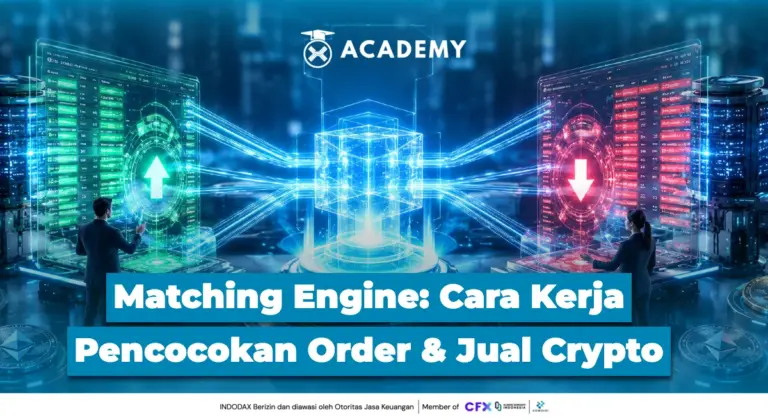
Every time the Buy or Sell button is pressed on a crypto exchange, the transaction does not occur randomly. Behind that process, there is a system called a Matching Engine that is responsible for receiving orders, comparing them with other orders in the Order Book, and executing the transactions automatically.
Without a matching engine, an order book-based exchange would not be able to pair buy and sell orders automatically. Through this article, we will discuss how a matching engine works, its relationship with the order book, and its role as a crucial component in crypto asset trading.
What is a Matching Engine?
A Matching Engine is the core software of an exchange tasked with matching buy and sell orders based on specific rules. This system is used so that the trading process can take place quickly, accurately, and automatically by bringing buyers and sellers together at the right price.
To understand its role further, let’s explore how the matching engine processes every transaction in the next section of this article.
Why is the Matching Engine an Important Component in Crypto Exchanges?
Crypto exchanges require a matching engine so that the buying and selling process can occur automatically without manual matching. This system can process numerous orders in milliseconds, making trading much more efficient and transaction execution significantly faster.
Besides increasing speed, the matching engine also helps maintain transparency and fairness because every order is processed based on the exact same rules.
How Does a Matching Engine Work?
The matching engine works by automatically processing each order until a transaction is successfully executed. Generally, the process unfolds as follows:
-
The Trader Sends an Order
The process begins when a trader submits a buy order or a sell order to the exchange.
-
The Order Enters the Order Book
Any order that does not immediately find a matching transaction is recorded in the Central Limit Order Book (CLOB), which is a list of all buy and sell orders waiting to be processed based on price.
-
The Matching Engine Compares Prices
The matching engine continuously scans the order book to find suitable prices. A transaction can be processed when the buying price is equal to or higher than the selling price.
-
The Transaction is Executed
Once a matching pair of orders is found, the transaction is executed automatically. If the order amount is not entirely fulfilled, the remaining order will stay in the order book until a suitable order arrives.
As an illustration: Trader A sends a buy order which then enters the order book. Next, the matching engine looks for a sell order from Trader B with a matching price. Once a suitable pair is found, the transaction is executed automatically. This process runs based on specific algorithms that determine the matching sequence of each order.
How Does the Matching Engine Determine Which Orders to Execute First?
After finding orders that can be paired, the matching engine uses specific rules to determine which order gets executed first:
-
Price Priority
The matching engine will prioritize orders with the best prices. On the buy side, higher prices are prioritized, while on the sell side, lower prices take priority.
-
Time Priority (FIFO)
If there are multiple orders with the exact same price, the system will process the order that came in first. This principle is known as First In, First Out (FIFO).
-
Other Algorithms Used by Exchanges
Besides Price Priority and FIFO, some exchanges use other algorithms, such as Pro-Rata (which divides execution based on order size) and Hybrid Matching (which combines several priority methods). Each exchange can implement different algorithms according to its system design and trading policies.
The Relationship Between the Matching Engine and the Order Book
The Order Book (or CLOB) stores the queue of buy and sell orders, whereas the matching engine reads that data to match and execute transactions. The matching engine does not replace the function of the order book; rather, they work together and complement each other.
Types of Orders Processed by the Matching Engine
The matching engine processes various types of orders according to the instructions provided by the trader. Here are the most common types:
-
Market Order
A command to buy or sell an asset at the best available price at that moment. The matching engine will immediately find a suitable order and execute the transaction.
-
Limit Order
A command to buy or sell an asset at a specific price. The matching engine will keep this order in the order book until another order meets the specified price.
-
Stop Order
An order that only becomes active when the price reaches a certain level. Once active, the matching engine processes it according to the selected order type (such as a market or limit order).
Why Do Some Orders Not Execute Immediately?
Not all orders can be processed immediately by the matching engine. This happens if a suitable order has not yet been found, due to the following reasons:
-
Prices Haven’t Met
An order will remain in the order book if the buy price and sell price do not align.
-
Liquidity is Still Low
A small number of orders in the market means the matching process takes longer.
-
Order Volume is Too Large
Large orders might not be fulfilled instantly because there isn’t enough volume available at the desired price.
-
No Counterparty
An order cannot be executed if there is no other party willing to buy or sell at the corresponding price.
For example: If there is a buy order for Bitcoin at Rp1,000,000,000, while the cheapest sell order is still Rp1,010,000,000, a transaction will not occur until one party changes their price or a new, matching order appears.
Factors Influencing Matching Engine Performance
The performance of a matching engine is influenced by several factors that dictate how quickly and stably transactions can be processed:
-
Latency
The time it takes for the system to process an order. The lower the latency, the faster transactions are executed.
-
Throughput
Indicates the number of orders the system can process within a specific timeframe (e.g., per second). Higher throughput means more transactions can be handled.
-
Scalability
The system’s ability to continue functioning well even as the number of users and orders keeps increasing.
-
System Stability
A stable system ensures the matching engine keeps running accurately and consistently, even during periods of high trading activity.
Pros and Limitations of a Matching Engine
Every matching engine has advantages and limitations that affect the trading process on an exchange, as seen in the following table:
| Pros | Limitations |
| Processes transactions very quickly. | Relies heavily on market liquidity availability. |
| Matches orders automatically without manual intervention. | Requires robust and highly reliable system infrastructure. |
| Helps maintain transparency through clear matching rules. | Performance can degrade during extremely high traffic or order volumes. |
| Increases the efficiency of the trading process. | Matching results depend on the specific algorithms implemented by each exchange. |
| Executes transactions accurately according to applicable rules. | (None) |
Common Mistakes Beginners Make When Understanding Matching Engines
There are still many misunderstandings about how matching engines work. Here are the most common ones:
-
Thinking the Matching Engine Determines Crypto Prices
The matching engine does not determine asset prices. Prices are formed by the intersection of market supply and demand.
-
Assuming the Matching Engine is the Same as Blockchain
They have different functions. The matching engine matches orders on an exchange, while the blockchain records and verifies transactions on the network.
-
Thinking All Orders Execute Instantly
Not all orders are processed immediately. A new order is only executed if there is a matching counterpart at the right price.
-
Ignoring the Role of Liquidity
Liquidity affects order execution speed. The higher the liquidity, the easier it is for the matching engine to find a trading counterparty.
Conclusion
In conclusion, the matching engine is the technology that enables automatic crypto asset trading on an exchange by matching buy and sell orders based on specific rules. Together with the Central Limit Order Book (CLOB), this system ensures the order-matching process is fast, transparent, and efficient.
Understanding how a matching engine works also helps explain why some orders execute instantly, why some have to wait, and why others haven’t found a counterparty. By understanding these mechanisms, you can grasp the trading process more holistically, rather than just looking at the price changes on your screen.
That concludes the interesting information about matching engines and how they work to pair crypto buy and sell orders. You can dive deeper into this topic through the collection of crypto articles at Indodax Academy. Besides gaining deep insights through various popular crypto educational articles, you can also broaden your knowledge through tutorial collections and choose from a variety of popular articles that suit your interests.
Beyond updating your knowledge, you can also directly monitor digital asset prices on Indodax Market, such as the price of Bitcoin (BTC to IDR) or other assets, and follow the latest developments via recent crypto news.
For a more personalized trading experience, explore the OTC trading services from Indodax. Don’t forget to turn on notifications so you won’t miss important information regarding blockchain, crypto assets, and other trading opportunities. You can also follow our latest news via Google News for faster and more reliable information access. For an easy and secure trading experience, download the best crypto app from INDODAX on the App Store or Google Play Store.
Maximize your crypto assets with the INDODAX crypto staking feature—a practical way to earn passive income from your stored assets. Register on INDODAX now and complete your KYC easily to start trading crypto more safely, comfortably, and reliably!
Official Indodax CS Contacts
-
Official Customer Support Number: (021) 5065 8888
-
Official Priority Indodax CS Number: (021) 5036 8888
-
Support Email: [email protected]
Follow INDODAX’s social media here: Instagram, X, Youtube & Telegram

FAQ
- What is a Matching Engine?
A Matching Engine is the core software on an exchange tasked with matching buy and sell orders based on specific rules so that transactions can occur automatically. - How does a Matching Engine work?
Every submitted order enters the Order Book or Central Limit Order Book (CLOB). Next, the matching engine searches for an order pair with an appropriate price and executes the transaction automatically when matching conditions are met. - Does the Matching Engine determine crypto prices?
No. Prices are formed by the interaction between supply and demand, while the matching engine only pairs orders according to applicable rules. - What is the relationship between the Matching Engine and the Order Book?
The order book stores the list of orders, while the matching engine reads and matches those orders to generate transactions. - Why hasn’t my order executed immediately?
Because the offered price has not yet met a counterparty, liquidity is limited, or the order volume cannot be fulfilled yet. - What is the difference between a Matching Engine and an AMM?
A matching engine uses an order book to match buy and sell orders, whereas an AMM (Automated Market Maker) uses liquidity pools and pricing algorithms without a traditional order book. - Do all crypto exchanges use a Matching Engine?
Most Centralized Exchanges (CEX) use matching engines to process orders. Meanwhile, many Decentralized Exchanges (DEX) rely on Automated Market Maker (AMM) mechanisms, although some modern DEXs are also starting to adopt order book-based models. - Why is latency important in a Matching Engine?
- The lower the latency, the faster the system processes and matches orders. This helps increase trading efficiency and reduces the risk of execution delays.
Author: Boy
[WARNING] DISCLAIMER: All forms of crypto asset transactions carry risks and have the potential for loss. Always invest based on your own independent research to minimize the risk of losing traded crypto assets (Do Your Own Research / DYOR). The information contained in this publication is provided generally without obligation and is for informational purposes only. This publication is not intended as, and should not be considered as, an offer, recommendation, solicitation, or advice to buy or sell any investment product, and must not be transmitted, disclosed, copied, or relied upon by anyone for any purpose.
 Polkadot 2.25%
 BNB 0.30%
 Solana 4.19%
 Ethereum 2.32%
 Cardano 1.02%
 Polygon Ecosystem Token 1.87%
 Tron 2.75%
 Market