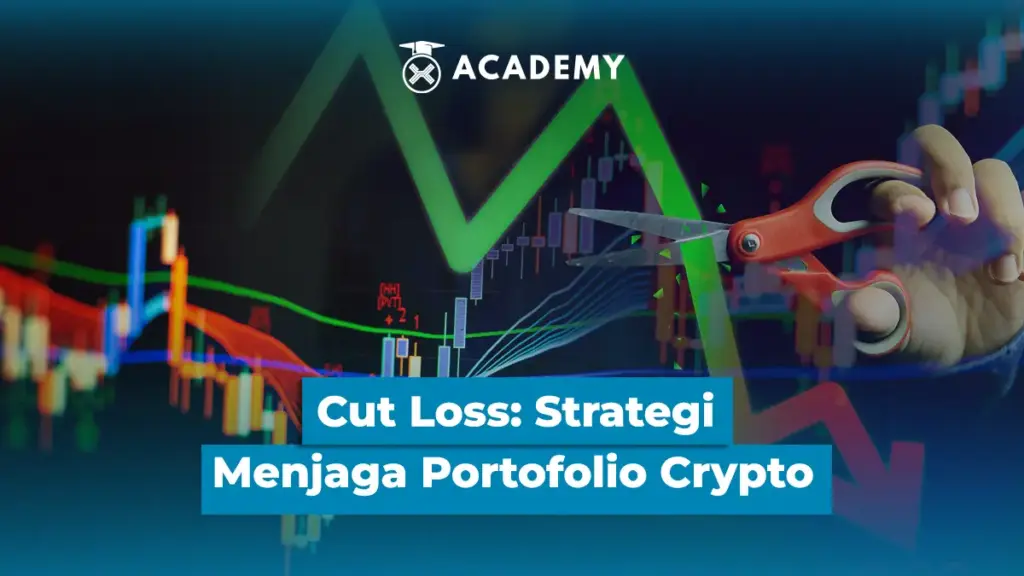
Most traders find it difficult to accept losses. When prices fall, they often hope they’ll rebound, leading them to postpone selling decisions. Eventually, small losses escalate into larger ones.
However, trading isn’t just about profit; it’s about maintaining capital through disciplined risk management. This is where cutting losses comes into play. Cutting losses isn’t a sign of failure, but rather part of risk management to keep losses under control.
This article discusses how to understand and develop a proper cut loss strategy. This isn’t meant to encourage panic selling, but rather to help you make more rational decisions.
What is a Cut Loss?

A cut loss is selling an asset when its price drops to limit losses. Therefore, you intentionally exit at a certain loss point to prevent losses from increasing if the price continues to fall.
Cutting a loss is not a sign of giving up, but rather part of a strategy and risk management strategy. It’s a pre-planned decision, not one driven by panic.
Unlike panic selling, which occurs due to fear and emotion, a cut loss is calculated. The main goal is clear: to preserve capital so that losses don’t increase.
Why is a Cut Loss Important in Crypto Trading?
The crypto market is known for being highly volatile and often moving beyond expectations. Prices can rise sharply, but can also fall sharply in a short period of time. That’s why a cut loss strategy is necessary. Here are some reasons why a cut loss is important in crypto trading.
1. The Crypto Market is Volatile
Crypto prices can rise or fall drastically in a short period of time. Without a clear stop-loss limit, a sharp decline can quickly magnify losses.
2. Capital is the Main Asset
Capital is the lifeblood of trading. If it runs out in one wrong position, you lose the opportunity to take advantage of other opportunities.
3. Avoiding Chain Losses
Holding a losing position indefinitely can cause losses to accumulate and erode a portfolio. A cut loss order helps stop losses early before they become more severe.
The Difference Between Cut Loss and Stop Loss
Many traders often confuse cut loss and stop loss orders. However, they differ in their execution methods, even though their goal is to limit losses. Here are some of the differences.
1. Cut Loss as a Manual Decision
Cut loss orders are executed directly by the trader. So, when the price drops to a predetermined limit, you decide to sell.
2. Stop Loss as an Automated Tool
A stop loss is an automated order. You place it at a specific price, and if the price reaches that level, the system will sell automatically without you having to click again.
3. Which is More Disciplined?
Stop losses are usually more helpful for discipline because they reduce the influence of emotions. You don’t have to hesitate or delay when the price moves down.
Why Does Cutting Losses Feel Difficult?
Logically, cutting losses sounds simple. However, in practice, many traders find it difficult due to psychological factors, including the following.
1. Loss Aversion
Naturally, humans are more afraid of experiencing losses than missing out on profitable opportunities. Losses feel more painful, so we tend to delay decisions even though we know the risks are greater.
2. Hope Bias
When prices fall, there’s a hope that they will soon rebound. This hope often leads traders to hold on too long, even when market conditions are unfavorable.
3. Ego and Validation
Selling at a loss can sometimes feel like admitting a wrong decision. Ego makes us want to prove our initial analysis was correct, even though the market doesn’t always go our way.
Strategies for Using Cut Losses More Rationally
To avoid cutting losses haphazardly or out of panic, you need a more measured and disciplined approach, using the following strategies.
1. Determine Your Risk Limit Before Entry
Before entering a position, determine the maximum risk you are willing to take, for example, 1-5% of your capital per position, depending on your risk profile. This way, you have a baseline for exit decisions, not just those made when emotions arise.
2. Use a Risk-Reward Ratio
Ensure that the potential profit is greater than the risk of loss by considering a risk-reward ratio, for example, a minimum of 1:2 or 1:3. This means that if you are prepared to lose 1 dollar, your profit target should be at least 2 or 3 dollars. This helps maintain balance in the long term.
3. Evaluate, Not Emotionally
When the price moves against your plan, focus on the data and your initial reason for entering, not fear or panic. A rational cut-loss is always based on analysis, not a knee-jerk reaction.
Does Cutting Losses Always Mean Failure?
Cutting losses is not the same as failure. In fact, in the world of professional trading, cutting losses is part of a healthy strategy for managing risk.
Even experienced traders often cut losses. They realize that not all analysis is accurate, and the market can move beyond expectations.
What separates long-term traders from those who don’t is the ability to limit losses, not always being right.
In trading, consistency is far more important than a single trade. Losing on one position isn’t a big deal as long as you stay disciplined and preserve your capital for the next opportunity.
The Long Term Impact of Cut Loss Discipline

In the long term, disciplined cut-loss practices help maintain portfolio stability because losses are not allowed to grow in a single position.
With clear limits, account value is more controlled and less easily shaken by a single wrong decision.
This habit also reduces the risk of a large drawdown, which is a sharp drop from the highest point to the lowest point. The smaller the drawdown, the more realistic the chance for the account to recover and gradually grow again.
Furthermore, trading performance tends to be more consistent because every risk is calculated from the start. The results may not always be spectacular, but they are more stable and manageable.
Equally important, a disciplined cut-loss rule helps avoid impulsive decisions. This way, you won’t be easily carried away by emotions when the market moves against your plan.
Conclusion
So, that was an interesting discussion about cut-loss as a difficult decision that saves a portfolio, which you can read more about in the Crypto Academy at INDODAX Academy.
In conclusion, cut-loss is a protective tool, not a sign of weakness. In practice, this decision can be uncomfortable because it forces traders to accept real losses.
However, that’s precisely where maturity in trading lies: the courage to limit risk before it escalates.
In the volatile and fast-moving crypto market, discipline is often more crucial than the ability to predict price direction.
No analysis is always accurate, and no trader is always right. What separates long-term traders from those who are quickly eliminated is how they manage losses.
Tough decisions like cutting losses often save portfolios in the long run. One small, controlled loss can prevent much greater damage.
Ultimately, risk management isn’t just a complement to a strategy, but the primary foundation for sustainable and measurable trading activities.
In addition to gaining in-depth insights through various popular crypto education articles, you can also broaden your horizons through a collection of tutorials and choose from a variety of popular articles that suit your interests.
Besides updating your knowledge, you can also directly monitor digital asset prices on Indodax Market and stay up-to-date with the latest crypto news. For a more personalized trading experience, explore Indodax’s OTC trading service. Don’t forget to activate notifications so you don’t miss out on important information about blockchain, crypto assets, and other trading opportunities.
You can also follow our latest news via Google News for faster and more reliable access to information. For an easy and secure trading experience, download the best crypto app from INDODAX on the App Store or Google Play Store.
Maximize your crypto assets with the INDODAX Earn feature, a practical way to earn passive income from your stored assets. Register now with INDODAX and easily complete KYC to start trading crypto more safely, conveniently, and reliably!
Indodax Official Contact
Customer Service Number: (021) 5065 8888 | Support Email: [email protected]
Also follow us on social media here: Instagram, X, Youtube & Telegram
FAQ
- What is a cut loss in trading?
A cut loss is a conscious decision to exit a losing position to prevent further losses. This is not a spontaneous reaction, but rather a step usually planned in advance as part of risk management. - Is a cut loss the same as a stop loss?
No. A cut loss refers to the action, while a stop loss is an automated tool for executing a loss limit. Both have the same goal, but differ in their implementation mechanisms. - What is the ideal percentage for a cut loss?
There is no one-size-fits-all figure. The limit depends greatly on each individual’s risk profile, capital size, and strategy. What matters is not the size of the number, but consistency in implementing it. - Does a cut loss mean the strategy is wrong?
Not always. Even a good strategy can still fail under certain conditions. A cut loss is actually a safety mechanism when the market moves outside the planned scenario. - What are the risks of not cutting losses?
Without a clear stop loss limit, a losing position can continue to grow and slowly erode capital. In addition to the financial impact, the psychological stress can also affect the quality of decisions in subsequent trades.

Author: Boy
 Polkadot 2.25%
 BNB 0.30%
 Solana 4.19%
 Ethereum 2.32%
 Cardano 1.02%
 Polygon Ecosystem Token 1.87%
 Tron 2.75%
 Market