The use of Artificial Intelligence (AI) is increasing in various digital systems. However, challenges arise regarding centralized data and control. Many AI systems still rely on a single entity, making their operation difficult to trace.
Therefore, blockchain is beginning to be seen as an alternative infrastructure for building AI agents that are more transparent, verifiable, and independent of a single entity.
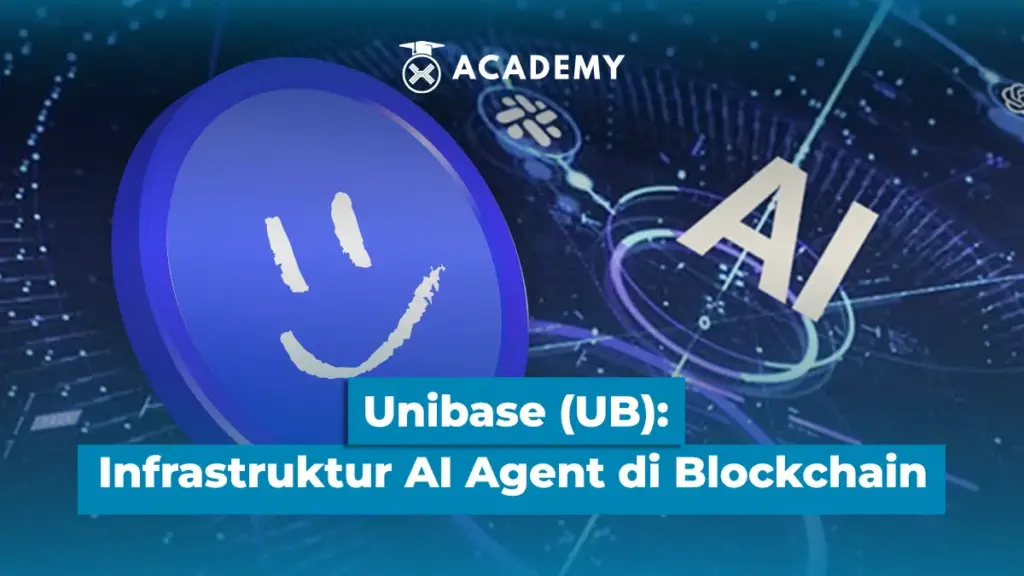
Unibase (UB) has emerged as one approach that attempts to combine AI agents with a decentralized blockchain-based system.
What is Unibase (UB)?

Unibase (UB) is a blockchain project focused on developing and managing AI agents in a decentralized system.
Essentially, Unibase provides a foundation for AI agents to run on the blockchain in a more open and independent manner.
In the Web3 and AI ecosystem, Unibase acts as infrastructure, not a single application or service. It serves as the foundational layer on which AI agents are built and interact with smart contracts and on-chain data.
Furthermore, it’s important to differentiate between Unibase and UB. Unibase refers to the network and its system, while UB is the token used within the ecosystem to support operations and coordination.
The Concept of an AI Agent in the Blockchain Ecosystem
An AI agent is an artificial intelligence system that can execute tasks and make decisions autonomously based on specific data and rules. It doesn’t simply wait for commands, but actively acts according to existing conditions.
In traditional systems, AI agents run on a centralized server owned by a single party, so all processes and data are under the full control of the service provider.
In contrast, blockchain-based AI agents are designed to run in decentralized systems, where their rules and activities can be openly traced and verified.
Verification and transparency are crucial because AI agents are often assigned critical roles. Users need to know that the AI ??is truly operating according to the rules, not based on unilateral decisions.
If AI agents run solely in centralized systems, challenges arise in trust, limited auditability, and the risk of abuse of control by a single entity.
Challenges of AI Agents in Centralized Systems
AI agents running in centralized systems are highly dependent on a single server and provider. If the server fails or the provider’s policies change, the entire system is impacted, leaving users with little choice.
The AI ??decision-making process in centralized models also tends to be closed. Users cannot see how data is processed or the reasoning behind the resulting decisions. Therefore, everything relies solely on trust.
Furthermore, data and activity logs are under the control of a single party, opening the risk of manipulation or alteration without a clear trace.
Furthermore, AI agents in centralized systems often struggle to connect with other systems. This is because each platform uses its own standards and is not designed to interact with each other.
How Is Blockchain Used in AI Agent Infrastructure?
The blockchain in AI agent infrastructure functions as an on-chain recorder of activities.
Every important action of the AI ??agent, such as task execution or interaction with other systems, can be recorded, leaving a clear and unchangeable trail.
Smart contracts, on the other hand, act as the rules of the game. This is where the basic logic of the AI ??agent is defined, from what it can and cannot do to how the AI ??executes specific instructions.
With rules written in smart contracts, the behavior of AI agents is not entirely dependent on unilateral decisions.
The concepts of verifiability and auditability arise because all activities can be reviewed. Anyone can trace whether an AI agent is operating according to the rules or deviating from them.
Regarding this, blockchain is not a substitute for AI. AI still performs analysis and decision-making processes.
Meanwhile, blockchain acts as a trust layer that ensures these processes are transparent and verifiable.
Unibase’s Role in Building Decentralized AI Agents
Unibase serves as the infrastructure layer for building and running AI agents in a decentralized system. Unibase does not create a specific AI, but rather provides the foundation for various AI agents to run on the blockchain.
The Unibase system is designed to be modular and composable. This means that AI agent components, data, and execution can be arranged and combined as needed. The network connects all these parts in a single, recorded and controlled flow.
Unibase’s primary focus is building an open and verifiable system. Thus, the AI ??agent’s operation is not solely dependent on trust but can be clearly observed and verified.
The Function of the UB Token in the Unibase Ecosystem
UB is a utility token used within the Unibase ecosystem to run and support system functions. This token serves as an operational tool, not the primary purpose of the Unibase project itself.
In practice, UB is used in network participation mechanisms. For example, when users or system components utilize infrastructure services, interact with AI agents, or execute specific processes within the network.
With the token, activities in the Unibase ecosystem can be regulated to run more orderly and coordinated.
The use of the Unibase infrastructure is directly related to the UB token. This is because the token is part of how the system manages access, processes, and interactions between components.
Standards and Their Implications
BEP-20 is the token standard used on the BNB Chain network. This standard establishes the basic rules for how a token is created, sent, and interacts with other systems within the blockchain network.
Tokens like UB use the BEP-20 standard because of its widespread and stable nature. By following this standard, tokens can be directly integrated into existing ecosystems without the need to build new mechanisms from scratch.
As a result, BEP-20 tokens are compatible with many wallets and blockchain services that support BNB Chain. Users can store, send, and interact with tokens using commonly used wallets, without complex technical setup.
For systems like Unibase, the token standard also simplifies integration. Infrastructure, applications, and smart contracts can be directly connected to the token.
This is because they all follow the same rules, making system development and usage more efficient.
What Can Be Learned from the Unibase Approach?

Unibase’s approach demonstrates that AI agents are now part of Web3 development, not just an add-on feature. AI no longer exists independently in closed applications, but runs within systems that emphasize openness and traceability.
This emphasizes the importance of infrastructure. Without a clear foundation, AI agents are difficult to monitor, develop, or connect with other systems.
By focusing on infrastructure, AI can develop as a comprehensive ecosystem, not just a one-way solution.
Unibase also demonstrates the role of blockchain as a tool for transparency and accountability. Blockchain doesn’t replace AI, but ensures that AI processes and decisions can be audited and accounted for.
The key lesson is that understanding blockchain-based AI projects isn’t limited to their applications.
What’s important is how the system is built, how trust is maintained, and how technology is used to create more open mechanisms.
In addition to gaining in-depth insights through various popular crypto education articles, you can also broaden your horizons through a collection of tutorials and choose from a variety of popular articles that align with your interests.
Besides updating your knowledge, you can also directly monitor digital asset prices on Indodax Market and stay up-to-date with the latest crypto news. For a more personalized trading experience, explore Indodax’s OTC trading service. Don’t forget to activate notifications so you don’t miss out on important information about blockchain, crypto assets, and other trading opportunities.
You can also follow our latest news via Google News for faster and more reliable access to information. For an easy and secure trading experience, download the best crypto app from INDODAX on the App Store or Google Play Store.
Maximize your crypto assets with the INDODAX Earn feature, a practical way to earn passive income from your stored assets. Register now with INDODAX and easily complete KYC to start trading crypto more safely, conveniently, and reliably!
Indodax Official Contact
Customer Service Number: (021) 5065 8888 | Support Email: [email protected]
Also follow us on social media here: Instagram, X, Youtube & Telegram
Conclusion
So, that was an interesting discussion about Unibase (UB) as an AI Agent infrastructure on the blockchain and how it works. You can read more about it in the INDODAX Academy Crypto Academy.
In conclusion, Unibase demonstrates that discussions about AI in the Web3 field are no longer focused solely on model sophistication or analytical capabilities.
The focus is shifting to more fundamental issues, such as who controls the system, how decisions are recorded, and how trustworthy the process is.
In this regard, Unibase doesn’t seek to be the smartest AI, but rather offers a framework for AI agents to operate in a more open and structured environment.
Unibase’s infrastructure-based approach emphasizes that the primary problem with modern AI is often not its intelligence, but rather the transparency and accountability of the systems in which it operates.
By utilizing blockchain as a trust layer, Unibase demonstrates how AI agents can be managed without relying entirely on a single, closed entity.
For readers, understanding Unibase means viewing a crypto project not just in terms of its token or technological label, but in terms of the role of the system it builds and the real problems it aims to solve.
In an increasingly complex ecosystem, the ability to read the context of the infrastructure is becoming as important as understanding the product.
FAQ
- What differentiates Unibase from other AI projects?
Unibase isn’t focused on building a single AI model. The project emphasizes providing the infrastructure to enable multiple AI agents to run in a decentralized system, with traceable and verifiable activities. - Do Unibase’s AI agents operate entirely on the blockchain?
Not all AI processes run on the blockchain. The blockchain is used as a record-keeping, rule-setting, and verification layer, while the AI’s analysis and decision-making processes are still handled by the AI ??system itself. - Why is transparency important for AI agents?
Because AI agents are often given crucial roles in digital systems. Without transparency, users have no way of knowing whether the AI ??is operating according to the rules or whether it is influenced by vested interests. - What role does the UB token play in the day-to-day operations of the Unibase system?
The UB token is used to support network operations, such as regulating participation and use of infrastructure services. This token serves as part of the system’s mechanics, not the project’s primary focus. - Does understanding Unibase require a deep understanding of blockchain technology?
Not necessarily. What is more important is to understand the basic concepts, namely how AI agents are managed, how trust is built, and why decentralized infrastructure is considered relevant to addressing today’s AI challenges.

Author: Boy
 Polkadot 2.25%
 BNB 0.52%
 Solana 4.62%
 Ethereum 2.32%
 Cardano 1.02%
 Polygon Ecosystem Token 1.87%
 Tron 2.75%
 Market