
Almost every trader is familiar with Fibonacci Retracement and Fibonacci Extension. However, not many know that the names are derived from an Italian mathematician named Leonardo Fibonacci, who lived over 800 years ago.
Although he lived long before the stock market and crypto markets existed, his mathematical concepts are still used in technical analysis.
In this article, we will discuss Leonardo Fibonacci, his contributions to the world of mathematics, and how the Fibonacci sequence became a popular analytical tool in the crypto market.
Who was Leonardo Fibonacci?
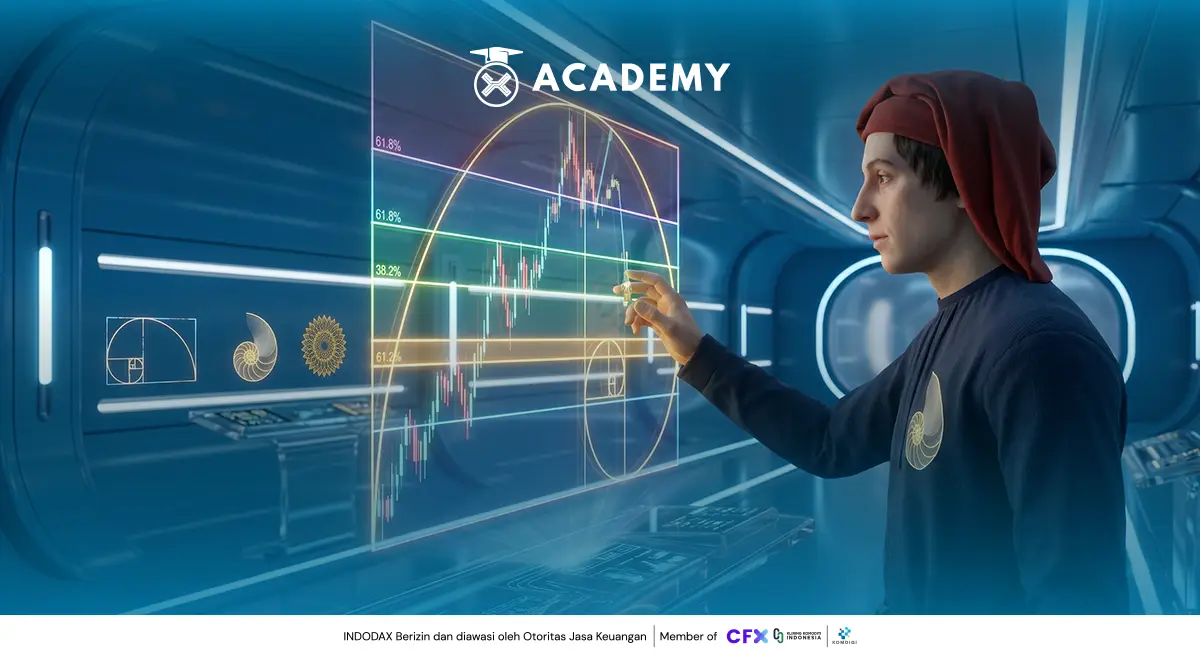
Leonardo Fibonacci was an Italian mathematician who lived around 1175–1250, or in the 12th to 13th centuries, as quoted from Wikipedia.
His full name was Leonardo Pisano or Leonardo da Pisa, as he was from the city of Pisa.
However, he is better known by the name Fibonacci, which comes from the term filius Bonacci, or “son of Bonacci,” referring to his father, Guilielmo Bonacci. This nickname later gained popularity and is still used today.
Leonardo Fibonacci’s Life Journey
Leonardo Fibonacci’s life journey was greatly influenced by his learning experiences and travels to various regions around the Mediterranean Sea, as explained below.
1. Childhood and Background
Leonardo Fibonacci was born in Pisa, Italy. From childhood, he followed his father, a merchant, and frequently traveled to Bugia, North Africa, thus gaining the opportunity to study outside of Europe.
2. Learning Mathematics from the Arab World
During his travels, Fibonacci studied the Hindu-Arabic number system. He saw that this system was much simpler and more practical than Roman numerals, making it easier to use for various calculations.
Liber Abaci: The Book That Changed the World of Mathematics
In 1202, Leonardo Fibonacci published Liber Abaci to introduce the Hindu-Arabic number system to Europe as a replacement for the more complicated Roman numerals.
This book brought about major changes by simplifying calculations, thus encouraging the development of trade, accounting, mathematics, and science.
What is the Fibonacci Sequence?
The Fibonacci Sequence is a sequence of numbers in which each number is the sum of the previous two numbers, in the context of modern technical analysis. This sequence begins with 0, 1, 1, 2, 3, 5, 8, 13, 21, and continues in the same pattern.
Why is it called Fibonacci Numbers?
The sequence is named after Leonardo Fibonacci. Although not the creator, Fibonacci popularized the concept in Europe through his work Liber Abaci, and the sequence later became known by his name.
The Fibonacci Sequence’s Relationship to the Golden Ratio
The Fibonacci Sequence is closely related to the Golden Ratio, which is a ratio of approximately 1:1.618 or 0.618 (61.8%). The 61.8% ratio became famous because it frequently appears in the relationships between numbers in the Fibonacci sequence.
The Golden Ratio is found in various patterns in nature, such as flower arrangements, shell spirals, and fruits.
Furthermore, this ratio is also widely used in art, architecture, and mathematics because it is believed to reflect balanced and harmonious proportions.
Why Is Leonardo Fibonacci’s Name Used in Trading?
Modern traders use Fibonacci ratios to help analyze price movements, such as finding areas of support, resistance, and potential trend reversals through Fibonacci Retracements.
The name Fibonacci is used because the indicator is built from ratios derived from the Fibonacci sequence, such as 61.8%, 38.2%, and 23.6%. In other words, Leonardo Fibonacci never created a trading indicator.
However, the number series he popularized through Liber Abaci later became the basis for the development of one of the most widely used technical analysis tools in financial markets, including crypto.
Why Do Crypto Traders Still Use Fibonacci?
Fibonacci is still widely used because it helps traders read the structure of price movements and complements technical analysis, as explained below.
1. Helps Read Market Structure
Fibonacci ratios are often used to identify areas of price correction so traders can estimate support and resistance points, or opportunities for trend continuation.
2. Used with Other Indicators
In practice, Fibonacci is usually combined with indicators such as RSI, support and resistance, trendlines, and volume to provide stronger analysis results and not rely solely on a single indicator.
3. Not Used as the Sole Basis for Analysis
Fibonacci is an analytical tool, not a tool that can accurately predict price movements. Therefore, its results need to be confirmed with other indicators and prevailing market conditions.
Interesting Facts about Leonardo Fibonacci
Leonardo Fibonacci did not invent the Fibonacci sequence, but rather popularized it in Europe through Liber Abaci.
He also introduced the Hindu-Arabic numbering system, which is more practical than Roman numerals. To this day, his work and name are still studied and used in modern technical analysis through various Fibonacci indicators.
Common Misconceptions about Leonardo Fibonacci
There are several misconceptions about Leonardo Fibonacci and the Fibonacci concept that are still common today, including the following.
1. Fibonacci Did Not Invent the Number 0
Fibonacci did not invent the number 0. He played a role in introducing the Hindu-Arabic number system, including the use of the number 0, to Europe through Liber Abaci.
2. Fibonacci Did Not Create Trading Indicators
Fibonacci lived long before the birth of modern financial markets. Fibonacci indicators for trading were developed later, utilizing ratios from the Fibonacci sequence.
3. The Fibonacci Sequence Is Not a Price Prediction
The Fibonacci sequence is not a method for price forecasting. Fibonacci ratios are only used as a reference in technical analysis to identify areas of price movement.
4. Fibonacci Ratios Are Not Always Accurate
Fibonacci ratios do not always produce accurate signals. Therefore, this indicator is generally used in conjunction with other analytical tools to increase reliability.
What Can Investors Learn from Leonardo Fibonacci?

Leonardo Fibonacci’s contributions demonstrate that mathematical concepts can endure for centuries and remain relevant, including in modern financial market analysis.
This also serves as a reminder that understanding the theoretical basis behind technical indicators is just as important as reading charts, so that investment decisions don’t rely solely on the signals they generate.
Conclusion
Leonardo Fibonacci is known not only for the number sequence that bears his name, but also for his role in introducing the Hindu-Arabic numeral system to Europe through Liber Abaci.
This contribution had a significant influence on the development of mathematics and formed the basis for the Fibonacci ratios, which are now used in indicators such as the Fibonacci Retracement and Fibonacci Extension.
Although he never created a trading indicator, Fibonacci’s legacy remains relevant today.
Stock, forex, and crypto traders use these ratios as a tool to read market structure, proving that a mathematical concept can continue to be used across time when it has a strong foundation.
That’s some interesting information about Leonardo Fibonacci, the man behind the Fibonacci Retracement, which you can explore further in this collection of crypto articles from Indodax Academy.
Besides gaining in-depth insights through various popular crypto educational articles, you can also broaden your horizons through a collection of tutorials and choose from a variety of popular articles that suit your interests.
Besides updating your knowledge, you can also directly monitor digital asset prices on the Indodax Market, such as Bitcoin (BTC to IDR) or other assets, and stay up-to-date with the latest crypto news.
For a more personalized trading experience, explore Indodax’s OTC trading service. Don’t forget to activate notifications so you don’t miss out on important information about blockchain, crypto assets, and other trading opportunities.
You can also follow our latest news via Google News for faster and more reliable access to information. For an easy and secure trading experience, download the best crypto app from INDODAX on the App Store or Google Play Store.
Maximize your crypto assets with the INDODAX crypto staking feature, a practical way to earn passive income from your stored assets.
Register now with INDODAX and easily complete KYC to start trading crypto more safely, conveniently, and reliably!
Official Indodax Customer Support Contact
Official Customer Support Number: (021) 5065 8888
Official Indodax Priority Customer Support Number: (021) 5036 8888
Help Email: [email protected]
Also follow INDODAX on social media here: Instagram, X, YouTube & Telegram

FAQ
- Who was Leonardo Fibonacci?
Leonardo Fibonacci, also known as Leonardo da Pisa, was an Italian mathematician known for popularizing the Hindu-Arabic numeral system in Europe and introducing the Fibonacci sequence through his book Liber Abaci. - Did Leonardo Fibonacci invent the Fibonacci Retracement?
No. Leonardo Fibonacci did not invent the Fibonacci Retracement indicator. This indicator was developed long after his time, utilizing ratios derived from the Fibonacci sequence. - What does Leonardo Fibonacci have to do with crypto trading?
The Fibonacci sequence, popularized by Leonardo Fibonacci, is the basis for the ratios in the Fibonacci Retracement and Fibonacci Extension indicators, which are widely used by crypto traders for technical analysis. - What is Liber Abaci?
Liber Abaci is a mathematics book published by Leonardo Fibonacci in 1202 and played a key role in introducing the Hindu-Arabic numeral system to Europe. - Why are Fibonacci numbers found so frequently in nature?
The Fibonacci sequence often appears in the growth patterns of plants, flowers, shells, and various natural phenomena because it is related to growth efficiency and the Golden Ratio. - Is the Fibonacci Retracement always accurate?
No. The Fibonacci Retracement is a technical analysis tool that should be used in conjunction with other indicators and supported by risk management. - Why do crypto traders still use Fibonacci today?
Because the Fibonacci ratio can help identify areas of support, resistance, and potential price corrections, making it easier for traders to read market structure. - What lessons can be learned from Leonardo Fibonacci?
Leonardo Fibonacci demonstrated that powerful mathematical concepts can remain relevant for centuries.
Dalam trading maupun investasi, memahami dasar teori di balik sebuah indikator akan membantu menghasilkan analisis yang lebih objektif daripada sekadar mengikuti sinyal tanpa memahami konsepnya.
Author: Boy
DISCLAIMER: All forms of crypto asset transactions carry risks and the potential for loss. Always invest based on independent research to minimize the risk of loss of crypto assets traded (Do Your Own Research/ DYOR). The information contained in this publication is provided on a general basis without obligation and is for informational purposes only. This publication is not intended to be, and should not be construed as, an offer, recommendation, solicitation, or advice to buy or sell any investment product and may not be transmitted, disclosed, copied, or relied upon by anyone for any purpose.
 Polkadot 2.25%
 BNB 0.52%
 Solana 4.62%
 Ethereum 2.32%
 Cardano 1.02%
 Polygon Ecosystem Token 1.87%
 Tron 2.75%
 Market