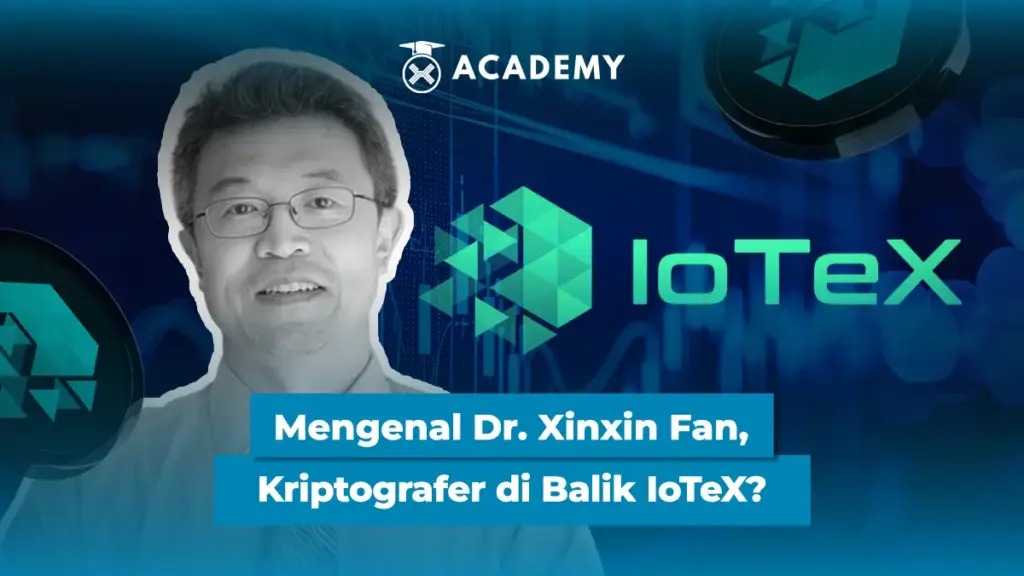
Blockchain is often viewed as a ready-to-use product such as a transaction network, token, or decentralized application that runs on top of it.
In fact, many important innovations are born from the long-running research process of cryptography and system security, far from the public spotlight.
Behind the consensus mechanisms and data protection, there is the work of researchers who ensure the network remains resilient to attacks, efficient in use, and able to withstand changing technical requirements.
One of the figures behind this layer is Dr. Xinxin Fan, a cryptography researcher directly involved in the development of blockchain technology through his role at IoTeX.
It’s important to understand that this article is intended as educational material to review Dr. Xinxin Fan’s background, contributions, and role in the blockchain ecosystem, without any project promotion or investment solicitation.
Who is Dr. Xinxin Fan?
Dr. Xinxin Fan is a cryptography and information security researcher with an academic and professional background in electrical and computer engineering.
Her areas of expertise include system security, applied cryptography, and their applications to communications technology and connected devices.
Her formal education began at Xidian University, where she earned a Bachelor of Applied Mathematics and a Master of Engineering in information systems and telecommunications engineering.
She then pursued doctoral studies at the University of Waterloo in Electrical and Computer Engineering, focusing on system security and privacy.
Dr. Fan’s research experience extends beyond academia to industry. In academia, she has been involved in research on communications security, embedded systems, and Machine-to-Machine and the Internet of Things.
In industry, she has conducted applied research on hardware security, cloud computing, and system privacy, including patent development and technology prototypes.
These experiences have established her credibility as a researcher focused on technical and scientific foundations.
Academic and Research Background
Dr. Fan’s academic background Xinxin Fan’s research interests centered on electrical and computer engineering, with a strong focus on system security.
Her doctoral studies at the University of Waterloo were in Electrical and Computer Engineering, focusing on cryptography, privacy protection, and communications and embedded systems security.
This research interest is evident in her involvement in theoretical and applied research addressing Machine-to-Machine security, the Internet of Things, and communications infrastructure.
She actively writes and contributes to scientific publications presented in journals, conferences, and academic forums, while also developing security solutions ready for implementation in real-world systems.
This academic foundation and research track record serve as the foundation for her contributions to the blockchain field, particularly in the design of cryptographic architectures and mechanisms that emphasize security, privacy, and network resilience.
The Journey from Research to Blockchain
Dr. Xinxin Fan’s journey to blockchain began with years of cryptography research focused on theoretical models, security schemes, and system threat analysis.
At this stage, the primary focus is ensuring a system is mathematically secure, although it often remains untested in wide-scale use cases and real-world conditions.
The challenge arises when these research findings need to be translated into practical solutions.
The difference between academic models and production environments is not only about scale, but also about device limitations, computational efficiency, and user interaction.
Experience in applied research and industry has fostered an understanding that security is not simply about paper strength; it must be resilient in live systems exposed to various risks.
Blockchain has emerged as a relevant medium for security researchers because it combines cryptography, distributed networks, and economic incentives in a single operational system.
For researchers with a security background, blockchain provides a platform to test, adapt, and apply cryptographic principles directly to public infrastructure.
From this point on, research no longer stops at publication but progresses to becoming part of a widely used technology architecture.
Dr. Xinxin Fan’s Role at IoTeX
At IoTeX, Dr. Xinxin Fan holds the role of Head of Cryptography, primarily responsible for the technical foundations of the network.
This position places her in the design and evaluation layer of cryptographic mechanisms used to maintain the security, integrity, and reliability of the system.
Her scope of work includes designing security architectures, reviewing cryptographic protocols, and testing the network’s resilience against various threat scenarios.
The focus is on ensuring the system operates securely over the long term, including data protection, transaction validation, and interactions between network components, rather than on market development, product narratives, or token dynamics.
This role is technical and fundamental, born out of the need to maintain blockchain as a reliable infrastructure.
Dr. Xinxin Fan’s contributions to IoTeX are largely behind the scenes, ensuring that cryptographic principles are applied correctly and consistently as the foundation of the network’s operation.
The Contribution of Cryptography to Blockchain Development
Cryptography is the primary layer that keeps blockchains running as designed.
Data integrity, transaction validity, and trust between unknown parties depend on consistently operating cryptographic mechanisms.
Without a proper cryptographic scheme, a distributed ledger can easily be manipulated or lose its trustworthiness.
In the consensus and transaction processes, cryptographic design determines how a network verifies truth without relying on a central authority.
Digital signatures, hash functions, and verification schemes support the authenticity of each transaction.
Meanwhile, consensus ensures a common agreement is reached even when the network consists of many nodes with differing interests.
Incorrect design choices at this stage can open security holes or reduce system efficiency.
In large-scale blockchains, the relevance of cryptographic security becomes even more critical. The more users and transactions there are, the greater the incentive to attack the network.
Cryptography designed with scale, performance, and long-term resilience in mind plays a role in maintaining network stability and ensuring the blockchain remains reliable as public infrastructure.
Research Focus on Blockchain Security and Privacy
The focus of research on blockchain security and privacy stems from the need to protect data and transactions in open networks.
Every recorded transaction must be verifiable for its validity without opening up the possibility of manipulation, while the data involved must be protected from easy exploitation.
Security at this stage concerns not only asset protection but also the reliability of the system as a whole.
User privacy is becoming an increasingly important issue in decentralized networks. Transparency, the strength of blockchain, also presents challenges because transaction traces can be analyzed and linked to specific behavioral patterns.
Research in this area seeks to find a balance between system openness and user identity protection, without sacrificing the fundamental, publicly verifiable nature of the network.
As blockchain grows, new challenges continue to emerge. The increasing scale of use, integration with external devices and services, and the complexity of decentralized applications expand the risk profile.
This demands a research approach that not only addresses current threats but also anticipates how security and privacy will need to adapt to ensure blockchain’s widespread and sustainable use.
Long-Term Security Issues and New Technological Threats
Blockchain security doesn’t stop with today’s threats. The development of new technologies, particularly quantum computing, raises serious questions about the resilience of currently widely used cryptographic schemes.
Algorithms considered secure under classical computing conditions have the potential to weaken when processing power surges far beyond their initial design assumptions.
This situation emphasizes the importance of long-term cryptographic research. Security is not simply a response to past attacks, but rather an ongoing effort to anticipate changes in the technological landscape.
Research on quantum-resistant algorithms, more adaptive protocol design, and security migration strategies are part of the work that must begin long before these threats actually appear in the field.
In this context, the role of researchers like Dr. Xinxin Fan lies at the preparation and prevention level.
Her contributions relate not only to securing current systems but also to ensuring that blockchain foundations are flexible enough to withstand future technological changes.
This approach lends a long-term dimension to blockchain development, transcending short-term needs and fleeting innovation cycles.
Why is the Role of Cryptographers Important in the Blockchain World?
Blockchain development is often measured by the number of applications, users, or adoption rate. However, beyond that, the sustainability of a network is largely determined by the strength of its security foundation.
Without security guarantees, growth can actually increase risks and accelerate system vulnerabilities.
Trust in blockchain is not built through a central authority, but through consistently operating cryptographic mechanisms. This is where the role of cryptographers becomes crucial.
They design and assess algorithms, protocols, and security assumptions that enable the network to operate without direct trust. This foundation ensures the reliability of transactions, data, and consensus.
The contributions of cryptography researchers often take place behind the scenes and rarely receive the spotlight. While not always visible to end users, their role is crucial to the long-term stability of blockchain.
Understanding this layer provides a more holistic perspective on the blockchain industry, focusing not only on products and adoption, but also on the scientific work that underpins it.
Dr. Xinxin Fan’s Position in the Blockchain Ecosystem
Dr. Xinxin Fan’s position in the blockchain ecosystem is more accurately viewed as a researcher and technical practitioner.
Her role lies at the technology design and strengthening level, primarily related to cryptography and system security, rather than in promotion or market dynamics.
She does not act as a public figure shaping price opinions or investment trends. Her contributions are in more fundamental aspects, such as protocol security evaluation, cryptographic mechanism design, and long-term network resilience.
These areas are rarely visible to the general public but determine whether a blockchain can function reliably.
By positioning Dr. Xinxin Fan as a contributor on the fundamental side of technology, this article maintains a neutral and educational perspective.
The focus is not on personal branding or popularity narratives, but on the technical roles that underpin the blockchain infrastructure as a whole.
The Challenge of Developing a Secure and Scalable Blockchain
Developing a secure and scalable blockchain is a complex dilemma.
Increased security often demands stricter verification processes, while efficiency demands push systems to process transactions quickly and at the lowest possible cost.
Finding a balance between these two interests is a major challenge in designing blockchain infrastructure.
On the other hand, decentralized systems bring a high level of complexity. The absence of a central authority means each component must be designed to verify each other and continue functioning even if a portion of the network experiences disruption.
This complexity increases the potential for risk, whether from design errors, implementation errors, or interactions between technology layers.
This situation demands close collaboration between researchers and developers. Researchers ensure the theoretical foundations and security assumptions remain robust.
Meanwhile, developers translate these assumptions into a usable and maintainable system.
Without this collaborative effort, blockchains risk becoming systems that are secure in theory but difficult to implement, or conversely, easy to use but vulnerable in terms of security.
Conclusion
So, that was an interesting discussion about Dr. Xinxin Fan, the cryptographer behind IoTeX, which you can read more about in the INDODAX Academy’s Crypto Academy.
In conclusion, Dr. Xinxin Fan can be seen as an example of the role of cryptographers working behind the scenes in blockchain technology development.
Her research and technical experience demonstrate that blockchain progress is determined not only by product innovation, but also by thoroughness in designing and maintaining system security.
Her contributions also emphasize the importance of security research as part of Web3 development.
Cryptography, privacy, and network resilience are the foundations that allow this technology to function openly without losing user trust.
Ultimately, blockchain thrives not only because of its adoption rate or popularity, but also because of the cryptographic foundation that underpins the entire ecosystem.
Understanding these layers helps us view blockchain as a technological infrastructure built through long-term scientific and engineering work, or a continuous development process.
That’s some interesting information about Blockchain that you can explore further in Indodax Academy’s collection of crypto articles. In addition to gaining in-depth insights through various popular crypto education articles, you can also broaden your horizons through a collection of tutorials and choose from a variety of popular articles that suit your interests.
Besides updating your knowledge, you can also directly monitor digital asset prices on Indodax Market and stay up-to-date with the latest crypto news. For a more personalized trading experience, explore Indodax’s OTC trading service. Don’t forget to activate notifications so you don’t miss out on important information about blockchain, crypto assets, and other trading opportunities.
You can also follow our latest news via Google News for faster and more reliable access to information. For an easy and secure trading experience, download the best crypto app from INDODAX on the App Store or Google Play Store.
Maximize your crypto assets with the INDODAX Earn feature, a practical way to earn passive income from your stored assets. Register now with INDODAX and easily complete KYC to start trading crypto more safely, conveniently, and reliably!
Indodax Official Contact
Customer Service Number: (021) 5065 8888 | Support Email: [email protected]
Also follow us on social media here: Instagram, X, Youtube & Telegram
FAQ
1.Who is Dr. Xinxin Fan?
Dr. Xinxin Fan is a cryptography and information security researcher involved in the development of blockchain technology, including her role at IoTeX.
2.Is Dr. Xinxin Fan a crypto trader or influencer?
No. Her role focuses on research, cryptography, and blockchain system security, not market activity or the promotion of crypto assets.
3.What are Dr. Xinxin Fan’s main contributions to blockchain?
Her contributions lie in the design and evaluation of cryptographic systems and the security of blockchain networks.
4.Why is cryptography important in blockchain?
Cryptography maintains transaction security, data integrity, and trust in decentralized blockchain systems.
5.Does this article discuss specific investments or tokens?
No. This article is purely educational and does not include investment recommendations or the promotion of crypto assets.

Author: Boy
 Polkadot 2.25%
 BNB 0.52%
 Solana 4.62%
 Ethereum 2.32%
 Cardano 1.02%
 Polygon Ecosystem Token 1.87%
 Tron 2.75%
 Market