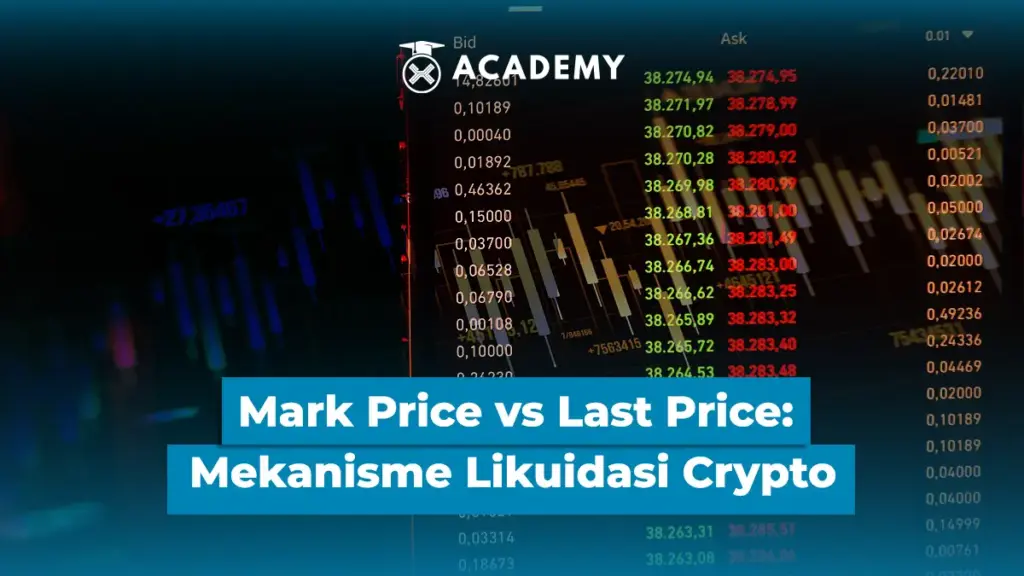
In crypto futures, , many traders are confused when the crypto price on the chart appears to have not yet reached the liquidation price calculated by the system, but the position has already been liquidated.
This occurs because there is a discrepancy between the price displayed on the chart and the price used by the system. Charts typically display the last price, while the system uses the mark price to calculate liquidation.
Why is there more than one price? Because the last price can change due to momentary transactions, while the system requires a more stable price to prevent liquidation from being triggered by short spikes.
In this article, we will discuss the logic behind the mark price and why the system does not use the last price to determine liquidation.
What Is the Last Price in Crypto Futures?
In crypto futures, the system uses several types of prices. One of them is the last price, which is the price traders most often see on the chart. Here’s a definition and its role in trading.
1. Definition of Last Price
The last price is the price of the last transaction that occurred in a futures contract in the order book.
Every time a buyer and seller match and a transaction occurs, that price becomes the last price. This number appears as a candlestick movement on the chart and is continuously updated in real time.
2. How the Last Price is Formed
The last price is formed from direct interaction between buyers and sellers in the futures market. When someone places a market order and it is executed, the transaction price immediately becomes the last price.
Because buying and selling activity can occur very quickly, prices can change within seconds.
In perpetual contracts like BTCUSDT, the futures price can differ from the spot price of the underlying asset because these contracts have their own supply and demand in the futures market.
3. Characteristics of the Last Price
The last price is highly volatile because it follows the most recent transaction without considering the broader market context.
This price can spike or fall sharply due to just one large order. If liquidity is thin, even small movements can cause spikes that appear extreme on the chart.
Furthermore, under high volume conditions in the futures market, the contract price can move further away from the spot price of the underlying asset.
4. The Role of the Last Price in Trading
The last price plays a crucial role in determining whether your order is executed. This price is also used to calculate realized profit and loss, which is the profit or loss that has actually occurred after the position is closed.
Because it reflects the most recent transaction, the last price reflects market sentiment at that time, although it does not necessarily represent the asset’s overall fair value.
What Is Mark Price?
In crypto futures, the mark price is the reference price the system uses to measure position risk, not the price actually traded in the market. Here’s the definition and its function in the system.
1. Definition of Mark Price
Mark price is the estimated fair value of a futures contract. This price is used to calculate unrealized PnL, which is the profit or loss that remains before the position is closed.
2. Components of Mark Price
Mark price is usually calculated from several components. One is the index price, which is the average of spot prices from several exchanges to avoid relying on a single market.
Then there’s the funding rate, which helps keep the futures price close to the spot price. In addition, there’s a smoothing mechanism to dampen extreme spikes and prevent momentary manipulation.
3. Why Mark Price Is More Stable
Mark Price doesn’t simply follow the last transaction like the last price. Because it’s calculated from a combination of several sources and filtered, the price is more stable and less susceptible to short spikes or market noise.
4. Function of Mark Price in the System
Mark price is used to calculate margin requirements. This price also triggers liquidation if it reaches the liquidation price. Furthermore, the mark price is the basis for calculating unrealized P&L, providing a more objective picture of the position.
Why Doesn’t Liquidation Use the Last Price?
In crypto futures, liquidation doesn’t use the last price because it’s too volatile in a short period of time. There are several other reasons to be aware of, including the following:
1. Avoiding Liquidation Due to Flash Spikes
For example, if a whale buys or sells in large quantities, this transaction can cause the last price to spike sharply.
If liquidation uses this price, many positions could be impacted by a single rapid movement. Meanwhile, the mark price usually only moves slightly because it’s calculated from the market average.
2. Preventing Market Manipulation
The last price is more susceptible to spoofing or short-term pumps. If used as a reference for liquidation, retail traders could be disadvantaged by movements that don’t truly reflect market conditions.
In this case, the mark price helps provide protection because it doesn’t rely on a single transaction.
3. Maintaining the Stability of the Derivatives System
Futures require prices that are close to fair value, not just the most recent transaction. The margin and liquidation systems should not be subject to noise or short-term fluctuations. Therefore, mark prices are used to ensure fairness and stability.
The Relationship Between Mark Price, Last Price, and Index Price
In crypto futures, there are three types of prices that often appear: mark price, last price, and index price. All three are interconnected but have different roles in the system, as explained below.
1. What Is an Index Price
An index price is a weighted average of spot prices from several major exchanges. Because it is derived from multiple sources and weighted, this price helps avoid distortion if one exchange experiences an extreme spike.
2. The Difference in Their Functions
The last price is the price of the last transaction that occurred on the platform where you are trading. This is what is visible on the chart and determines order execution. Meanwhile, the index price is a global market reference that reflects spot prices more broadly.
The mark price is the system price for calculating risk, including margin, unrealized PnL, and liquidation.
3. How the Three Interact
The index price serves as the basis for maintaining prices in line with the global spot market. The mark price is usually calculated from the index price and then adjusted for stability.
Meanwhile, the last price moves according to transactions in the futures market and can momentarily differ from the other two prices.
Impact for Crypto Traders
The difference between the mark price and the last price is not merely technical. For traders, it can have a direct impact on PnL and liquidation risk, including the following:
1. Unrealized PnL Can Differ from the Chart
Unrealized PnL is calculated based on the mark price, not the last price shown on the chart. This means that even if the price on the chart still looks safe, the value of your position may be under pressure because the system refers to the mark price.
2. Liquidation Price Needs to be Monitored with the Mark Price
Many traders focus too much on candlestick movements. However, liquidation occurs when the mark price touches the liquidation price. Therefore, it’s important to monitor not only the chart but also the reference price used by the system.
3. Risk Management Strategy
It’s best to avoid using excessive leverage in futures trading, as the distance to liquidation can quickly narrow. Additionally, monitor the funding rate in perpetual contracts, as this can affect costs and futures price dynamics.
Most importantly, understand pricing and liquidation mechanisms before opening a position to avoid being caught off guard by rapid market movements.
Common Mistakes of Beginner Traders
Many novice traders don’t actually lose because of the market, but because of a misunderstanding. When a position is liquidated, even though the price on the chart doesn’t appear to have reached the limit, they immediately assume the exchange is cheating.
However, the system uses the mark price to calculate liquidation, not the price on the chart.
Many also assume the price on the chart is the only price available. In reality, there is the last transaction price and the system reference price, and the two can differ.
Furthermore, many still don’t understand the difference between unrealized and realized PnL. Unrealized is still a provisional calculation as long as the position hasn’t been closed. Realized profit or loss is only truly determined after the position is closed.
Conclusion
So, that was an interesting discussion about mark price vs. last price and the reasons why liquidation doesn’t use the last price. You can read more about it in the INDODAX Academy’s Crypto Academy.
In conclusion, the difference between mark price and last price is often considered merely a technical detail behind the scenes of futures platforms. In fact, this is the core of how the system protects the stability of the derivatives market.
The last price indicates the last transaction that occurred. It’s fast-moving, reactive, and reflects momentary activity. The mark price, on the other hand, is how the system interprets the fair value of your position based on broader market conditions. When extreme spikes occur within seconds, the system doesn’t necessarily consider them a true reflection of risk.
That’s why liquidations don’t use the last price. If the system only followed the last candle, even small volatility or a single large transaction could trigger a disproportionate wave of liquidations. In a highly leveraged market, such a mechanism is dangerous.
For traders, understanding this difference means understanding how risk works. Trading futures isn’t just about reading price direction, but also understanding how margins are calculated, how positions are valued, and when the system considers risk to have exceeded its limits.
In many cases, disciplined traders aren’t the ones who enter the market the quickest, but rather the ones who best understand how the system works.
In addition to gaining in-depth insights through popular crypto education articles, you can also broaden your horizons through a collection of tutorials and choose from a variety of popular articles that suit your interests.
Besides updating your knowledge, you can also directly monitor digital asset prices on Indodax Market and stay up-to-date with the latest crypto news. For a more personalized trading experience, explore Indodax’s OTC trading service. Don’t forget to activate notifications so you don’t miss out on important information about blockchain, crypto assets, and other trading opportunities.
You can also follow our latest news via Google News for faster and more reliable access to information. For an easy and secure trading experience, download the best crypto app from INDODAX on the App Store or Google Play Store.
Maximize your crypto assets with the INDODAX Earn feature, a practical way to earn passive income from your stored assets. Register now with INDODAX and easily complete KYC to start trading crypto more safely, conveniently, and reliably!
Indodax Official Contact
Customer Service Number: (021) 5065 8888 | Support Email: [email protected]
Also follow us on social media here: Instagram, X, Youtube & Telegram
FAQ
- What is the main difference between mark price and last price?
Last price is the price of the last transaction that occurred in the futures market. Mark price is the reference price calculated by the system to assess position risk. The last price determines order execution, while the mark price determines unrealized PnL and liquidation. - Why can a position be liquidated even though the chart hasn’t reached that price?
Because liquidation doesn’t look at the last price on the chart. The system uses the mark price. If the mark price has reached the liquidation price, the position can be closed even though the last candle hasn’t reached that level. - Can the mark price be manipulated?
Generally, it’s more difficult. The mark price is calculated from several sources, such as index prices and other adjustment components, so it doesn’t rely on a single transaction or exchange. This mechanism is designed to reduce the impact of short-term manipulation. - Which price is used to calculate profit and loss?
Unrealized PnL is calculated using the mark price because it reflects the current risk assessment. Realized PnL is calculated based on the execution price when the position is actually closed, which is related to the last price. - Do all exchanges use mark price for liquidation?
Most derivatives platforms use a similar mechanism because the futures market requires a more stable reference price than the last transaction. However, the details of the calculation can vary by platform.

Author: Boy
 Polkadot 2.25%
 BNB 0.52%
 Solana 4.62%
 Ethereum 2.32%
 Cardano 1.02%
 Polygon Ecosystem Token 1.87%
 Tron 2.75%
 Market