In the past, financial assets were always managed through banks or intermediaries. Then, times changed, and blockchain emerged to change that.
In DeFi (Decentralized Finance), asset ownership is recorded directly on the network. Profit sharing and asset management can be automated without the need for intermediaries or third parties.
This is where financial NFTs emerged, namely NFTs (Non-Fungible Tokens) that are not just collectibles but also have financial functions such as storing assets or generating yield.
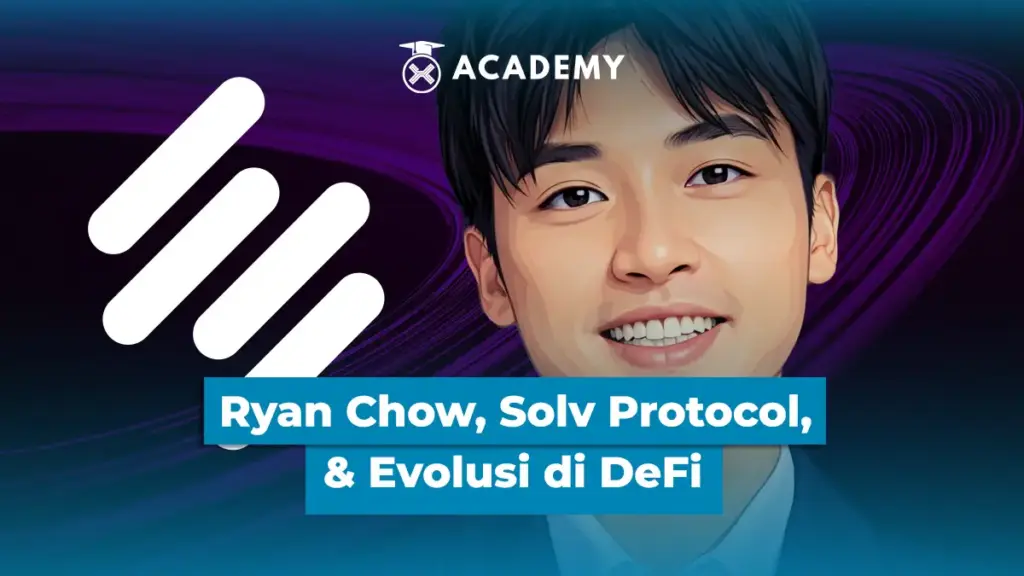
Ryan Chow is one of the figures promoting this approach through Solv Protocol. In this case, he makes NFTs a more practical tool for managing assets in the DeFi ecosystem.
Who is Ryan Chow?

Ryan Chow is the co-founder and CEO of Solv Protocol. He has an educational background in global financial systems, giving him an understanding of how international financial markets and traditional financial structures work.
He began his career in the financial sector as an analyst. His research focused on integrating blockchain into the financial system, including the development of digital asset products and their regulatory frameworks.
This experience led him to develop DeFi through Solv Protocol.
He designed an infrastructure that connects traditional finance, CeFi (Centralized Finance), and DeFi within a single blockchain-based asset management framework.
Ryan Chow’s Early Involvement in the Blockchain World
Ryan Chow’s interest in blockchain began with the idea of ??asset tokenization, which involves converting financial assets into tokens that are easier to manage and transfer.
He sees blockchain not just as a new technology but as a foundation for building a more efficient financial system.
This interest has led to his experience building blockchain solutions for the industrial sector. The technology is used to improve workflows and data management.
From this process, Ryan increasingly realized that the traditional financial system tends to be slow, full of intermediaries, and less flexible when dealing with digital assets.
What is Solv Protocol?
Solv Protocol is a decentralized asset management platform used to manage crypto assets in a structured manner on the blockchain.
This platform helps assets like Bitcoin not only be stored but also utilized in various financial schemes without having to transfer ownership to a centralized party.
Solv Protocol sits at the intersection or bridge between DeFi, CeFi, and TradFi (Traditional Finance).
This means that Solv is designed to connect the needs of DeFi users with more centralized financial systems and conventional financial models within a single infrastructure.
Solv Protocol’s primary focus is not on creating retail applications for general users, but rather on building the underlying infrastructure.
This infrastructure enables various parties (from financial platforms to institutions) to manage assets, yield, and liquidity on the blockchain in a more streamlined and standardized manner.
Asset Management Challenges in DeFi
Asset management in DeFi still faces several fundamental challenges. One of these is liquidity fragmentation, where assets and liquidity are spread across many different protocols.
This situation makes fund management less efficient because assets are not concentrated in a single, structured system.
Furthermore, on-chain financial instruments are still limited. Many DeFi products focus only on short-term transactions, thus not supporting more complex and long-term asset management.
Another challenge lies in the management of yields and long-term assets. Changes in strategy and risk still need to be monitored manually, making it difficult to build a stable investment strategy.
Ryan Chow’s Role in Solv Protocol Development
As co-founder and CEO of Solv Protocol, Ryan Chow’s role extends beyond managing the business direction and also determining how the Solv system is built from the outset.
He is also directly involved in designing how assets are managed on the blockchain. His focus is on the basic structure, such as asset recording and management flows, for a more streamlined and secure use.
This approach sets Solv apart from many other DeFi platforms. Solv isn’t pursuing quick features for retail users, but rather building the foundation of a system that can be used long-term by various parties.
Understanding the Concept of Financial NFTs
Most commonly known NFTs are digital collectibles, such as images or unique items with collectible value. This type generally has no direct financial function other than being able to be bought and sold.
However, financial NFTs are different. These NFTs are used to represent ownership of assets or financial rights, such as claims on yield, digital bonds, or assets locked within a system.
Therefore, NFTs not only indicate who the owner is, but also the economic rights inherent in them.
NFTs are chosen as financial instruments in DeFi because of their unique and easily transferable nature.
With NFTs, ownership structures and financial rights can be encapsulated in a single, clear, transparent, and tradable token without relying on intermediaries.
The Role of ERC-3525 in the Evolution of Financial NFTs
ERC-3525 is a token standard created for financial needs on the blockchain. This standard allows NFTs to store not only the owner’s identity but also the financial value within them.
Unlike the freely fungible ERC-20 and the completely unique ERC-721, ERC-3525 sits somewhere in between. These tokens have an identity like NFTs, but their value can be partially divided and transferred.
This semi-fungible nature makes ERC-3525 suitable for on-chain financial systems. Instruments such as yield claims or digital financial assets can be packaged in NFTs, which are more flexible and easier to manage.
Solv Vouchers and a New Approach to Asset Management
Solv Vouchers are a digital asset format in the Solv Protocol used to represent ownership and financial rights. These vouchers store asset information and yield schemes in a single, clear format.
In asset management, vouchers help separate ownership rights and yields. Assets can be managed and distributed without complicated processes, streamlining yield management.
This system also supports the needs of DAOs and institutions. Crowdfunding and profit sharing can be conducted on the blockchain with a more structured and easily monitored structure.
The Impact of Financial NFTs on the DeFi Ecosystem
Financial NFTs expand the variety of financial instruments on the blockchain. Assets are not just tokens, but can represent ownership rights, investment returns, or specific financial structures.
This approach also increases flexibility and efficiency in asset management. Assets and yields can be managed in a single, streamlined system, eliminating numerous manual processes.
In the long term, financial NFTs are helping DeFi move towards more mature asset management. This opens up the opportunity for institutions to get involved as the financial structure on the blockchain becomes clearer and more standardized.
What Can Be Learned from Ryan Chow’s Approach

Ryan Chow’s approach demonstrates that DeFi doesn’t just grow from superficial applications. Its development is largely determined by a well-organized and long-term infrastructure.
He also emphasized the importance of system design in asset tokenization. Without a clear structure, digital assets are difficult to manage, share, or further develop.
This demonstrates that financial NFTs are more than just a trend. They are used as a tool to regulate ownership and financial rights, not just a passing fad.
Conclusion
So, that was an interesting discussion about Ryan Chow, the man behind Solv Protocol and the evolution of Financial NFTs in DeFi. You can read more about this in the INDODAX Academy’s Crypto Academy.
In conclusion, Ryan Chow’s journey demonstrates that DeFi’s growth doesn’t always come from visible applications. Much progress is happening behind the scenes, through underlying systems that are rarely highlighted.
The emphasis on infrastructure demonstrates that asset management on the blockchain needs to be designed with a clear and sustainable structure, not just a collection of quick features or temporary experiments.
Solv Protocol serves as an example of how asset management in DeFi can be built in a more structured manner.
Financial NFTs, standards like ERC-3525, and voucher systems emerged because of real limitations in on-chain financial systems, not because they followed a trend.
This demonstrates that understanding blockchain isn’t just about the product itself. The way the system is designed is equally important.
This is where builders like Ryan Chow play a significant role, as they build the framework that allows DeFi to mature and endure.
That’s some interesting information about global crypto figures like Ryan Chow, the figure behind Solv Protocol, which you can explore further in Indodax Academy’s collection of crypto articles. Besides gaining in-depth insights through popular crypto education articles, you can also broaden your horizons through a collection of tutorials and choose from a variety of popular articles that suit your interests.
Besides updating your knowledge, you can also directly monitor digital asset prices on Indodax Market and stay up-to-date with the latest crypto news. For a more personalized trading experience, explore Indodax’s OTC trading service. Don’t forget to activate notifications so you don’t miss out on important information about blockchain, crypto assets, and other trading opportunities.
You can also follow our latest news via Google News for faster and more reliable access to information. For an easy and secure trading experience, download the best crypto app from INDODAX on the App Store or Google Play Store.
Maximize your crypto assets with the INDODAX Earn feature, a practical way to earn passive income from your stored assets. Register now with INDODAX and easily complete KYC to start trading crypto more safely, conveniently, and reliably!
Indodax Official Contact
Customer Service Number: (021) 5065 8888 | Support Email: [email protected]
Also follow us on social media here: Instagram, X, Youtube & Telegram
FAQ
- Why is Ryan Chow often referred to as a builder, rather than a crypto public figure?
Because his contributions are in system and infrastructure design, not token promotion or short-term market activity. - What differentiates Solv Protocol from other DeFi platforms in general?
Solv isn’t focused on retail applications, but rather on asset management infrastructure that can be used by various parties, including institutions and DAOs. - Why can NFTs be used for financial matters?
Because NFTs can clearly store identity and rights. In a financial context, this facilitates ownership recording, yield claims, and more complex asset structures. - Are financial NFTs only relevant to DeFi?
No. This concept is designed to bridge DeFi with more centralized and conventional financial systems. - Is this article aimed at discussing investment opportunities?
No. The focus is on understanding the systems, technology, and design approaches behind the evolution of asset management on the blockchain.

Author: Boy
 Polkadot 2.25%
 BNB 0.52%
 Solana 4.62%
 Ethereum 2.32%
 Cardano 1.02%
 Polygon Ecosystem Token 1.87%
 Tron 2.75%
 Market