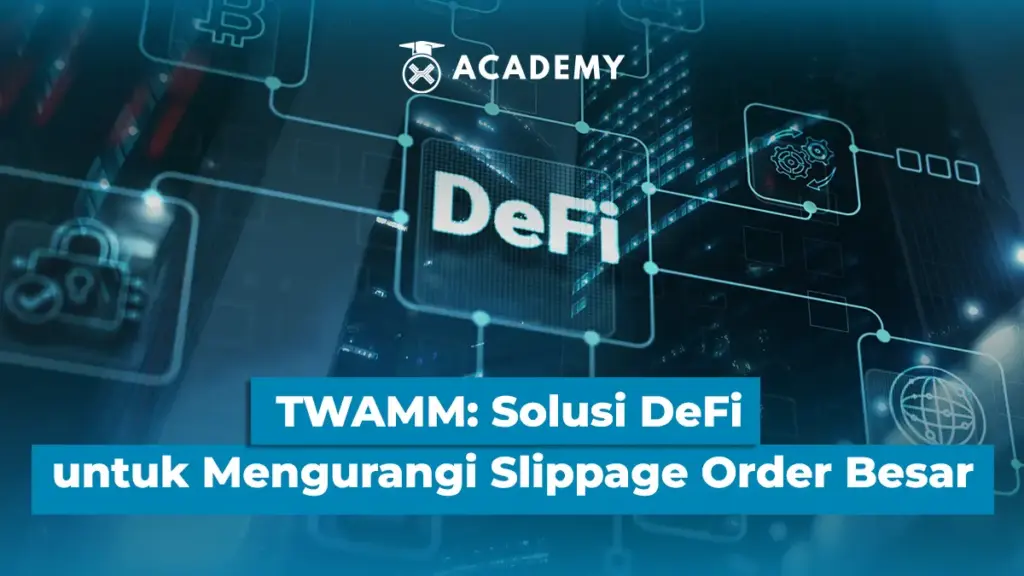
In Decentralized Finance (DeFi), large swaps in Automated Market Makers (AMMs) often trigger immediate problems. Once a large transaction enters, prices can spike sharply and slippage widens.
This situation not only harms the swap operator but also shifts market prices, encourages arbitrage, and impacts other traders who are not involved in the transaction.
This situation demonstrates that the problem goes beyond whales. Executing large orders too quickly can have market-wide effects.
This raises the need for a more refined mechanism, one that can execute large volumes without causing price fluctuations and excessively increasing slippage.
What is a TWAMM?

TWAMM stands for Time-Weighted Automated Market Maker. In DeFi, TWAMM is neither a token nor a platform, but rather a mechanism that governs how transactions are executed within an AMM, particularly for large orders.
The primary purpose of TWAMM is to allow large transactions to be executed incrementally over a specific timeframe, thereby minimizing slippage and preventing sudden impacts on market prices.
By breaking down a single large order into a stream of smaller, automated transactions, TWAMM helps maintain more stable and efficient price movements.
This mechanism is necessary because DeFi is increasingly dealing with large volumes. Without a more refined approach, large order executions tend to disrupt prices and have knock-on effects on the market.
TWAMMs address this need, offering a more controlled and ecosystem-friendly execution method.
The Main Problem with Large Orders in Traditional AMMs
In conventional AMMs, prices move according to the balance of assets in the pool. During small transactions, these changes are barely noticeable.
However, in practice, when a large order is executed immediately, the asset composition in the pool changes drastically, and the AMM responds with sharp price adjustments.
Prices don’t shift due to market sentiment, but because liquidity is forced to adjust simultaneously.
This situation triggers a significant price impact. The larger the order size compared to available liquidity, the further the price is pushed from its initial position.
Slippage also increases because traders don’t exchange assets at a single price, but rather along a constantly shifting curve. This is a common reality in practice, especially in pools with limited liquidity.
The impact isn’t limited to the transaction participants. Sudden price changes affect other traders, trigger rapid arbitrage, and temporarily shift the market price structure.
As a result, large order executions in traditional AMMs often create widespread disruption, even without fundamental changes to the market itself.
How TWAMM Works to Reduce Slippage
TWAMM presents a different approach to handling large orders in AMMs. Here’s how TWAMM works to reduce slippage when executing large orders in AMMs.
Time-Based Phased Execution Concept
Large orders are not executed all at once, but are broken down into many smaller swaps that run automatically over a specific period of time. This way, pressure on the pool doesn’t come in one large wave, but rather is spread out over time.
A simple analogy is like buying in small installments throughout the day, rather than buying everything in one transaction. Prices move more smoothly, and slippage doesn’t accumulate at one point.
The Role of AMMs and Arbitrageurs
During the phased execution process, prices in TWAMM AMMs may deviate slightly from market prices. This deviation is not a bug, but rather part of the dynamics of the mechanism.
Arbitrageurs, or price gap hunters, play a crucial role in closing these gaps by trading in the opposite direction, bringing prices back into line with the market.
Without arbitrageurs, TWAMMs would struggle to maintain long-term execution close to the market average.
Differences Between TWAMMs and Traditional AMMs
In traditional AMMs, orders are executed instantly, and large orders immediately drive prices up or down. Price impacts are felt immediately, slippage is high, and short-term volatility increases.
TWAMMs take a different approach with phased execution, so price impacts occur gradually. Slippage is more controlled, volatility is lower, and liquidity is not forced to adjust suddenly.
Who Benefits from TWAMMs?
TWAMMs are not intended for everyone. This mechanism is most beneficial for traders who frequently deal with high volumes and sensitive price impacts, including the following:
Traders with Large Orders
For traders with large transaction sizes, TWAMMs offer a much more reasonable execution method than instant swaps.
Instead of hitting the pool in a single transaction and triggering a price spike, orders are executed in phases over a period of time.
The risks of slippage, frontrunning, and price impact are more manageable because market pressure is spread out slowly, rather than concentrated in a single location.
Liquidity Providers (LPs)
For LPs, TWAMMs tend to create more stable pool dynamics. Step-by-step execution reduces the extreme price swings that typically arise from large orders, resulting in a smoother price structure within the pool.
While TWAMMs create room for arbitrage, this activity actually helps keep prices aligned with the market, ultimately mitigating sudden shocks to liquidity.
However, LPs still need to understand that long-term transaction flow patterns differ from traditional AMMs.
DAOs and DeFi Treasuries
TWAMMs are particularly relevant for DAOs and DeFi Treasuries that need to rebalance assets on a large scale. Instant execution is often too expensive and risks disrupting the market.
With TWAMMs, asset management can be carried out in a scalable manner, close to the average market price, without having to rely on CEXs or centralized trading desks.
That’s why this mechanism is often discussed in institutional contexts, where efficiency, price impact, and governance are key concerns.
Limitations and Risks of TWAMM
While TWAMM is often positioned as a solution for large order execution in DeFi, this approach still has limitations that need to be honestly understood.
Slippage can be reduced because transactions are executed in stages, but this doesn’t mean it’s completely eliminated. During the execution period, prices still fluctuate according to market dynamics, so the final result can still differ from the trader’s initial expectations.
Furthermore, TWAMM carries volatility risk because orders are executed over a period of time, not in a single moment.
If market conditions change sharply during this period, the average price obtained can be affected.
Furthermore, the TWAMM mechanism also relies on available liquidity and the role of arbitrage to keep prices close to the broader market. When liquidity dwindles or arbitrage activity weakens, price deviations can persist for longer.
In practice, TWAMM is not always the optimal choice for all market conditions. In very fast or volatile situations, a phased execution strategy can actually lag behind price movements.
Therefore, TWAMMs should be understood as a tool for managing large orders, not a universal solution suitable for every trading scenario.
Why TWAMMs Are Increasingly Relevant in DeFi Today

The relevance of TWAMMs in the DeFi ecosystem is inextricably linked to the changing composition of market participants.
As investor participation with larger capital increases, the need for a way to execute large orders without disrupting prices becomes increasingly apparent.
This pattern is similar to practices in traditional markets, where large orders are rarely executed simultaneously due to the risk of excessive price impact.
Conversely, the role of decentralized exchanges (DEXs) is also evolving. DEXs no longer solely serve small retail transactions but are increasingly becoming venues for more serious liquidity execution.
In this context, TWAMMs offer more efficient execution than conventional AMMs because orders are executed in stages with more controlled price pressure and gas fees.
The development of TWAMMs also reflects the evolution of AMM design itself. While earlier generations of AMMs focused on simplicity and open access, newer mechanisms have begun to address diverse and complex execution needs.
TWAMMs represent one such adaptation, combining long-standing TradFi principles with the on-chain characteristics of DeFi, without altering the AMM’s role as open market infrastructure.
Conclusion
So, that was an interesting discussion about TWAMM as a DeFi solution to reduce slippage on large orders, which you can read more about in the INDODAX Academy’s Crypto Academy.
In conclusion, TWAMM is a mechanism that helps execute large orders in DeFi in a smoother and more controlled manner.
By spreading transactions over a specific time period, TWAMM is able to reduce the price pressure and slippage that typically occur with conventional AMMs, although it doesn’t completely eliminate them.
Ultimately, TWAMM should be seen as part of the evolution of DeFi design, which strives to adapt to increasingly diverse market needs.
More than just a gimmick, this mechanism demonstrates how DeFi infrastructure continues to evolve to handle greater scale and complexity.
In addition to gaining in-depth insights through various popular crypto education articles, you can also broaden your horizons through a collection of tutorials and choose from a variety of popular articles that suit your interests.
Besides updating your knowledge, you can also directly monitor digital asset prices on Indodax Market and stay up-to-date with the latest crypto news. For a more personalized trading experience, explore Indodax’s OTC trading service. Don’t forget to activate notifications so you don’t miss out on important information about blockchain, crypto assets, and other trading opportunities.
You can also follow our latest news via Google News for faster and more reliable access to information. For an easy and secure trading experience, download the best crypto app from INDODAX on the App Store or Google Play Store.
Maximize your crypto assets with the INDODAX Earn feature, a practical way to earn passive income from your stored assets. Register now with INDODAX and easily complete KYC to start trading crypto more safely, conveniently, and reliably!
Indodax Official Contact
Customer Service Number: (021) 5065 8888 | Support Email: [email protected]
Also follow us on social media here: Instagram, X, Youtube & Telegram
FAQ
- What is the difference between TWAMM and TWAP
TWAP is a time-based order execution strategy commonly used in traditional trading systems and CEXs, typically executed by a broker or off-chain algorithm. Meanwhile, TWAMM is an implementation of the TWAP concept brought directly into the AMM mechanism in DeFi, allowing incremental order execution on-chain, automatically, and without intermediaries. - Is TWAMM suitable for retail traders?
Generally, TWAMM is more relevant for traders with large order sizes. Retail traders with small amounts are usually less affected by slippage, so instant swaps on a regular AMM are quite efficient. However, TWAMM can still be useful for certain retail traders who want to execute orders incrementally to avoid the impact of short-term volatility. - Is TWAMM always better than a regular AMM?
Not always. TWAMMs are designed for specific conditions, particularly when executing large orders. For small swaps or fast execution requirements, a regular AMM is actually simpler and more efficient. TWAMM is an option when the primary goal is to reduce price impact, not transaction speed. - Does TWAMM completely eliminate slippage?
No. TWAMM does not eliminate slippage completely. This mechanism aims to reduce slippage and price impact by spreading order executions over a specific timeframe. In volatile market conditions, with thin liquidity, or minimal arbitrage, slippage can still occur. - Where is TWAMM typically used?
TWAMM is generally discussed and implemented in: DeFi protocols that support long-term order execution
New generation DEXs with more flexible AMM designs
The needs of DAOs or treasuries that rebalance large amounts of assets. TWAMM is not a standard feature across all DEXs, but rather a specialized mechanism for specific execution needs.

Author: Boy
 Polkadot 2.25%
 BNB 0.52%
 Solana 4.62%
 Ethereum 2.32%
 Cardano 1.02%
 Polygon Ecosystem Token 1.87%
 Tron 2.75%
 Market